
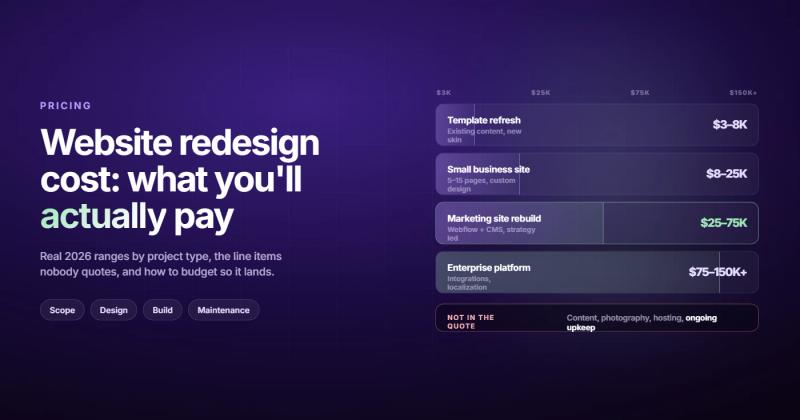
A website redesign costs between $3,000 and $150,000+ in 2026. That range is enormous, and not very helpful. The honest answer is that website redesign cost depends on what you're actually building, who's building it, and whether you're redesigning because something is broken or because someone in a meeting said "our site looks dated."
I've quoted, scoped, and built enough redesign projects to know that the price tag rarely surprises people. What surprises them is what's included (or not included) in that price. This post breaks down real numbers, explains what actually drives cost, and helps you figure out whether a redesign is even the right move.

How Much Does a Website Redesign Actually Cost?
Here's the short version. If you're a small business with a 5-15 page site and you hire a freelancer or small agency, expect $3,000 to $25,000. A mid-size company with 20-50 pages, custom features, and integrations? $25,000 to $75,000. Enterprise sites with hundreds of pages, complex data flows, and compliance requirements? $75,000 to $150,000+.
Those numbers assume you're hiring professionals. If you're doing it yourself with a template on Squarespace or Wix, you could spend $500 to $2,000 in platform fees and plugins, plus a few hundred hours of your time that you could've spent on literally anything else.
But here's what those ranges don't tell you: a $5,000 redesign and a $50,000 redesign might look identical on the surface. The difference is usually in strategy, content, SEO migration, and the parts that don't show up in a screenshot.
What Actually Drives Website Redesign Cost
Every article about website design cost lists the same factors: number of pages, custom design, functionality. They're not wrong, but they're missing context. Let me walk through what actually moves the needle on cost, in order of impact.
Strategy and discovery
The cheapest redesigns skip this entirely. You get a questionnaire, a mood board, and a homepage mockup within a week. The expensive redesigns start with research: who are your users, what are they trying to do, where are they dropping off, and what does your analytics data actually say?
This phase alone can cost $2,000 to $15,000 at an agency. And it's the phase most likely to save you from rebuilding the wrong thing.
I once had a client who wanted a full redesign because their bounce rate was high. We looked at the data and found that 80% of their traffic was hitting one blog post, reading it, and leaving. That's not a design problem. That's a content strategy gap. We fixed the blog's internal linking instead of redesigning the site. Total cost: about $2,000 instead of $30,000.
Number of unique page templates
Not pages. Templates. A 50-page site might only need 5 templates (homepage, about, service, blog list, blog post). A 15-page site with a custom calculator, interactive portfolio, client portal, and pricing configurator might need 12+ templates. The template count drives design and development hours far more than page count.
Content creation vs. content migration
If you have existing content that needs to move to the new site, that's migration work. If you need new copy, new photos, and new case studies, that's content creation. These are very different costs.
Content migration (moving, reformatting, and QA-ing existing content): $1,000 to $5,000 for a small site, $5,000 to $20,000+ for large sites with complex data structures.
Content creation (copywriting, photography, video): $3,000 to $25,000+ depending on scope. Professional copywriting alone runs $100 to $400 per page.
Custom functionality
A brochure site with contact form? Low cost. A site that needs a booking system, payment processing, user authentication, API integrations with your CRM, custom dashboards, or multi-language support? Each of these adds $2,000 to $15,000+ in development time.
SEO migration
If your current site has any organic traffic, this is non-negotiable. Proper SEO migration during a redesign means mapping old URLs to new ones, setting up 301 redirects, preserving meta data, maintaining internal link structures, and monitoring rankings after launch. Skip this and you can lose months or years of organic traffic overnight.
This work costs $1,500 to $8,000 depending on site size, but the cost of not doing it is way higher. I've seen sites lose 40-60% of their organic traffic after a redesign because nobody handled the redirects.
Accessibility and compliance
WCAG compliance isn't optional for many businesses anymore, and even if it's not legally required for you, it's good practice. Getting a site to WCAG 2.2 AA compliance adds 10-20% to development costs. Ignoring it can add 100% to your legal costs later.
Website Redesign Cost by Project Type
Here's a realistic breakdown of what different types of redesigns actually cost in 2026. These are based on hiring a competent agency or senior freelancer, not the cheapest option on Fiverr.
| Project Type | Pages | Typical Cost | Timeline |
|---|---|---|---|
| Simple brochure site refresh | 5-10 | $3,000 - $10,000 | 2-4 weeks |
| Small business full redesign | 10-20 | $10,000 - $30,000 | 4-8 weeks |
| Mid-market B2B site | 20-50 | $25,000 - $75,000 | 8-14 weeks |
| E-commerce redesign | 50-200+ | $30,000 - $100,000 | 10-20 weeks |
| Enterprise / SaaS platform | 50-500+ | $75,000 - $200,000+ | 16-30+ weeks |
Two things about this table. First, the ranges overlap because complexity matters more than page count. A 15-page SaaS site with a custom pricing calculator, API docs, and gated content costs more than a 40-page service business with repeated templates.
Second, these numbers assume the project includes design, development, basic content migration, and QA. Content creation, SEO migration, and ongoing maintenance are usually quoted separately.
DIY vs. Freelancer vs. Agency: Where Your Money Goes
The "how much does a website cost" question is inseparable from the "who builds it" question. Here's what you're actually paying for with each option.
DIY (Squarespace, Wix, basic WordPress)
Cost: $200 to $2,000 per year in platform fees and plugins.
What you get: a template with your content plugged in. If you're a solo consultant or a local business that needs a digital business card, this is fine. If you need custom functionality, SEO that actually works, or a site that differentiates you from competitors using the same template, this won't cut it.
The hidden cost: your time. Most business owners who "build their own website" spend 40-100+ hours on it and end up with something that looks... like they built their own website. That's not a knock on their intelligence. Web design is a skill, like plumbing or accounting. You wouldn't wire your own office.
Freelancer
Cost: $3,000 to $30,000 depending on experience and scope.
What you get: one person who handles design and development (sometimes both, sometimes just one). Good freelancers are excellent. They're responsive, they care about the work, and their overhead is low so their rates can be competitive.
The risk: a single point of failure. If your freelancer gets sick, gets busy, or disappears, your project stalls. There's also a natural ceiling on complexity. One person can't be expert at strategy, design, development, content, and SEO simultaneously. Anyone who claims they are is probably mediocre at several of those.
Agency
Cost: $15,000 to $200,000+ depending on agency size and project scope.
What you get: a team. Strategist, designer, developer, copywriter, project manager. The work is coordinated, the process is structured, and there's institutional knowledge about what works.
The risk: you might be paying for overhead that doesn't benefit your project. A 50-person agency with a downtown office has different cost structures than a lean 5-person remote team. The work quality doesn't always scale with the price tag. Some of the best work I've seen comes from focused agencies with 3-8 people who actually care about the output, not agencies with impressive client logos and a PR team.
The Platform Question: How It Affects Web Design Pricing
Your platform choice affects both the upfront redesign cost and what you'll pay in the years after launch.
WordPress
Still the most common platform, still the most variable in cost. A WordPress redesign ranges from $5,000 (theme customization) to $100,000+ (fully custom theme with advanced functionality). The development is flexible but comes with maintenance overhead: plugin updates, security patches, hosting management, and the occasional "why is my site showing a white screen" panic at 6 AM.
Ongoing cost: $100 to $500/month for hosting, maintenance, and security. More if you're running WooCommerce or complex plugins.
Webflow
If you're getting a Webflow website redesign cost estimate, expect $5,000 to $50,000 for most business sites. Webflow development tends to cost less on the maintenance side because there are no plugins to break, no PHP updates to manage, and the hosting is handled by the platform.
Where Webflow saves money long-term: your marketing team can edit content without calling a developer. That's not a small thing. The cost of "can you change this headline" adds up fast when every change requires a developer.
Ongoing cost: $30 to $70/month for the CMS plan, plus hosting. No separate hosting, security plugins, or backup systems to manage.
Custom build (React, Next.js, headless CMS)
The most expensive option upfront ($30,000 to $200,000+) but sometimes the only option that makes sense. If your site needs to integrate deeply with internal systems, handle complex data flows, or support functionality that no platform provides out of the box, custom is the way to go.
The trap: building custom when you don't need custom. I've seen companies spend $80,000 on a custom React site that could've been built in Webflow for $15,000. The developer wanted to use the cool tech. The client wanted a site that works. Those are different goals.
Shopify (for e-commerce)
If you're selling products online, Shopify redesigns range from $5,000 for a theme customization to $50,000+ for a fully custom Shopify Plus build. The platform handles payments, inventory, and shipping out of the box, which saves significant development cost compared to building that functionality on WordPress or a custom stack.
Ongoing cost: $39 to $399/month for the platform, plus transaction fees. Shopify Plus runs $2,300/month. Add app subscriptions ($50 to $500/month depending on how many you need), and the monthly total can climb faster than you'd expect.
How platform choice compounds over time
Here's something most pricing articles skip: the three-year total cost of ownership. A $10,000 WordPress build with $400/month maintenance costs $24,400 over three years. A $15,000 Webflow build with $150/month maintenance costs $20,400. The "more expensive" option is actually $4,000 cheaper over three years. Always run the math past year one.
Hidden Costs Nobody Mentions in the Quote
Here's where most pricing guides stop being useful. They list the build cost and call it a day. But the build cost is 60-70% of the total you'll actually spend in year one.
Photography and video. Stock photos make your $30,000 site look like a $3,000 template. Custom photography costs $2,000 to $10,000. Video? $5,000 to $25,000 per piece. Budget for at least custom photography if nothing else.
Copywriting. "We'll provide the content" is the most dangerous phrase in web design. Most clients don't have professional copy ready, and the project stalls for weeks while someone tries to write their About page between meetings. Budget $100 to $400 per page for professional copywriting, or $3,000 to $15,000 for a full site.
Third-party tools. CRM integrations, email marketing platforms, analytics tools, chat widgets, booking systems. Each comes with its own monthly fee. $50 to $500/month in SaaS subscriptions that nobody accounted for during the proposal.
Training. Someone on your team needs to learn the CMS. That's 2-4 hours of training at minimum. Agencies typically include this, but not always. If they don't, budget $500 to $1,500 for training sessions.
Post-launch fixes. Every site has bugs that surface after real users start interacting with it. Forms that don't work on Safari. Layouts that break on specific Android phones. A "quick fix" sprint in the first month after launch costs $1,000 to $3,000 on average.
Website Cost and Maintenance After Launch
The redesign is a one-time cost. Website cost and maintenance is what you pay every month for years afterward. This is where website strategy matters more than web design pricing, because a cheap build with expensive maintenance is a bad deal.
| Expense | Monthly Cost | Notes |
|---|---|---|
| Hosting | $20 - $300 | Depends on platform and traffic |
| SSL certificate | $0 - $20 | Free with most modern hosting |
| CMS platform fees | $0 - $70 | Webflow, Shopify, etc. |
| Security/maintenance | $50 - $300 | Higher for WordPress |
| Content updates | $200 - $2,000 | Blog posts, page updates |
| SEO ongoing | $500 - $5,000 | Technical SEO, content, link building |
| Analytics/reporting | $0 - $200 | GA4 is free, paid tools vary |
A typical small business should budget $300 to $1,000/month for website maintenance, or $3,600 to $12,000/year. Companies investing in active SEO and content spend $2,000 to $7,000/month.
The platform you chose during the redesign directly affects these numbers. A WordPress site with 15 plugins needs more monthly attention than a Webflow site with native features. That $5,000 you "saved" by going with the cheaper platform can cost you $3,000 to $5,000 extra per year in maintenance. Over three years, the cheaper option is more expensive.
Do You Actually Need a Redesign?
This is the question nobody writing "how much does a website cost" articles wants you to ask, because the answer might be "you don't need one."
A redesign makes sense when your site has fundamental structural problems: the information architecture doesn't match how people use it, the technology can't support what you need it to do, or the design actively hurts conversions. These are real problems that require real solutions.
A redesign does NOT make sense when: your competitor launched a new site and now yours "looks old," someone on your team saw a website they liked and wants yours to look like it, or you haven't updated your content in two years and assume the design is the problem.
Most sites don't need a full redesign. They need specific fixes:
- Slow load times? That's a performance optimization project, not a redesign. Check your Core Web Vitals first.
- Low conversions? That's a conversion optimization problem. Test your CTAs, your copy, your forms. You can do this without touching the design.
- Outdated content? Update the content. A redesign doesn't fix bad copy; it just puts bad copy in a prettier container.
- Mobile experience is broken? A responsive overhaul costs 30-50% of a full redesign and focuses the budget where the problem actually lives.
The most expensive redesign is the one that doesn't solve the actual problem.
How to Get an Accurate Website Redesign Cost Estimate
If you've decided you do need a redesign, here's how to avoid the $15,000 surprise that turns into a $40,000 invoice.
Step 1: Define what "done" looks like before you talk to anyone
Write down exactly what you need. Not "a modern website." Specific things. "A 15-page site with a blog, contact form, and HubSpot integration that loads in under 2 seconds on mobile." The more specific your brief, the more accurate the quote.
Step 2: Get at least three quotes
Not for the cheapest option. For comparison. If one agency quotes $8,000 and two others quote $25,000, the $8,000 agency is either much leaner, much less experienced, or scoping a much smaller project. Ask what's included. The line items matter more than the total.
Step 3: Ask about what's NOT included
Content creation? Photography? SEO migration? Ongoing maintenance? Post-launch support? The proposal should tell you exactly what happens after the site goes live. If it doesn't, you'll find out the hard way that "launch" is not "done."
Step 4: Check the timeline against reality
A quality redesign for a 20-page business site takes 6-12 weeks minimum. If someone promises it in 2 weeks, they're either using a template with your logo swapped in, or they haven't accounted for revision rounds and content delays. Building a website takes time for good reasons.
Step 5: Budget for after launch
Add 15-25% to the build cost for year-one maintenance, training, bug fixes, and the inevitable "can we add one more thing?" requests. This isn't pessimism. It's planning.
The Cost of Not Redesigning
There's a flip side to "don't redesign if you don't need to." If your site genuinely has problems, delaying has its own cost.
A site that loads in 6 seconds loses roughly 50% of visitors before the page finishes rendering. If you're spending $3,000/month on ads driving traffic to a slow site, you're burning $1,500/month. That's $18,000/year in wasted ad spend. A $15,000 redesign that brings load time under 2 seconds pays for itself in under a year.
A site that isn't mobile-friendly in 2026 is leaving 60-70% of its traffic on a broken experience. According to Statista's mobile traffic data, mobile accounts for over 60% of global web traffic. If your mobile experience is bad, the majority of your visitors are having a bad time.
A site without proper SEO foundations is invisible. You can have the most beautiful design in your industry, but if nobody finds it, it's a $50,000 digital billboard in a forest.
The question isn't just "how much does a website redesign cost?" It's "how much is your current site costing you?"
How Often Should You Redesign Your Website?
The standard answer you'll find everywhere is "every 2-3 years." That's not wrong, but it's not the right question either.
A better framework: redesign when the gap between what your site does and what your business needs becomes too expensive to bridge with incremental changes. For some companies, that's every 18 months. For others, a well-built site lasts 5+ years with regular content updates and minor improvements.
The companies that redesign most often are usually the ones who cheaped out the first time. A $5,000 site built on a rigid template hits its ceiling fast. You spend $3,000 on fixes, then $4,000 on a "refresh," and before you know it you've spent $12,000 on a site that still doesn't work the way you need it to. A $20,000 site built on a flexible platform with room to grow can save you from that cycle entirely.
Think of it like buying work boots. The $40 pair lasts six months and you replace them twice a year. The $150 pair lasts three years. Over three years, the cheap boots cost $240. Quality upfront costs less in the long run. Same principle applies to web design pricing.
If you're in a fast-moving industry (tech, fintech, health tech), plan for a visual refresh every 2-3 years and a structural redesign every 4-5 years. If you're in a stable industry (legal, accounting, manufacturing), a well-built site with regular content updates can go 4-6 years without a full redesign.
Frequently Asked Questions
How much does it cost to redesign a small business website?
A small business website redesign typically costs $3,000 to $30,000 in 2026, depending on whether you hire a freelancer or an agency, and whether you need custom functionality or a straightforward brochure site. A basic 5-10 page site refresh runs $3,000 to $10,000, while a full redesign with custom features and professional content costs $15,000 to $30,000.
Why do website redesign costs vary so much?
The variation comes down to scope, not quality. A site with 5 templates, existing content, and basic contact forms is a fundamentally different project than one with custom integrations, original photography, professional copywriting, and accessibility compliance. The number of unique page templates, custom functionality requirements, and content creation needs drive cost more than page count.
How long does a website redesign take?
A simple site refresh takes 2-4 weeks. A full redesign for a small to mid-size business takes 6-14 weeks. Enterprise sites with complex requirements take 16-30+ weeks. The biggest timeline risk isn't development speed but content delays and stakeholder feedback cycles.
Should I redesign my website or just update it?
Update if your site's structure, technology, and core user flows still work. Redesign if you need to change the underlying architecture, switch platforms, or fundamentally restructure how visitors navigate your site. A good rule: if 70% or more of the site needs to change, it's a redesign. Under 30%? Targeted updates will give you more ROI per dollar spent.
How much does website maintenance cost per month?
Expect $300 to $1,000/month for basic maintenance (hosting, security, minor updates). If you're investing in active SEO, content creation, and ongoing optimization, budget $2,000 to $7,000/month. The platform you chose during the redesign affects this: WordPress sites with many plugins need more maintenance than Webflow or static sites.
What's included in a website redesign quote?
A good quote should include strategy/discovery, wireframing, visual design, development, basic content migration, QA testing, and launch support. Many quotes exclude content creation, photography, SEO migration, third-party tool setup, and ongoing maintenance. Always ask what's NOT included before signing.
Is a $5,000 website redesign worth it?
It depends on what you need. For a basic template customization with your content plugged in, $5,000 can work. For a custom-designed site with strategy, professional content, and SEO migration? $5,000 won't cover it. You get what you pay for, and the cheapest option usually has hidden costs (your time, missed opportunities, future fixes) that add up quickly.
How do I budget for a website redesign?
Start with your goals, not a dollar amount. Define what the site needs to do, get three quotes, and add 15-25% for year-one post-launch costs. Budget separately for content creation, photography, and ongoing SEO if those aren't included in the build quote. Most businesses underbudget by 30-40% because they only account for the build, not the full first-year cost of ownership.
Comments