
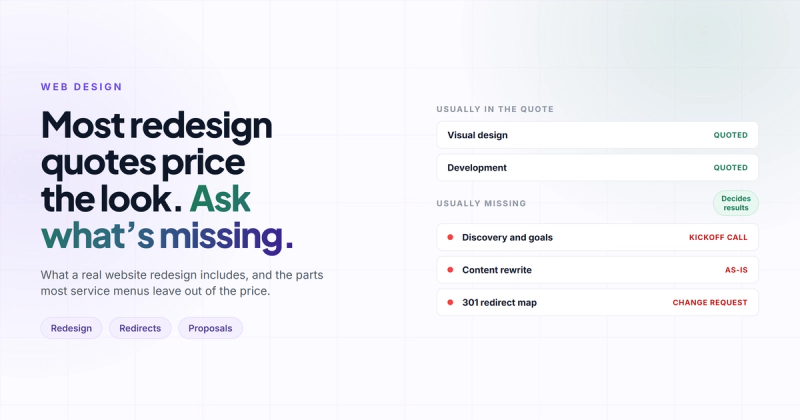
Search for website redesign services and you'll get a menu. Lite, Moderate, Complete Overhaul. Pick a size, get a price, wait two weeks. Nobody on that page asks what's actually broken.
Here's the plain answer. Website redesign services are the work of rebuilding an existing website's structure, content, design and code around a business goal, while keeping what already works: your rankings, your URLs, the pages that bring in leads. A real redesign includes discovery, an audit of the current site, information architecture, UX and visual design, development, an SEO migration plan with redirects, launch QA and measurement after launch. If a quote only covers the design and the build, you're buying half of it.
Think of it like renovating a house. Paint is cheap and fast and everyone can see it. Moving the plumbing is slow, invisible and the reason renovations go over budget. A website redesign has plumbing too, and most of the menus skip it.
What website redesign services actually include
Every agency page lists services. Few of them list the order, and order is the whole game, because each step decides what the next one is allowed to change.
- Discovery. What should the site do for the business that it doesn't do now? More demo requests, fewer support emails, a new market. One sentence, agreed before anyone opens Figma.
- An audit of the current site. Analytics, Search Console, heatmaps if you have them. Which pages bring traffic, which ones convert, which ones nobody has visited since 2021 (there are always more of those than you'd think).
- Information architecture and content. Sitemap, page goals, the copy itself. This is where most redesigns quietly fail, because the brief says "modern and clean" and the content stays exactly as confusing as before.
- UX and visual design: wireframes, then high-fidelity screens, then a component system so page 30 looks like page 1.
- Development, on whatever stack fits the team that will maintain it.
- SEO migration. A redirect map for every URL that changes, plus metadata, internal links and the sitemap moved over properly.
- Launch and the first month after it. QA on real devices, then watching rankings and conversions against the numbers you recorded before you started.
If you want the step-by-step version from the client side, I wrote a separate guide on how to redesign a website. This post is about what you should expect when you're paying someone else to do it.
The menu problem: lite, moderate, complete overhaul
Look at the top results for this search and almost all of them are service pages built the same way. A list of problems your site might have. A list of services. Often a three-tier menu: a light refresh of fonts, colours and images, a moderate version with some structural changes, and a full overhaul. One of them prices the whole thing from $2,500 to $15,000 and says it typically takes about two weeks, a month at most.
Two weeks. For a site that ranks, converts and has a few years of content on it.
The tier model sizes the job by how much the site will look different. That's the paint. What actually decides the effort is how much the structure changes: how many URLs move, how much content gets rewritten, how many integrations break when the forms change. A "lite" redesign that renames twenty pages can do more damage to your traffic than a full visual overhaul that keeps every URL where it was.
So when an agency offers you a size before it has looked at your analytics, it's quoting the paint. The plumbing comes later, usually as a change request (and usually in the week you hoped to launch).
If you're trying to work out a realistic number, my breakdown of website redesign cost goes through where the money really goes.
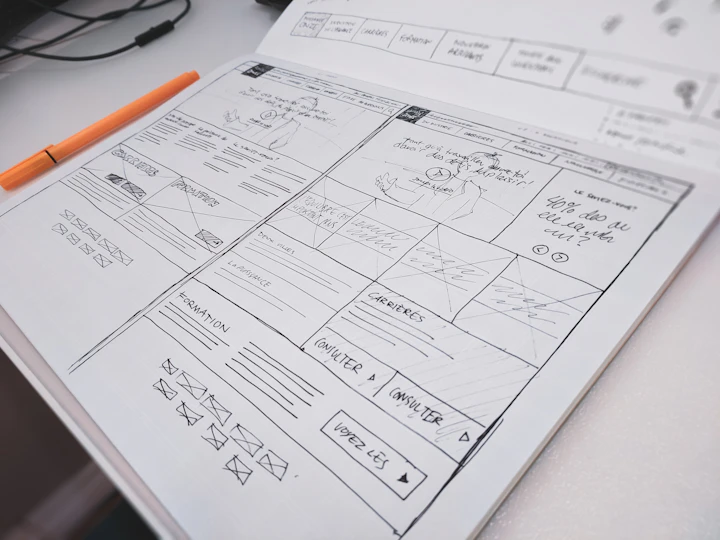
Discovery is the part you're actually paying for
In September I took "Webflow development" and "Webflow migration" off my own website. The homepage, the service pages, the footer, my Upwork profile. They became plain "web development" and "website migration".
I once hid my React background so I could sell Webflow. Then I took Webflow off my own site. AI can build from a design now. Nobody is paying for the build anymore. They're paying for knowing what to build.
That shift matters when you buy website redesign services. The build is getting cheaper every year. The thinking before it isn't. A good website redesign agency spends real hours on questions like these before quoting anything:
- Who lands on the site, and what were they searching for when they did?
- Which three pages bring most of your leads? (There are almost always three. Sometimes two.)
- What does a sales call keep having to explain that the website should have explained already?
- Who will update the site after launch, and how technical are they really?
That last one gets skipped constantly. A beautiful site your marketing team is scared to edit is a site that will look exactly the same in three years, with the same outdated pricing page.
If an agency can't tell you what it learned in discovery, in writing, it didn't do discovery. It had a kickoff call.
The plumbing: SEO migration and redirects
This is the part none of the top-ranking service pages explain properly, and it's the part that costs you the most when it goes wrong.
When a redesign changes URLs (it almost always does), every old address needs a permanent redirect to its closest new equivalent. Google's own guide on site moves with URL changes recommends 301 or 308 redirects, says to map old URLs to new ones from your sitemaps, logs, analytics and Search Console, and says to keep those redirects for as long as possible, generally at least a year. It also warns that rankings may fluctuate while Google recrawls the site.
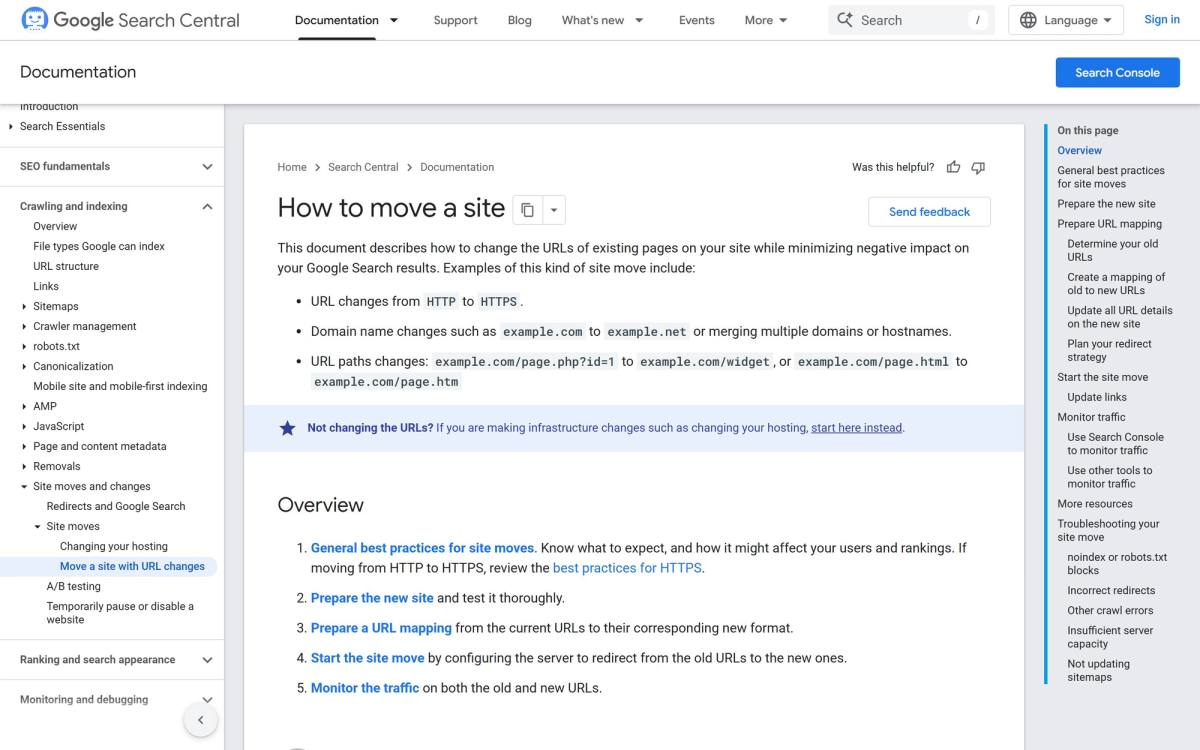
The redirect map itself is boring. That's fine. Boring is what working plumbing looks like:
/services/web-design-agency   301 -> /services/design
/blog/2022/redesign-tips       301 -> /blog/web-design-tips
/about-us                      301 -> /about
/pricing-old                   301 -> /pricing
/case-studies/acme             301 -> /portfolio/acme
The most common shortcut is the lazy version: every old URL that doesn't have an obvious match gets pointed at the homepage. Google's guide calls that out directly. Sending many old URLs to one unrelated page throws away the reason those pages ranked in the first place.
Ask any agency you're talking to who builds the redirect map, when, and how it gets tested after launch. If the answer is "we'll handle SEO", ask again. I go deeper on this in the post on website redesign SEO, including what to record before the old site goes offline.
Design and build (the part everyone pictures)
Yes, the redesign should look better. It should also be faster, easier to use on a phone and honest.
Faster has real numbers now. Google's Core Web Vitals treat a page as good when Largest Contentful Paint is 2.5 seconds or less, Interaction to Next Paint is 200 milliseconds or less and Cumulative Layout Shift is 0.1 or less, measured at the 75th percentile of real visits. Put those in the contract as targets. "Optimised for performance" means nothing until someone writes down a number.
Honest is the one that gets missed. When I redesigned my own SaaS service page from a reference layout, the reference was full of client logos and a case study that didn't exist. One of the "clients" was called Kubaya. I replaced every one with real clients and a real case study, and cut a section label that promised proof the page didn't have yet.
A fake logo wall is worse than no logo wall. The one visitor who checks will tell everyone else. If your redesign comes back with placeholder testimonials "for now", make sure "for now" has a date.
The stack question deserves one sentence: pick whatever your team can maintain, not whatever the agency likes building in. My web design service is stack agnostic for exactly that reason.
How to read a website redesign proposal
Most proposals look complete. Line them up against this and the gaps show fast.
| The proposal says | Ask this |
|---|---|
| "Modern, clean, responsive design" | What goal is the redesign measured against, and what's the number today? |
| "SEO-friendly" | Who builds the redirect map, and how is it tested after launch? |
| "Content migration included" | Migrated as-is, or rewritten? Who writes it? |
| "Two to four weeks" | Does that include discovery and content, or does the clock start at design? |
| "Post-launch support" | For how long, and does it include fixing rankings or only bugs? |
| A fixed tier (Lite, Pro, Enterprise) | Was the tier picked before or after anyone looked at our analytics? |
None of these are trick questions. A good website redesign company answers all of them in one email.
And sometimes the honest answer is that you don't need a redesign at all. If traffic is fine and conversions are the problem, a UX audit and three fixed pages will beat a full rebuild that takes four months to tell you the same thing.
FAQ
What is included in website redesign services?
A full redesign covers discovery, an audit of the current site, information architecture and content, UX and visual design, development, an SEO migration plan with redirects, launch QA and measurement after launch. Many quotes only cover design and development, so check that content and redirects are named in the scope.
How long does a website redesign take?
A small brochure site can be redesigned in a few weeks. A site with real traffic, dozens of pages and content that needs rewriting usually takes two to four months, because discovery, content and the redirect plan take longer than the design itself.
Will a website redesign hurt my SEO?
It can, if URLs change without redirects or pages that ranked get deleted. Google's guidance is to map every old URL to its closest new one with a permanent redirect and keep those redirects for at least a year. Done properly, a redesign usually helps SEO because the new site is faster and better structured.
Should I redesign or rebuild my website?
Redesign when the structure and content mostly work and the problem is presentation, speed or conversion. Rebuild when the platform itself blocks you, for example when your team can't edit pages without a developer or the site can't be made fast on its current stack.
How much do website redesign services cost?
Prices range from a few thousand dollars for a small site to well into five figures for a large one. The biggest cost drivers are the number of pages, how much content gets rewritten and how many integrations the site has, not how different the new design looks.
How do I know my website needs a redesign?
Look at the numbers before the looks. If traffic is healthy but leads are flat, or visitors leave from the same few pages, or your team avoids updating the site because it's painful, those are real reasons. "It looks dated" on its own usually means a competitor launched something new.
Before you sign anything
Go back to the house. Nobody walks into a renovation and asks for "the medium package". You ask where the pipes run, which walls hold the roof up and what happens to the kitchen while the work is going on.
Ask the same about your website. Which pages carry the business, which URLs move, who writes the words, what the numbers are today. An agency that's happy to talk plumbing is one that has done this before.
The paint can wait. It's the easy part.
Comments