
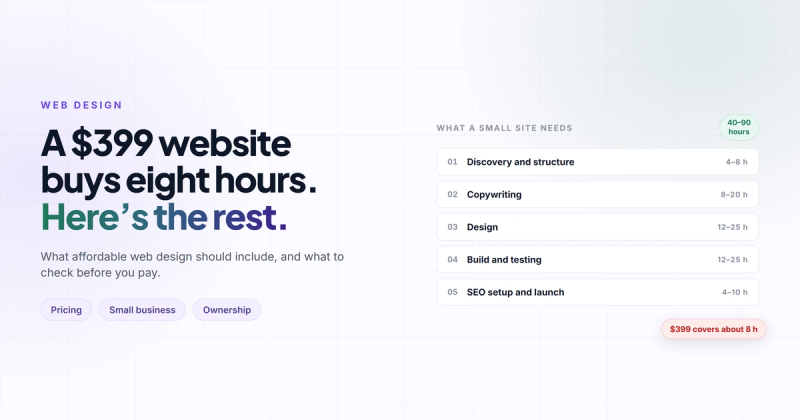
Somewhere on page one of Google right now, a web design company will build you an eight-page website for $399. Custom design, SEO included, delivered in seven days. I'm a developer with over ten years of frontend work behind me, and I still can't figure out where those hours come from.
Here's the plain answer. Affordable web design services are the ones where the price covers everything your website needs to bring in customers, and nothing you'll pay for twice later. For a small business site of 5-10 pages from a freelancer or a small agency, that usually means $3,000 to $10,000 in 2026. Below roughly $1,000 you're not buying a cheaper version of the same thing. You're buying a different thing.
The rest of this post is about telling those two apart before you sign.
What "affordable" actually means (hint: not the number on the box)
Remember the free phone? The one you walked out of the shop with for $0, on a 24-month contract at $60 a month? Nobody who did the math afterwards called it free.
Cheap websites work the same way. The headline price is the phone. The contract is everything that comes after: the monthly hosting fee you can't cancel, the copy you have to write yourself, the "small change" billed at an hourly rate, and the rebuild you'll need in 18 months when the site still isn't bringing in leads.
So affordable has two parts, and most pricing pages only talk about one of them:
- What you pay up front. The quote.
- What you pay over the next two or three years, including the cost of a website that looks fine but sells nothing. That one never appears on a pricing page (funny how that works).
A $6,000 website that brings in two clients a month is cheaper than a $400 one that brings in none. That sounds like an agency line, and it is. It's also arithmetic.
The six-hour website: do the math on any quote
Every website price is hours multiplied by a rate. There's no magic in between. So the fastest way to judge a quote is to work out how many hours it can possibly buy.
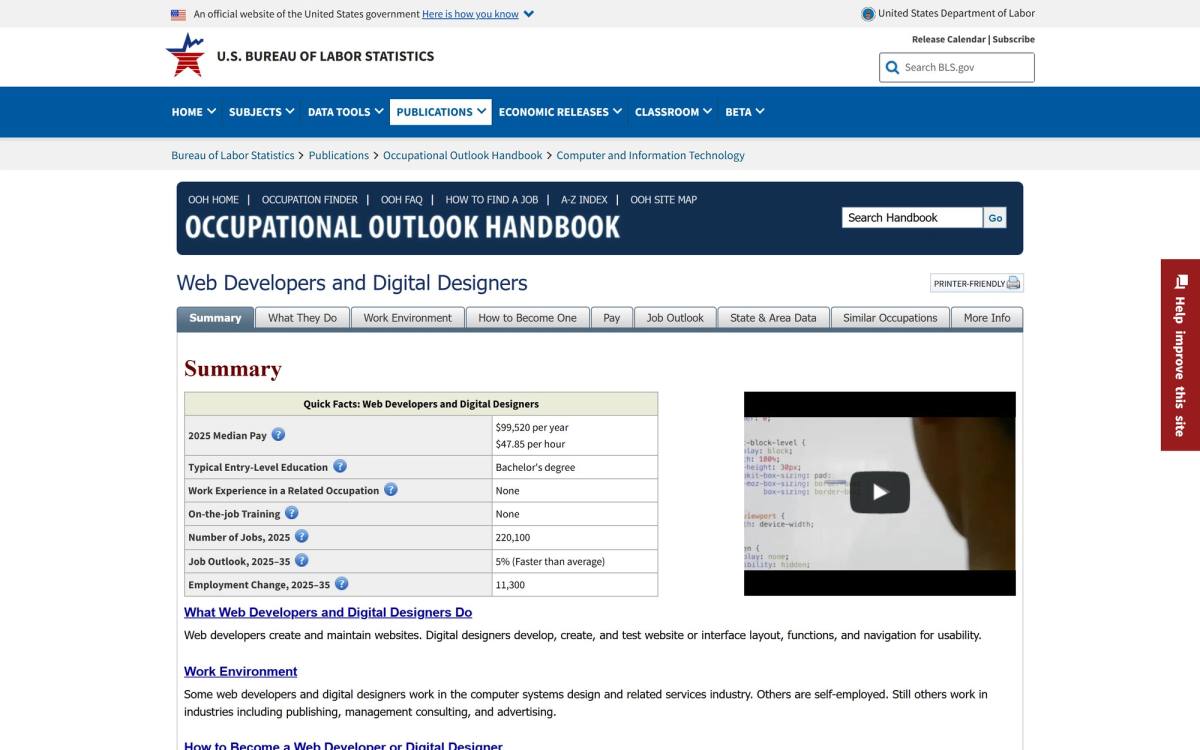
The US Bureau of Labor Statistics puts the 2025 median pay for web developers and digital designers at $47.85 an hour. That's what an employee takes home, before any agency overhead, software or sales costs. Real billing rates sit above it.
Now divide. A $299 website buys about six hours at that median. A $399 one buys about eight. Here's roughly what a small business website actually needs, with my own estimates for a lean 5-8 page site done properly:
| Work | Realistic hours | What it decides |
|---|---|---|
| Discovery and structure | 4-8 | Which pages exist and what each one has to make a visitor do |
| Copywriting | 8-20 | Whether a stranger understands what you sell in five seconds |
| Design | 12-25 | Trust, hierarchy, how it reads on a phone |
| Build and responsive testing | 12-25 | Speed, forms that actually send, a CMS you can edit |
| SEO setup, analytics, launch QA | 4-10 | Whether Google can find it and whether you can measure it |
That's 40 to 90 hours. Six hours covers picking a template and swapping the logo, and that's exactly what a six-hour website is.
I'll admit estimates like this are always optimistic. I once worked out the return on covering a few acres of my land in the Serbian countryside with solar panels, and it looked brilliant on paper right up until I added the costs nobody lists in the brochure. Website quotes behave the same way. The hours you don't see in the quote don't disappear. They move to you.
Affordable vs cheap: where a low price comes from
A low price isn't automatically a red flag. What matters is why it's low. Some reasons are perfectly healthy:
- Smaller scope. Five pages instead of fifteen. A one-page site for a new service. Fewer pages is the most honest discount there is.
- You already have the inputs. Brand guidelines, a logo, good photos, a first draft of the copy. Every one of those removes hours from the table above.
- A good template, used well. A template isn't a crime. A template with your text pasted into the placeholder slots is the problem. The difference is whether someone planned the structure around your customers first.
- Location. I run my agency from Sremska Mitrovica in Serbia, and the cost of living here isn't the cost of living in Boston. That gap shows up in rates. It says nothing about quality, in either direction.
And some reasons should make you close the tab:
- Copywriting isn't included, or "you provide the content". Then you're paying for a frame and painting the picture yourself.
- "Unlimited revisions." Nobody can afford unlimited anything at $399. In practice it means unlimited small tweaks to a design that was never planned, which is the most expensive way to get a website.
- "SEO included" with no list of what that means. Usually a title tag and a plugin.
- A delivery time measured in days for a site with eight custom pages.
One test covers most of this: ask what isn't included. A good provider answers in one breath. A cheap one has to go and check.
The contract hidden inside a cheap website
Back to the free phone. The worst part of those deals was never the monthly fee. It was being locked in.
Cheap websites have their own version, and it's ownership. Before you pay anyone, get clear answers to three things:
- Whose name is the domain registered in? It must be yours, in your own registrar account. If the agency registers it "for convenience" and you part ways, your web address leaves with them.
- Can you take the website with you? Some budget packages are built on a proprietary builder that has no export. You're renting the site. Stop paying and it's gone.
- What does it cost per month after launch, and what does that fee actually cover? Hosting on a small site is cheap. A $79 monthly "care plan" that covers hosting and nothing else is a phone contract with a nicer logo.
None of this is unusual. It's just written in the part of the page nobody scrolls to. Read that part.
How to check an affordable web design company before you pay
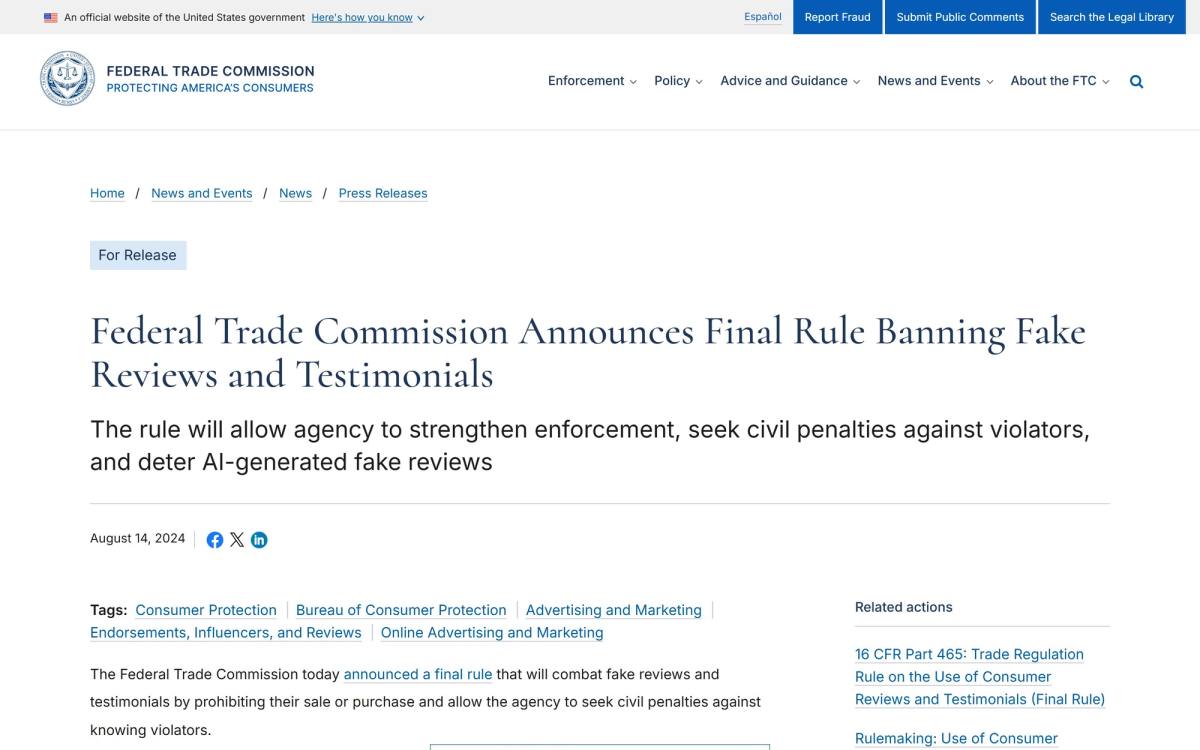
Reviews are the first thing everyone looks at, so they're also the first thing that gets faked. In the US that's now a federal problem: the FTC's rule banning fake reviews and testimonials took effect in October 2024, and it covers reviews written by company insiders and "independent" review sites a company secretly controls.
So read reviews the way you'd read a used car listing. A wall of perfect five-star reviews with no names and no projects is weaker proof than a slightly imperfect record you can trace.
I know this one from the other side. Most of my own reviews are development projects on Upwork: around 60 of them, and a rating that has slipped to 4.9. They say "great developer" while I'm trying to sell strategy and design. The temptation is to write the testimonials you wish you had. I'd rather show 60 real projects and a 4.9 than a perfect 5.0 nobody believes, and you should trust the providers who make the same choice.
Beyond reviews, these questions sort the good cheap from the bad cheap fast:
- Can I see three live websites you built, and talk to one of those clients?
- Who writes the copy, and how many rounds of edits are included?
- What exactly is in "SEO included"? (If the answer includes a ranking guarantee, walk away. Google's own guidance on hiring an SEO says plainly that no one can guarantee a #1 ranking.)
- Will I be able to edit text and add pages myself without paying you?
- What happens to the site if I stop paying the monthly fee?
The way they answer matters as much as what they say. Vague and enthusiastic is a worse sign than specific and boring. We wrote a longer guide on how to choose a web design agency if you're comparing several quotes at once.

How to get a better website for less money
This is the part none of the "top 10 affordable agencies" lists cover: you control a big chunk of the price yourself. Every hour you remove from the table above is money you keep, and none of these cost you quality.
Cut pages, not corners
Most small businesses launch with pages nobody visits. A homepage, one page per service that actually sells, an about page and a contact page is enough to start. You can add the rest once you know what people search for.
Bring a first draft of the copy
You don't need to write well. You need to write down what you sell, who buys it, what they ask on the phone, and why they pick you. A good provider turns that into copy in a fraction of the time it takes to pull it out of you in meetings.
Launch in phases
Phase one: the pages that bring in leads. Phase two, a few months later: the blog, the case studies, the nice-to-haves. Same total, spread out, and phase two is planned with real data instead of guesses. It's also how you avoid paying for a full website redesign two years from now.
Pick a platform you can edit yourself
If changing a phone number needs a developer, you'll pay for that developer forever. Ask for a CMS walkthrough before launch, not after.
Ask for a fixed scope and a fixed price
Hourly billing on an open scope is where small budgets quietly turn into large ones. A fixed price forces both sides to agree on what's being built before anyone starts building it.
When the $300 website is the right call
I'll defend the cheap option, in a few specific cases.
If you're testing an idea and need a page that exists by Friday, a template is fine. Same for a side project, a placeholder while your real site gets built, or a business where every customer comes from referrals and the website only has to prove you're real. In those cases nobody is judging the site on leads, so don't pay for lead generation.
The mistake is buying the placeholder and expecting it to do the job of a sales tool. If your website is supposed to bring in customers from Google, it needs the structure, the copy and the SEO foundation for a new website that a six-hour budget can't hold.
Cheap is fine when the website doesn't have a job. The moment it has one, you're paying for the job, not the pages.
Frequently asked questions
How much do affordable web design services cost?
For a small business website of 5-10 pages built by a freelancer or a small agency, expect roughly $3,000 to $10,000 in 2026. The range depends mostly on page count, whether copywriting is included and how much custom design you need. Anything under $1,000 is almost always a lightly edited template.
Is a $500 website worth it?
It can be, if the site doesn't need to win customers on its own, for example a placeholder or a referral-only business. At typical developer pay, $500 buys about ten hours of work, which isn't enough for strategy, copy, custom design and a proper build. If you need the site to generate leads, budget for the hours that job takes.
What's the difference between affordable and cheap web design?
Cheap is a low price. Affordable is a low total cost for a website that does its job. A cheap site often moves the real costs somewhere else: copy you write yourself, monthly fees you can't cancel, or a rebuild a year later.
Should I own my domain and website?
Yes, always. Register the domain in your own name and your own registrar account, and make sure the site can be moved if you change providers. If a package keeps either one in the agency's account, you're renting your website.
Do affordable web design packages include SEO?
Most claim to, and most mean basic setup: page titles, meta descriptions and a sitemap. That's worth having but it isn't an SEO strategy. Ask for the exact list, and treat any ranking guarantee as a red flag.
How long should an affordable website take to build?
A small, properly planned site usually takes 3-6 weeks, most of it spent on structure, copy and feedback rounds rather than the build itself. Delivery in a few days is possible only when the design and structure are a template.
Pay for the job, not the phone
Next time a $399 website shows up in your search results, do the division. Eight hours. Then ask what the other 40 to 80 hours of work will cost you, and who's going to do them. Usually it's you, on weekends, in a builder you didn't pick.
The affordable option is the one where that answer is "nobody, it's in the quote". If you'd like a quote like that, with every line spelled out before you pay anything, have a look at how we approach web design. No 24-month contract, I promise.
Comments