
You're about to spend somewhere between $5,000 and $150,000 on a website. The agency you pick will determine whether that money turns into revenue or regret. And here's the uncomfortable truth: most people choose a web design agency the same way they choose a restaurant on vacation. They scroll, they look at the pictures, they pick one that looks nice. Then they're surprised when the experience doesn't match the photos.
Choosing a web design agency isn't about finding the prettiest portfolio. It's about finding a team that understands your business problem and has a repeatable process for solving it. I've been on both sides of this transaction for over a decade, and the pattern of what makes a project succeed or fail is clear. It almost never comes down to design talent. It comes down to communication, process, and whether the agency actually understands what you're trying to accomplish.
Here's how to choose a web design agency without getting burned.

Define Your Goals Before You Talk to Anyone
Most failed web projects share the same origin story: the client didn't know what they actually needed. They knew they wanted "a new website" but couldn't articulate why, or what success would look like six months after launch.
Before you reach out to a single agency, answer these questions honestly:
- What's the primary purpose of this site? (Lead generation, e-commerce, brand credibility, hiring)
- What specific outcome would make this investment worthwhile?
- Who is actually visiting your site, and what do they need to do there?
- What's broken about your current site? Is it a design problem, a messaging problem, or a technical problem?
I've seen companies spend $80,000 on a redesign when their actual problem was a confusing service page that needed three paragraphs rewritten. That's not a design problem disguised as a design problem. That's a website strategy problem.
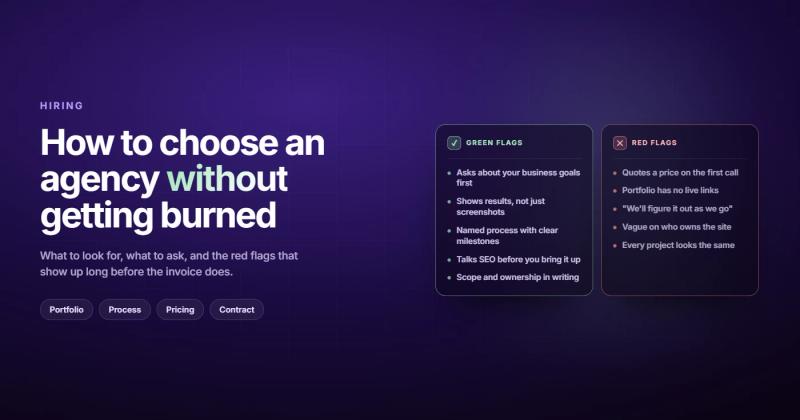
Write your goals down. Bring them to every agency call. If an agency doesn't ask about your goals in the first conversation, that tells you everything you need to know.
Evaluate Their Portfolio (But Not the Way You Think)
Everyone looks at portfolios. Almost nobody looks at them correctly.
Here's what most people do: scroll through screenshots, decide the work "looks nice," and move on. That's like hiring an architect because their blueprints are printed on nice paper.
Here's what to actually evaluate:
- Visit the live sites. Check if they load fast. Pull up Google PageSpeed Insights. A portfolio piece that scores 30 on performance tells you the agency doesn't care about what happens after launch.
- Check on mobile. Not just "does it resize" but does the experience actually make sense on a phone? Can you complete the primary action without zooming or squinting? (Nielsen Norman Group has solid benchmarks for this.)
- Look for results, not just visuals. Did the portfolio case study mention what improved? Traffic? Conversions? Bounce rate? If they only talk about how it looks, they only think about how it looks.
- Look for sites in your industry or with similar complexity. A stunning single-page portfolio for a photographer doesn't prove they can handle your 50-page B2B site with integrations.
One more thing. If every site in their portfolio looks identical with different logos swapped in, that's a template factory. You're paying for custom thinking, not a theme with your colors.
Assess Their Experience and Specialization
There's nothing wrong with a newer agency. Some of the best work I've seen comes from lean teams with something to prove. But experience matters for one specific reason: they've already made the mistakes.
An agency with 5+ years of operation has shipped dozens of sites. They've dealt with scope creep, difficult stakeholders, last-minute content changes, and projects where the client disappeared for three weeks in the middle of the build. They have systems for handling all of this.
A newer agency might deliver great design but crumble when things get complicated. And things always get complicated.
Ask about specialization too. Some agencies focus on specific platforms (Webflow, WordPress, Shopify). Some focus on industries (healthcare, SaaS, law firms). Some focus on specific business stages (startups, enterprise redesigns, migrations). The more their specialization overlaps with your needs, the less time you'll spend explaining your world to them.
Questions to Ask Every Agency on the First Call
The discovery call isn't just the agency interviewing you. You're interviewing them. Here are the questions that separate strong agencies from ones coasting on pretty Dribbble shots:
- What does your process look like from kickoff to launch? You want specifics. Phases, deliverables, timelines. Vague answers mean a vague process.
- Who will actually work on my project? Is it the senior designer on the call, or a junior they'll hand it off to on Monday? This matters more than people admit.
- How do you handle revisions and feedback? Unlimited revisions sounds generous until you realize it means they don't get it right early. Two to three rounds of structured feedback is better than infinite do-overs.
- What happens after launch? Hosting, maintenance, security updates, content changes. If they build it and disappear, you need a plan for who takes over.
- Can you share a reference from a recent client? Any agency proud of their work will connect you with someone who can vouch for the experience.
- What do you need from me, and when? Good agencies know exactly what they need from you (content, assets, feedback) and will set clear deadlines. This protects both sides.
If they can't answer these clearly, they'll struggle to run your project clearly too.
Their Process Matters More Than Their Talent
This one surprises people. You'd think the most important thing about a web design agency would be their design skills. It's not. It's their process.
I once spent two weeks building a custom animation system for a client's homepage. Silky smooth. Perfectly timed. The client's actual customers were on 4G connections in rural areas. Nobody ever saw the animations. They bounced before the page finished loading. That's when I stopped designing for my own internet connection.
A strong process means the agency will discover these kinds of misalignments before they become expensive problems. A weak process means beautiful work that doesn't serve the business.
What a good process looks like:
- Discovery phase where they learn your business, audience, and goals
- Strategy phase where they plan the site architecture and messaging hierarchy
- Design phase with structured feedback rounds (not endless back-and-forth)
- Development phase with staging previews and QA testing
- Launch phase with a checklist, redirects, and monitoring
If an agency jumps straight from "signed contract" to "here's a homepage mockup," they skipped the part where they figure out whether the homepage should even look that way. Strategy before pixels. Always.
Pricing: What to Expect and What to Watch For
Web design pricing is all over the place. You'll get quotes ranging from $2,000 to $200,000 for what sounds like the same thing. Here's why the numbers vary so much:
| Price Range | What You Typically Get |
|---|---|
| $2,000 - $10,000 | Template-based, limited customization, minimal strategy. Freelancer or small shop. |
| $10,000 - $40,000 | Custom design, proper process, content strategy input, SEO basics, responsive. |
| $40,000 - $100,000+ | Full strategy, UX research, custom development, integrations, ongoing support. |
None of these are inherently "right." The right price depends on what the website needs to do for your business. A local bakery doesn't need a $50,000 site. A B2B company doing $10M in revenue probably shouldn't build their lead generation machine on a $3,000 template.
What to watch for in pricing:
- Quotes that don't include content strategy, SEO setup, or post-launch support. These will cost extra later.
- Quotes that seem dramatically lower than everyone else. Either they're cutting scope or cutting corners.
- No line-item breakdown. You should know what you're paying for at each phase.
- Ownership ambiguity. Make sure you own the site, the code, and the content when it's done. Some agencies hold your site hostage on proprietary systems.
For a deeper breakdown of what drives these numbers, I wrote a full guide on website redesign costs.
Check Their SEO Capabilities
A beautiful website that nobody finds is an expensive art project. Any agency building your site should understand the basics of search engine optimization. Not necessarily at the level of a dedicated SEO agency, but enough to not sabotage your rankings.
At minimum, they should be handling:
- Proper heading hierarchy (one H1, logical H2-H3 structure)
- Fast page load speeds (Core Web Vitals passing)
- Mobile-first responsive design
- Clean URL structures
- 301 redirects during migration (this one gets botched constantly)
- Meta titles and descriptions
- Image optimization and alt text
Ask them directly: "What's your approach to SEO during the build?" If they say "we hand that off to the client" or "we can add that later," that's a red flag. SEO isn't an afterthought you bolt on. It's baked into the architecture from day one. If you're redesigning an existing site, make sure they understand how to redesign without losing SEO.
Red Flags That Should End the Conversation
After a decade working with clients and watching other agencies operate, here are the patterns that consistently predict a bad outcome:
- They promise specific rankings. "We'll get you to page 1 in 90 days." Nobody can promise that. Google isn't predictable. Run.
- Their own website is slow, broken, or outdated. If they can't maintain their own site, what makes you think they'll maintain yours?
- No contract or vague contracts. A professional agency has clear terms for scope, timeline, revisions, ownership, and cancellation.
- They pressure you to sign quickly. "This price is only good until Friday" is used car lot energy. Good agencies don't need high-pressure sales because their work speaks for itself.
- They don't ask about your business. If the entire first call is about design preferences and colour palettes without understanding what the site needs to achieve, they're decorators, not strategists.
- They won't share references or recent case studies. Either they don't have happy clients, or they don't have clients at all.
- Everything is proprietary. Proprietary CMS, proprietary code, proprietary hosting. This is lock-in. When you leave, you lose everything.
Trust your gut on this. If something feels off during the sales process, it won't improve once they have your money.
Local vs. Remote: Does Location Matter?
Ten years ago, I would have said go local. Meet in person, build rapport, pop in for reviews. That world is gone.
Remote agencies have access to global talent, often charge less than agencies in expensive cities, and have built communication systems that are genuinely good. Zoom, Loom, Figma comments, Slack channels. The tools exist.
That said, local still makes sense in specific cases:
- You need photography or video production on-site
- Your industry is hyper-local and the agency understands the market
- You strongly prefer face-to-face communication and won't adapt to async
For most businesses, the right agency is the one that fits your project best regardless of where they sit. A great agency 3,000 miles away will outperform a mediocre one across the street every time.
Cultural Fit and Communication Style
This is the part nobody writes about, but it's responsible for more project failures than bad design. You need to actually like working with these people. You'll spend weeks or months in close communication. If your styles clash, it poisons everything.
Here's what cultural fit actually means in practice:
- Do they communicate at the frequency and depth you need?
- Are they direct when something isn't working, or do they avoid conflict?
- Do they push back on bad ideas respectfully, or do they just build whatever you ask?
- Do they respond within a business day, or do messages disappear into a void?
The best agencies act as strategic partners, not order-takers. They should challenge your assumptions (politely) and bring expertise you don't have. If you wanted someone to execute your exact vision without input, you'd hire a freelancer, not an agency.
Pay attention to the sales process. How they sell is how they'll work. Fast responses during sales but slow responses after signing? That's a pattern too.
Protect Yourself: What Your Contract Should Cover
I don't care how friendly the agency seems. Get everything in writing. Projects go sideways. People leave agencies mid-project. Companies get acquired. The contract is what protects you when goodwill runs out.
Your agreement should cover:
- Scope of work with specific deliverables (not "a modern website" but "12 pages, custom design, CMS integration, contact form")
- Timeline with milestones and what happens if either side misses them
- Revision limits and what counts as a revision vs. a change in scope
- Ownership of assets (you should own everything: code, design files, content, domain)
- Payment schedule tied to deliverables, not just calendar dates
- Cancellation terms with clear rules for what happens to work completed so far
- Post-launch support period and what's included
If an agency resists putting these things in writing, that's your biggest red flag of all.
A Practical Selection Process (What I'd Do)
If I were choosing a web design agency tomorrow, here's exactly how I'd approach it:
- Write down my goals, budget range, and timeline
- Shortlist 3-5 agencies based on portfolio relevance and specialization
- Book discovery calls with all of them in the same week (for comparison)
- Ask every agency the same questions (makes comparison fair)
- Request a proposal with scope, timeline, and pricing from the top 2-3
- Check references. Actually call them. Ask what went wrong, not just what went right.
- Pick the one where process + expertise + communication style all align with your needs
Don't pick the cheapest. Don't pick the most expensive. Pick the one that understood your problem best and showed you a clear path to solving it.
A website is a business asset that should work for you for 3-5 years. Spend the extra week on selection. Your future self will thank you when you're not rebuilding everything 8 months later because the agency cut corners or misunderstood the brief.
Frequently Asked Questions
How much does it cost to hire a web design agency?
Most custom web design projects cost between $10,000 and $50,000. Simple brochure sites start around $5,000. Complex sites with integrations, e-commerce, or custom functionality run $50,000-$150,000+. The variation comes from scope, not quality. A $15,000 site can be excellent if the scope matches the budget.
Should I choose a local web design agency or a remote one?
Remote is fine for most projects. Communication tools have eliminated the proximity advantage. Choose local only if you need on-site services (photography, local market knowledge) or if you genuinely won't adapt to video calls and async communication. Quality of work matters more than ZIP code.
How long does a web design project typically take?
A standard custom website takes 8-16 weeks from kickoff to launch. Simple sites can be done in 4-6 weeks. Complex projects with extensive strategy, content creation, and integrations take 4-6 months. The biggest delay is almost always client-side: late content, slow feedback, and changing requirements mid-build. For more detail, check our guide on how long it takes to build a website.
What's the difference between a web design agency and a freelancer?
Agencies offer broader expertise (design + development + strategy + SEO) and redundancy (if one person is sick, the project continues). Freelancers are typically cheaper and offer more direct communication but may lack depth in areas outside their specialty. For simple sites, a strong freelancer is fine. For complex business-critical sites, an agency's team structure reduces risk.
What red flags indicate a bad web design agency?
The biggest red flags: they guarantee specific Google rankings, their own website is broken or slow, they avoid putting terms in writing, they don't ask about your business goals on the first call, and they use proprietary systems that lock you in. Also watch for agencies that only talk about design aesthetics without mentioning performance, conversions, or business outcomes.
Do I need an agency that specializes in my industry?
Not necessarily, but it helps. Industry specialists understand your audience, compliance requirements, and competitive landscape without needing months of education. Generalist agencies with strong research processes can also deliver great work. The key is whether they ask smart questions about your market or just apply the same template to every industry.
Comments