
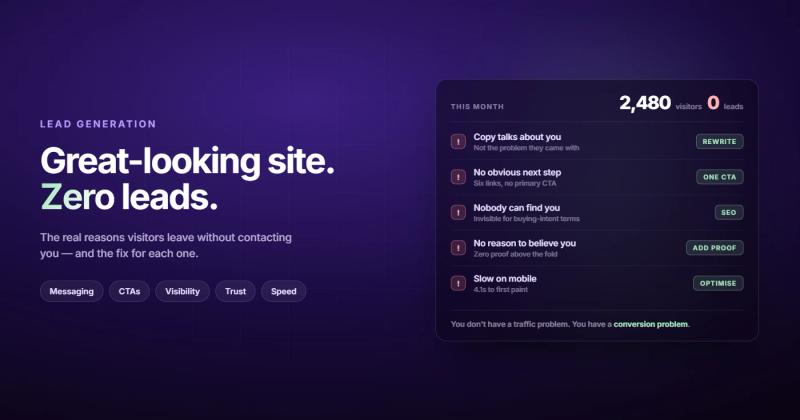
Your website looks good. You spent real money on it. You even have some traffic. But the phone isn't ringing, the inbox is quiet, and the contact form might as well not exist. Sound familiar?
Here's the short answer to why your website is not generating leads: it wasn't built to. Most business websites are digital brochures. They describe what you do, show some photos, list your services, and then... nothing. No reason for anyone to take the next step. No mechanism that turns a visitor into a conversation.
That's fixable. But you need to understand what's actually broken before you start changing things.

Your Website Talks About You Instead of Your Visitor's Problem
This is the most common issue I see, and it's the hardest one for business owners to accept.
You open a website and the first thing you read is "We are a leading provider of innovative solutions with 20 years of experience." Great. But what does that do for the person reading it? They came to your site with a problem. A specific, annoying, expensive problem. And instead of acknowledging that problem, you're talking about yourself.
Visitors don't care about your company history until they trust you. They won't trust you until they feel understood. And they won't feel understood if the first thing you show them is a mission statement instead of a clear description of the problem you solve.
I once spent two weeks building a gorgeous homepage for a client. Animations, custom illustrations, the works. Their bounce rate actually went up. The page was so focused on looking impressive that it forgot to tell visitors what the company actually does. We stripped it back to a clear headline, three benefit statements, and one CTA. Leads started coming in within the first week.
Flip your messaging. Lead with the visitor's pain. Follow with how you fix it. Save the "about us" stuff for later.
There's No Clear Next Step for Visitors to Take
If someone lands on your homepage and is interested, what are they supposed to do? If the answer requires scrolling to the footer and hunting for a contact link, you've already lost them.
Every page on your website needs a clear call to action. Not five different CTAs competing for attention. One primary action you want visitors to take, visible without scrolling. "Get a free quote." "Book a call." "See pricing." Whatever fits your business.
The Nielsen Norman Group's research on CTAs consistently shows that specificity beats vagueness. "Get your free website audit" converts better than "Contact us" because it tells visitors exactly what they'll receive.
Check your site right now. Open your homepage on your phone. Can you find the primary CTA within three seconds? If not, that's your first fix.
Nobody Can Actually Find Your Website
You can't convert website visitors into leads if you don't have visitors. And the biggest source of qualified traffic for most B2B companies is organic search.
If your site doesn't show up when someone Googles the problem you solve, you're invisible. It doesn't matter how beautiful your site is.
The usual culprits:
- No keyword strategy. You built pages around what you want to say, not what people search for.
- Thin content. Five sentences on a service page won't outrank a competitor's 1,500-word guide.
- No blog or resource section. Without regular content, search engines have no reason to keep coming back.
- Technical issues. Broken links, missing meta tags, slow load times. The stuff visitors never see but Google definitely does.
Running an SEO audit is the fastest way to figure out whether your site has a visibility problem or a conversion problem. They require very different fixes.
Your Site Loads Like It's Running on a Modem
Google published data showing that 53% of mobile visitors leave a page that takes longer than 3 seconds to load. Three seconds. That's less time than it takes to read this sentence.
Slow sites kill lead generation in two ways. Visitors bounce before they see your content, and Google pushes slow sites down in rankings, so fewer people find you in the first place.
The most common speed killers: uncompressed images (I've seen hero images that are literally 8MB), too many third-party scripts, autoplay videos that nobody asked for, and bloated page builders that generate 400 lines of HTML for what should be a simple heading.
If you're not sure how your site performs, run it through Google's PageSpeed Insights. The results are often... educational. We wrote a whole post on why your website feels slow if you want to dig into this.
You Haven't Given Visitors a Reason to Trust You
People don't fill out contact forms for companies they don't trust. And trust online is fragile. One missing piece can make a visitor hesitate, and hesitation kills conversions.
Trust signals include:
- Client testimonials with real names (not "J.S. from New York")
- Case studies showing actual results with numbers
- Logos of companies you've worked with
- Industry certifications or awards
- A real team page with actual photos, not stock images
- A physical address and phone number
That last one matters more than people think. A website with no address and no phone number feels like it could disappear tomorrow. Visitors notice.
Your Mobile Experience Is an Afterthought
More than half of all web traffic comes from mobile devices. If your contact form is impossible to fill out on a phone, or your CTA button is 12 pixels wide on a small screen, you're losing leads every single day and you don't even know it.
Open your website on your phone right now. Try to complete the action you want visitors to take. Fill out the form. Click the button. Make the call. If anything feels annoying or broken, multiply that annoyance by every mobile visitor you've ever had.
Mobile isn't a "nice to have" checkbox. It's where most of your visitors are. If your landing page experience falls apart on mobile, your lead generation falls apart with it.
You're Attracting the Wrong People
Traffic without leads often means you're getting visitors who were never going to buy from you. This happens when your SEO targets broad keywords instead of specific ones, or when your content attracts researchers and students instead of buyers.
A B2B consulting firm ranking for "what is project management" will get tons of traffic. College students writing papers. People who are curious but have zero budget. That's not your audience.
Instead, targeting "project management consulting for construction companies" gets fewer visitors but every single one of them is closer to becoming a client. Quality over quantity. Every time.
Your website strategy should define exactly who you're trying to reach before you write a single word of content.
You're Measuring the Wrong Things
Here's something competitors won't tell you: most businesses track pageviews and sessions. They watch the line go up and feel good about it. But pageviews don't pay invoices.
The metrics that actually matter for website lead generation:
| Metric | Why It Matters |
|---|---|
| Form submission rate | Tells you if visitors are actually converting |
| Pages per session | Shows whether visitors engage or bounce |
| Traffic source quality | Reveals which channels bring actual leads, not just clicks |
| Exit pages | Shows where visitors give up and leave |
| Mobile vs desktop conversion | Exposes device-specific UX problems |
Set up Google Analytics goals for form submissions, phone clicks, and email clicks. If you can't measure it, you can't fix it. And you can't tell the difference between a traffic problem and a conversion problem without this data.
How to Start Fixing This (Without a Full Redesign)
You don't need a new website. Most lead generation problems are solved by targeted fixes, not complete overhauls.
- Rewrite your homepage headline. Replace company-focused copy with visitor-focused copy. Name the problem you solve.
- Add one clear CTA above the fold on every page. Make it specific. "Get a free audit" beats "Learn more."
- Add trust signals. If you have testimonials, put them where people see them. If you don't have testimonials, start asking for them today.
- Fix your page speed. Compress images, remove scripts you're not using, test on mobile.
- Set up conversion tracking. You need to know where leads come from before you can optimize.
- Start creating content that targets your actual buyers, not just anyone who might be curious.
Each of these fixes takes days, not months. And the compound effect of making all six changes is usually bigger than any single redesign.
If you've been staring at your analytics wondering why the traffic isn't turning into business, the answer is almost always somewhere in this list. Your website isn't broken. It's just not built for the job you need it to do. The difference between a B2B website that generates leads and one that doesn't usually comes down to these fundamentals.
Frequently Asked Questions
Why is my website getting traffic but no leads?
Traffic without leads usually means one of two things: you're attracting the wrong audience (people who will never buy from you), or your site lacks a clear conversion path. Check that your CTAs are visible, your messaging speaks to buyer problems, and your forms actually work on mobile.
How long does it take for a website to start generating leads?
If you already have traffic, conversion fixes (better CTAs, clearer messaging, trust signals) can produce results within weeks. If you need to build traffic through SEO first, expect 3-6 months before organic search starts delivering consistent leads.
Does website design actually affect lead generation?
Design affects trust and usability, both of which affect lead generation. But design alone won't save a site with bad messaging or no CTAs. The most important "design" decisions are structural: where you place CTAs, how you organize information, and whether the page loads fast enough for visitors to see it.
What is a good website conversion rate?
Most websites convert between 1-3% of visitors into leads. Top-performing sites hit 5-10%. If you're below 1%, there's likely a conversion problem on your site. If you're between 1-3%, focus on traffic growth. Above 3%, you're doing well. Optimize from there.
How can I tell if my website has a conversion problem or a traffic problem?
Check your analytics. If you're getting 1,000+ monthly visitors and fewer than 10 inquiries, that's a conversion problem. If you're getting under 200 monthly visitors, you need more traffic first. Fix the bigger gap before fine-tuning the smaller one.
Comments