
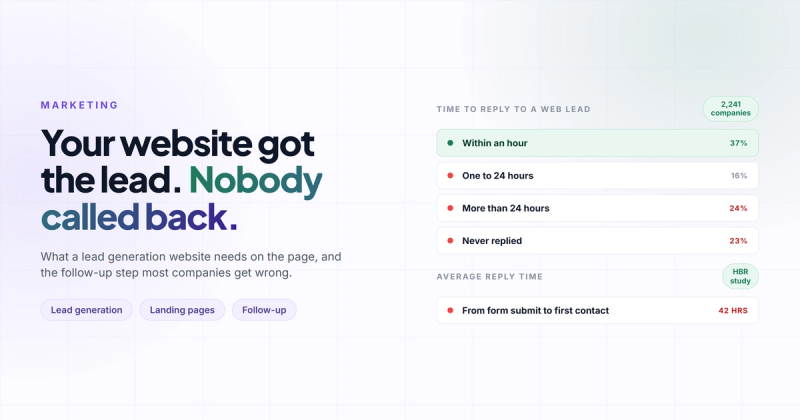
Most websites that "don't generate leads" are already getting some. The form fills land in an inbox nobody checks, a spam folder, or with a sales rep who calls back two days later.
A lead generation website is a site built to turn visitors into contacts you can follow up with: a call, a booked meeting, a quote request, or an email address. Everything on it, from the headline to the form to what happens after someone hits submit, exists to produce that one action. A regular business website tells people who you are. A lead generation website asks them to do something about it.
That's the textbook answer. Here's the less tidy one.
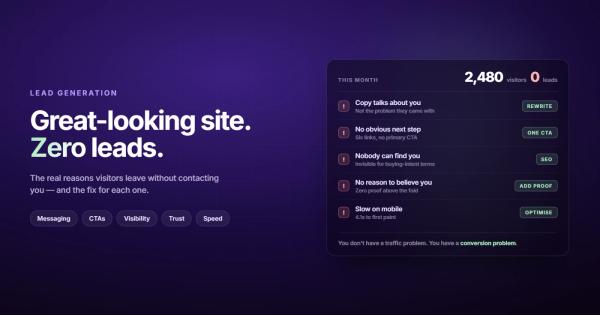
Getting more traffic won't fix that. A lead generation website is a system. The page is only the visible part of it.
What is a lead generation website, really?
The phrase means two different things, and the search results mix them up.
The first is your own business site, built to bring in leads for you. A plumber's site that gets calls. A software site that books demos. That's what this post covers.
The second is a site that generates leads to sell. Somebody builds "Best Roofers in Austin," ranks it, and sells every call to a local roofer. People call it rank and rent. It's a real business model, just a different topic from getting leads for your own company.
Lead generation website vs a regular business website
Two sites can look almost identical and perform completely differently. What separates them is what each page is asked to do.
| Question | Regular business website | Lead generation website |
|---|---|---|
| What's the homepage for? | Introducing the company | Getting the visitor to one next step |
| How many calls to action? | Several, all equal weight | One primary, one softer fallback |
| Where does the copy start? | "We are a team of passionate..." | The problem the visitor walked in with |
| What happens after a form fill? | An email to info@, eventually | Routed to a person, answered within the hour |
| How is success measured? | Traffic, maybe | Qualified leads and the cost of each one |
What actually makes a website generate leads
Every guide on page one lists the same elements: clear CTAs, trust signals, short forms, fast loading. All correct. None explain why some sites with all of those still get nothing.
Here's the mechanism as I see it. A lead happens when the visitor's reason to act is bigger than the cost of acting. The reason is your offer. The cost is everything that gets in the way: unclear copy, a slow page, a twelve-field form, a vague "Contact us" that promises nothing about what happens next.
Every element on those lists either raises the reason or lowers the cost.
A reason to act (the offer)
After reading Hormozi's $100M Offers, I realised my agency had no real offer. "I build websites" is what ten thousand other freelancers say. Nobody fills in a form for a commodity.
Your offer is the specific thing someone gets for raising their hand. A free quote within two hours. A 20-minute audit. A pricing calculator. "Contact us" isn't an offer. It's a mailbox.
One obvious next step
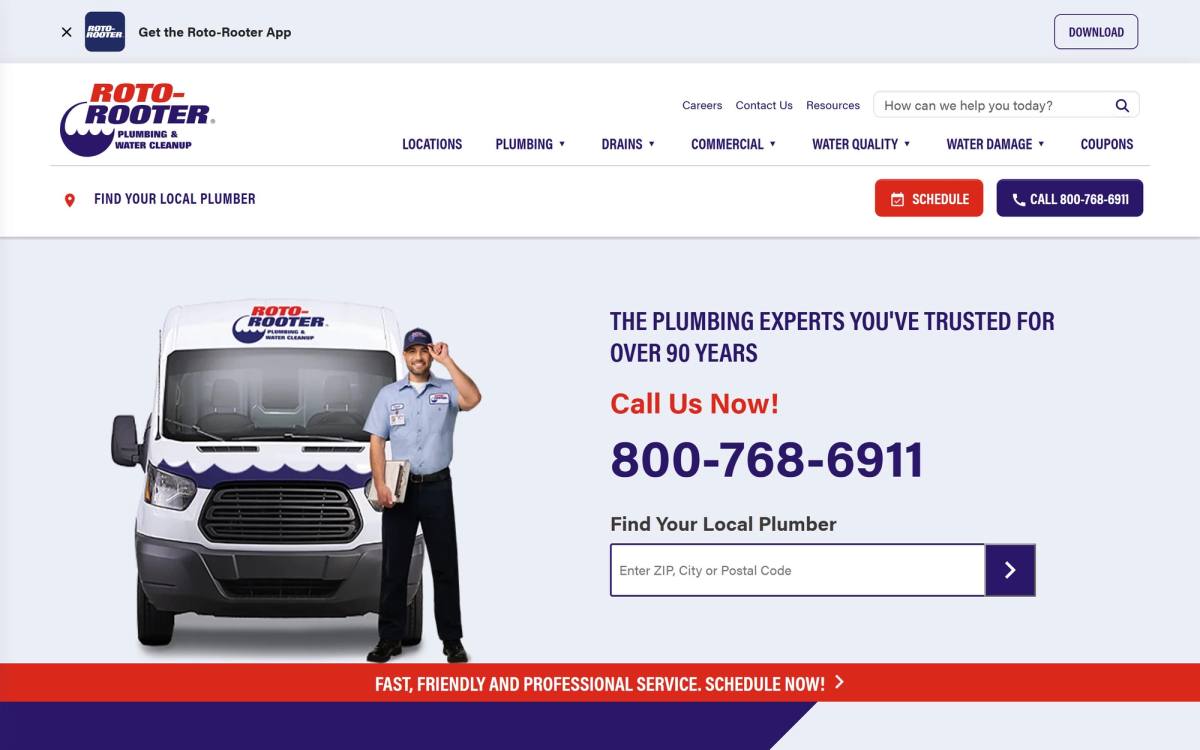
Roto-Rooter isn't winning design awards with that page, and doesn't need to. The visitor has a problem right now, and the page gives them three ways to hand it over.
Nobody buys enterprise software in a panic, so a B2B site changes the ask from "call now" to "book a demo."
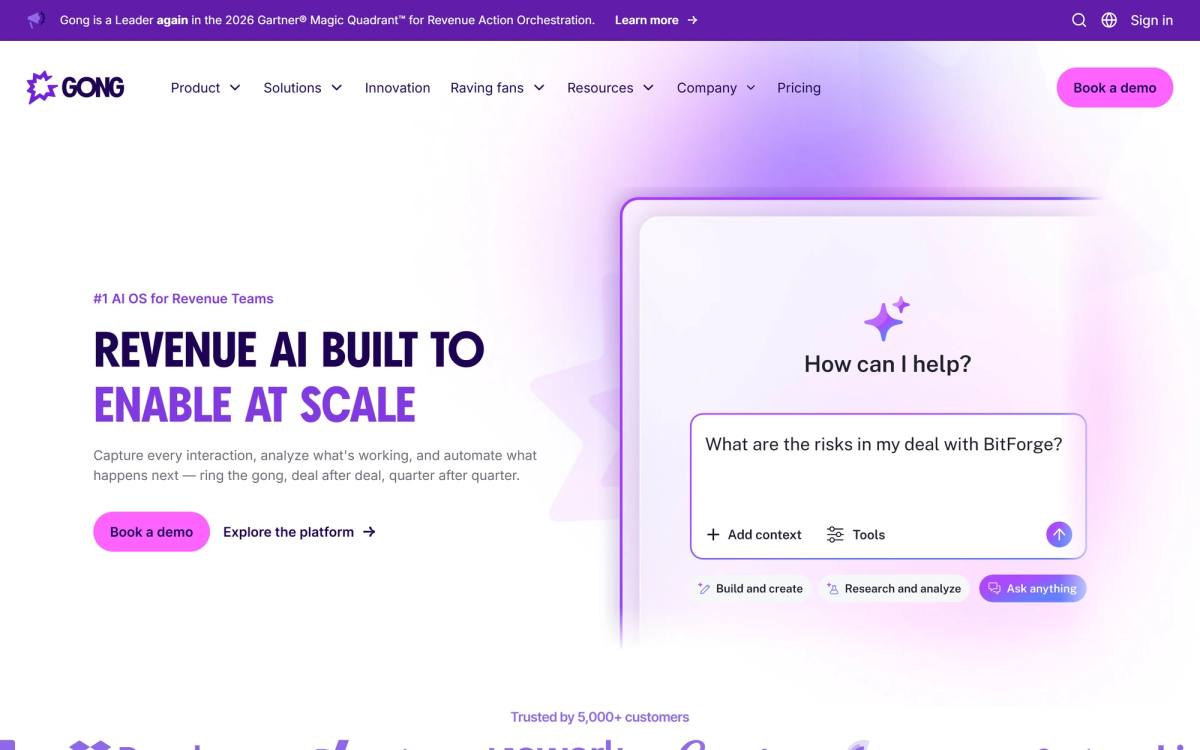
Different buyers, same rule. One primary action, repeated, plus a lower-commitment path so people who aren't ready don't just leave.
Lower the cost of acting
Most of the cost lives in three places:
- The form. Every field is a small tax. Ask for what you need to follow up and qualify, nothing more. The Nielsen Norman Group's form design guidelines are still the best short read on this.
- Doubt. Real testimonials with names, logos of clients, a photo of an actual human. Put them next to the form, not on a separate page nobody visits.
- Speed. A slow page on a phone is a lead you never knew you lost. Google's Core Web Vitals documentation tells you what "fast enough" means in numbers.
How to build a lead generation website, step by step
Notice how late the design shows up.
1. Define what a lead is
Write it in one sentence. "A homeowner within 30 km who wants a bathroom renovation quote." If you can't define it, you can't qualify it, and you'll end up celebrating form fills from spam bots.
2. Pick the offer and the fallback
The primary offer is for people ready to talk. The fallback is for people who aren't: a guide, a calculator, a case study. Two offers, not seven.
3. Write the page before anyone designs it
Headline that names the problem. Who it's for. Proof. The offer. What happens after they click. If the copy works as a plain Google Doc, design will make it better. If it doesn't, design will only make it prettier. I've watched plenty of companies try to fix a messaging problem with a redesign, and the numbers never move.
4. Build forms that qualify
Short, but not blind. One qualifying question ("What's your budget range?") saves your sales team hours. Say what happens next right above the button: "We reply within one business day with a quote."
5. Choose a platform you can actually edit
Nobody has ever hired my agency because of which CMS we use. The real platform question is narrow: can your team change a headline and launch a landing page without filing a ticket? If not, you'll stop testing. I compared the two most common options in Webflow vs WordPress.
6. Connect the form to something that isn't an inbox
Send forms to a CRM, or at least a shared channel with an owner. Set up SPF, DKIM and DMARC so notification emails actually arrive. Add conversion tracking so you know which page and traffic source produced each lead.
7. Build landing pages for each traffic source
Your homepage serves everyone, so it converts nobody especially well. A lead generation landing page built for one ad campaign or one search query almost always beats it. Run through a landing page checklist before you send paid traffic anywhere.
8. Test one thing at a time
When I was choosing a niche for the agency, I built three landing pages for three industries and let cold outreach tell me which one had legs. Same idea here: change the headline or the offer, measure for a few weeks, keep what wins. Data beats deliberation.

The part every guide skips: what happens after the form
Harvard Business Review audited 2,241 US companies by sending them web leads and timing the replies. Only 37% responded within an hour. 23% never responded at all. The average response time was 42 hours.
The same study found that companies contacting a lead within an hour were nearly seven times as likely to qualify it as those that waited even one hour longer, and more than 60 times as likely as companies that waited a day or more. (Source: The Short Life of Online Sales Leads.)
Think about that against your website budget. You could spend months moving a page from 2% to 3% conversion, which is hard. Or you could start answering within the hour and get a bigger lift for free.
A slow follow-up quietly undoes everything the website did right. The visitor did the hard part. Don't make them wait two days to find out if anyone noticed.
The fix is boring, which is why it works. An instant auto-reply that says when they'll hear from a human. A named owner for every lead. A calendar link in the confirmation email. Then check it weekly, because these systems rot quietly.
How to tell if your lead generation website is working
Form fills are a vanity metric if half of them are spam or students. The numbers worth watching:
- Qualified leads per month, using the definition you wrote in step one.
- Conversion rate by page and by traffic source, so you know which landing page earns its keep.
- Median response time from form submit to first human contact.
- Cost per qualified lead, including ad spend and the hours your team spends on junk.
If traffic is fine and qualified leads are low, the problem is on the page. A CRO audit will usually find it in a few hours. If both are low, read why your website isn't generating leads.
Frequently asked questions
What is a lead generation website?
It's a site designed to turn visitors into contacts a business can follow up with, such as calls, quote requests, demo bookings or email sign-ups. Each page focuses on one clear action, and every submission feeds a follow-up process.
How do I get leads from my website?
Give visitors a specific reason to act, like a free quote or audit, and make one call to action obvious on every page. Keep forms short, put real testimonials near them, and reply to every lead within an hour.
Is a landing page the same as a lead generation website?
No. A landing page is a single page built for one campaign or traffic source. A lead generation website is the whole site, including the homepage, service pages, landing pages and the follow-up system behind the forms.
Do lead generation websites make money?
Yes, in two ways. Your own lead generation website makes money by producing customers. Separately, some people rank sites for local services and sell the leads to businesses, a model called rank and rent.
What is the best platform for a lead generation website?
The one your team can update without a developer. Webflow, WordPress and Framer all work. Form handling, CRM integration and how fast you can launch new landing pages matter more than the brand name.
How much does a lead generation website cost?
A template-based site can cost a few thousand dollars, while a custom, strategy-led build is often five figures. The bigger cost is usually ongoing: landing pages, testing and follow-up.
Start with the boring fix
Do this today: fill in your own contact form and time how long it takes a human to reply. That number tells you more about your lead generation website than any heatmap.
Under an hour? Great, go fix your offer and your landing pages. "We're not sure"? You've found your biggest win, and it didn't cost a redesign. And when you want a site built around the lead instead of around the logo, that's the kind of web design work we do.
Comments