
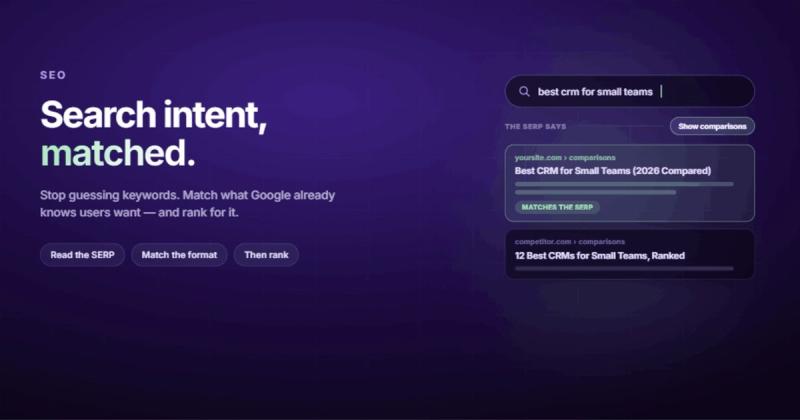
You can write the best article on the internet about a topic and still never rank for it, because Google has already decided that people searching it want a comparison table, not an essay.
What Is Search Intent Optimization (And Why Most People Get It Wrong)?
Search intent optimization is the practice of aligning your content with what someone actually wants when they type a query into Google. Not what you think they want. Not what your keyword tool says they want. What they actually want.
Here's the direct answer: if your page doesn't match what Google has already decided the user is looking for, you won't rank. Full stop. It doesn't matter how many backlinks you have, how perfectly you placed your keyword, or how long your content is. Intent mismatch kills rankings faster than any technical SEO issue I've ever seen.
Most people hear "search intent" and immediately jump to the four categories (informational, navigational, commercial, transactional) like it's a sorting quiz. They label their keyword, pick a format, and move on. That's the surface. The real skill is reading what Google is showing you on page one and reverse-engineering what the algorithm has already figured out about what users want.
It's the most expensive mistake in content: months spent on "the ultimate guide" to a topic where every result on page one is a comparison table. The guide can be genuinely good and still never rank, because it answers a question nobody on that results page is asking. Treat the SERP as your brief, not your keyword tool.
The Four Types of Search Intent (And the Fifth Nobody Mentions)
You've probably seen the standard four types. Let me give you the version that's actually useful for making content decisions.
Informational Intent
The searcher wants to learn something. They're not buying. They're not comparing. They want an answer or an explanation. Keywords often start with "what is," "how to," "why does," or they're plain noun phrases like "search intent types."
What Google shows: long-form guides, how-to posts, Wikipedia entries, knowledge panels, video carousels. If you see these on page one, you're dealing with informational intent.
Navigational Intent
The searcher already knows where they want to go. They're typing "Semrush login" or "Ahrefs blog" because it's faster than bookmarking. You can't really optimize for someone else's navigational query, and you shouldn't try.
Commercial Investigation
This is the comparison phase. "Best SEO tools 2026," "Webflow vs WordPress," "Ahrefs alternatives." The searcher has buying intent but isn't ready to pull the trigger. They want options, comparisons, reviews, pros and cons.
What Google shows: listicles, comparison posts, review roundups, "best of" articles. Often with tables and feature breakdowns.
Transactional Intent
Ready to act. "Buy Ahrefs subscription," "Semrush pricing," "hire webflow developer." The searcher has their wallet out (metaphorically or literally). Google shows product pages, pricing pages, landing pages with CTAs.
The Fifth Type: Fractured Intent
Here's what most guides skip. Sometimes Google itself isn't sure what the user wants. You'll see a SERP with a mix of everything: a how-to guide, a product page, a comparison, a video, and a local pack all on page one. This is fractured intent, and it's more common than people realize.
When you see a fractured SERP, you have an opportunity. Google is still testing. Pick the format that's most represented (even if it's only 3 out of 10 results) and do it better than everyone else. Or find the angle that bridges two intent types.

How to Identify Search Intent From the SERP (Not From Your Assumptions)
Forget what you think a keyword means. Open an incognito window, type the keyword, and look at what Google is actually showing. The SERP is Google telling you the answer to the intent question. You just need to read it.
Step 1: Look at the Content Type
Are the results blog posts? Product pages? Landing pages? Videos? If 8 out of 10 results are blog posts, Google has decided this is an informational query. Trying to rank a product page here is swimming upstream.
Step 2: Look at the Content Format
Within blog posts, what format dominates? How-to guides, listicles, opinion pieces, comparisons, definitions? If everyone ranking is writing "X vs Y" comparisons, your "complete guide" won't fit.
Step 3: Look at the Content Angle
What's the recurring promise in the titles? "For beginners," "in 2026," "step-by-step," "free"? The angle tells you what specific value Google thinks searchers want. A keyword like "search intent optimization" surfaces results promising clarity and actionability. Not theory.
Step 4: Check the SERP Features
People Also Ask boxes, featured snippets, video carousels, knowledge panels. Each feature is a signal. PAA boxes tell you what related questions exist. Featured snippets tell you Google wants a concise, direct answer. Video carousels tell you the topic benefits from visual explanation.
Step 5: Read the Top 3 Results
Actually read them. Not skim. What topics do all three cover? That's your minimum baseline. What does one cover that the others don't? That might be your differentiator or it might be irrelevant. Use judgment.
How to Optimize Your Content for Search Intent
Once you've identified the intent, here's how to actually build content that matches it.
Match the Dominant Format
If the top results are all listicles, write a listicle. I know it sounds boring. I know you want to be creative. But Google has already tested thousands of variations with real users and determined what format satisfies this specific query. Match it first, then add your perspective within that format.
Answer the Core Question Immediately
Don't make people scroll through 400 words of setup before you answer their question. Put your direct answer in the first 100 words. Google rewards this with featured snippets. Readers reward it with their attention.
I used to write long intros building up to the answer. Then I checked my analytics and saw where people were scrolling to. They skipped my beautiful intros every single time. Now I lead with the answer and explain the nuance after.
Cover Every Subtopic the Top Results Cover
If all three top-ranking pages discuss "types of search intent," you need to discuss types of search intent. If they all include examples, you need examples. This isn't copying. It's covering the topic with the completeness that Google has determined users expect.
Go Deeper on One Angle
Matching the baseline gets you competitive. Going deeper on one specific angle gets you rankings. Maybe the top results explain the four types but nobody talks about how intent shifts as a buyer moves through their journey. That's your opening.
Align Your Title and Meta Description With Intent
Your title tag should signal that your content matches what the searcher wants. If the intent is informational, your title should promise information: "How to," "What Is," "Guide to." If it's commercial, signal comparison: "Best," "vs," "Top." Don't write a transactional title for an informational query.
Why Search Intent Shifts (And How to Catch It)
Here's something the standard guides miss: intent isn't static. A keyword can change its dominant intent over time. "AI content" in 2023 was informational (what is AI content?). By 2025, the same keyword became commercial (which AI content tool should I buy?). In 2026, it's splitting between transactional and navigational as specific tools dominate.
Google's SERP reflects these shifts in real time. Pages that ranked perfectly six months ago can drop because the intent shifted underneath them. They didn't get worse. The query got different.
How to catch it: revisit your top-performing pages quarterly. Re-run the SERP analysis. If the results have changed shape (guides becoming comparisons, comparisons becoming product pages), your content needs to evolve with them.
How AI Overviews Are Changing Search Intent Optimization
Google's AI Overviews (the AI-generated answers at the top of search results) have added a new layer to intent optimization. For purely informational queries with simple answers, the AI Overview often satisfies the user without a click. That means the click-through for informational intent is dropping on queries where the answer is a definition or a short explanation.
What does this mean for your strategy? Two things.
First, target informational queries where the answer is too complex for a paragraph. "What is search intent" can be answered in a snippet. "How to optimize for search intent across a 200-page site" can't. Complexity is your moat.
Second, lean into intent types that require interaction: commercial investigation (people need to compare, click through, read reviews) and transactional (people need to actually buy something). AI Overviews can't complete a purchase for the user. Not yet, anyway.
Five Search Intent Mistakes That Tank Rankings
I've made most of these. Learned the hard way so you don't have to.
- Targeting a keyword without checking the SERP first. I used to pick keywords based purely on volume and difficulty scores. Wrote content. Published. Got nothing. The SERP told me exactly what format was needed and I didn't bother to look.
- Writing a guide when the SERP wants a list. If every result is "10 Best X" and you publish "The Complete Guide to X," you're invisible. Format matters as much as content quality.
- Ignoring the content angle. Two results can both be guides but have completely different angles. "For beginners" vs "for enterprise teams" target the same format but different audiences. Miss the angle, miss the ranking.
- Mixing intents on one page. Trying to rank for an informational keyword and sell your product on the same page confuses both Google and the reader. Pick one intent per page.
- Assuming your old content still matches. That blog post you wrote two years ago might have matched intent perfectly then. Check it now. SERPs evolve. Your content needs to evolve with them.
Integrating Search Intent Into Your Keyword Research
Most people do keyword research backwards. They find keywords with good volume and low difficulty, then figure out what to write. Flip it. Start with the SERP, determine the intent, and then decide if you can realistically compete with the content type that's winning.
Here's my actual process:
- Generate a keyword list from your topic cluster.
- For each keyword, check the SERP and categorize by intent type.
- Group keywords by intent and format, not just topic similarity.
- For each group, decide: can I create something that matches this format and goes deeper than what's currently ranking?
- If yes, add it to your content calendar. If no, skip it or wait until you can.
This approach means you'll target fewer keywords but rank for a much higher percentage of them. I'd rather publish 10 posts that all rank on page one than 50 posts where 45 are stuck on page three because they don't match intent.
Your SEO checklist should include an intent analysis step for every target keyword before you write a single word. And if you're in the middle of a website marketing strategy overhaul, intent mapping should be the foundation everything else sits on.
Tools That Help With Search Intent Analysis
You don't need paid tools to identify search intent. An incognito Google search is free and tells you everything. But if you're doing this at scale, a few tools speed things up:
| Tool | What It Does for Intent | Cost |
|---|---|---|
| Google (incognito) | Shows you the actual SERP, features, and formats ranking | Free |
| Semrush | Labels intent type per keyword, shows SERP features | Paid |
| Ahrefs | Shows SERP overview, content type, and traffic potential | Paid |
| AlsoAsked | Maps People Also Ask questions to understand related intents | Free/Paid |
| Google Search Console | Shows which queries bring clicks vs impressions (intent mismatch signal) | Free |
The best tool, honestly, is your own eyes on the SERP. Tools can scale the process but they can't replace the judgment call of "what does this result page tell me about what people want?"
If you're building a new site and need to get this right from day one, combining intent research with a solid website redesign SEO strategy will save you from the trap of building beautiful pages that target the wrong intent entirely.
Frequently Asked Questions
What is search intent in SEO?
Search intent is the reason behind a user's query. It's what they're actually trying to accomplish when they type something into Google. Understanding intent means understanding whether someone wants information, wants to navigate to a specific site, wants to compare options before buying, or is ready to make a purchase right now.
What are the 4 types of search intent?
The four types are informational (wanting to learn something), navigational (wanting to reach a specific website), commercial (wanting to compare options before buying), and transactional (ready to take action, usually a purchase). Some SEOs add a fifth: local intent, where the user wants to find a nearby business or service.
How do I optimize content for search intent?
Search the keyword in incognito mode, study the top-ranking results, identify the dominant content type and format, then create content that matches that format while going deeper on a specific angle. Don't guess what format to use. Let the SERP show you what Google has already determined works.
Why is search intent important for rankings?
Google's entire business model depends on showing users what they want. If your content doesn't match what a user expects when they search a keyword, Google won't rank it, regardless of your domain authority or backlink profile. Intent alignment is the prerequisite for everything else in SEO.
How often does search intent change?
It depends on the query. Evergreen topics (like "how to tie a tie") rarely shift. Trending topics, product categories, and technology-related queries can shift every few months as the market evolves. Check your top-performing pages quarterly by re-analyzing the SERP to catch shifts early.
Can one page target multiple search intents?
You can, but you probably shouldn't. Pages that try to inform and sell simultaneously tend to do both poorly. Pick the primary intent for each page. If you need to address multiple intents for a topic cluster, create separate pages, each optimized for its specific intent type, and link them together with solid internal linking.
Comments