
What Is a Website Marketing Strategy (and Why Most of Them Fail)?
A website marketing strategy is a plan for turning your website into a system that attracts the right visitors and converts them into customers. That's it. Not a 47-slide deck. Not a "holistic digital ecosystem." A plan. With steps. That you actually follow.
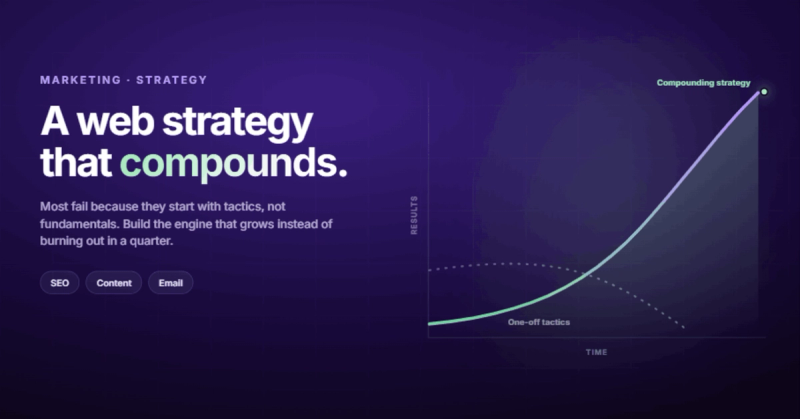
Most website marketing strategies fail because they start with tactics instead of fundamentals. Someone reads a blog post about TikTok ads, another one about email sequences, maybe a third about SEO keyword clusters, and suddenly the "strategy" is a pile of disconnected activities with no shared goal. Six months later, traffic is flat, the team is burned out, and the CEO is asking why they're paying for a blog nobody reads.
Sound familiar?
The problem isn't that you're doing the wrong things. It's that you're doing them without a structure that connects them to actual business outcomes. Your website isn't a brochure. It's the centre of every marketing channel you'll ever use. Paid ads drive people there. SEO brings people there. Social media links back there. Email campaigns click through there. If the hub doesn't work, nothing downstream works either.
Here's what a website marketing strategy actually needs to do, and how to build one that compounds over time instead of burning out in a quarter.

Start With the Goal, Not the Channel
I've had conversations with business owners who say "we need to be on LinkedIn" or "we should run Google Ads" before they can tell me what a lead is worth to them. That's like buying gym equipment before deciding whether you want to lose weight or gain muscle. The equipment isn't wrong. It's just irrelevant without a goal.
Before you pick any channel or tactic, answer two questions:
- What does a converted visitor look like? (Demo booked? Form filled? Product purchased?)
- What's one conversion worth to your business in revenue?
Everything flows from those two answers. If a converted visitor is worth $5,000 in annual contract value, you can afford to spend more per click than a business selling $30 t-shirts. Your strategy changes. Your channel mix changes. Your content priorities change.
Most web strategy guides skip this part entirely. They jump straight to "10 tactics you should be using" without ever asking what you're trying to accomplish. A tactic without a goal is just busywork with a marketing budget.
Your Website Is the Strategy (Not a Piece of It)
Here's the thing most businesses get backwards: they treat the website as one channel among many. SEO is a channel. Social media is a channel. Email is a channel. The website sits alongside them like a sibling.
That framing is wrong. Your website is the parent. Every other channel exists to drive people to it, and the website's job is to convert them once they arrive. If your site loads slowly, confuses visitors, or buries the call to action below three paragraphs of mission statement fluff, then every dollar you spend on marketing is being filtered through a broken funnel.
I once spent two weeks helping a client optimise their Google Ads campaigns. Click-through rates improved by 40%. Conversions didn't move at all. The landing page loaded in 7 seconds on mobile and had a form with 14 fields. We could've tripled the ad budget and it wouldn't have mattered. The website was the bottleneck.
Before you invest in driving traffic, make sure the thing receiving that traffic actually works. That means fast load times, clear messaging, obvious next steps, and a design that doesn't make visitors work to figure out what you do. We wrote a whole post on why your website feels slow and how to fix it if you want the technical breakdown.
SEO: The Channel That Compounds (If You Let It)
Search engine optimisation is the only marketing channel where the work you did six months ago can still generate leads today. Paid ads stop the second you stop paying. Social posts get buried in 48 hours. A blog post ranking on page one of Google keeps sending traffic for months, sometimes years.
But SEO isn't "write blog posts and hope." There's a mechanism to it.
Google ranks pages that best answer the searcher's question. That's the whole game. If someone searches "website marketing strategy," Google is looking for the page that most thoroughly, clearly, and credibly answers that query. Every SEO tactic you've ever heard of (keywords, backlinks, page speed, schema markup) exists to help Google identify that your page is the best answer.
The practical version:
- Find what your potential customers are actually searching for (keyword research, not guessing)
- Create content that answers those searches better than what currently ranks
- Make sure your technical SEO foundation doesn't sabotage your content (site speed, crawlability, mobile experience)
- Build authority over time through consistent publishing and earning links from credible sources
If you want a step-by-step breakdown, we built a 30-point SEO checklist that covers everything from title tags to internal linking. Use it as your audit baseline.
Content Marketing That Isn't Filler
I need to be blunt about something: most business blogs are bad. Not because the topics are wrong, but because the content doesn't actually help anyone. It reads like it was written to check an SEO box, not to answer a real question from a real person.
Here's the test: if you removed your company name from the blog post, would anyone be able to tell who wrote it? If the answer is no, you're producing commodity content. Anyone (including AI tools) can produce it, which means it has zero competitive value.
Content that works as a website marketing strategy has three qualities:
- It answers a specific question your buyer has. Not a vague industry overview. A specific question tied to a specific stage of their buying process.
- It shows firsthand experience. You've done this. You've seen results. You have an opinion that comes from practice, not from reading other blog posts.
- It connects to a next step. The reader finishes and knows exactly what to do, whether that's implementing the advice themselves or contacting someone who can help.
Our post on AI-generated content and SEO is a good example. It tackles a question B2B marketers are genuinely asking right now, takes a clear position, and backs it with what we've actually observed. That's the kind of content that earns links and builds trust. Filler content does neither.
AEO and AI Visibility: The Channel Nobody's Talking About
If you're building a web strategy in 2026 and not thinking about answer engine optimisation, you're already behind. ChatGPT, Gemini, Perplexity, and Google's AI Overviews are all pulling information from websites and presenting it directly to users. The question isn't whether AI will change how people find information. It already has.
The businesses that show up in AI-generated answers are the ones with clear, structured, experience-backed content. AI models favour content that directly answers questions, uses structured data (like FAQ schema), and comes from sources with established authority.
The good news: if you're already doing SEO well, AEO is a natural extension. The same qualities that make your content rank in Google (clarity, depth, structure, authority) are what AI models look for when generating answers. You're not starting from scratch. You're building on a foundation you already have.
The practical steps:
- Answer questions directly at the top of your content (don't bury the answer after 500 words of preamble)
- Use structured headings that match how people phrase questions
- Add FAQ sections with schema markup to your key pages
- Build topical authority by covering related topics thoroughly, not just one keyword per page
Our SEO and AEO service covers this in depth if you want someone to build this into your site architecture from the ground up.
Email Marketing: Still the Highest ROI Channel (Yes, Still)
Email generates roughly $36-42 for every $1 spent, depending on whose research you trust. It consistently outperforms every other marketing channel on ROI. This has been true for a decade and it's still true in 2026.
Why? Because email is the only channel where you own the audience. Google can change its algorithm. Facebook can throttle your organic reach. LinkedIn can tweak its feed. Your email list is yours. Nobody can take it away or reduce your access to it.
The website's role in email marketing is twofold:
- Capture subscribers. Give people a reason to hand over their email. Not "subscribe to our newsletter" (nobody wants another newsletter). Something specific. A checklist, a template, a tool, early access, a useful resource they can't get elsewhere.
- Convert email traffic. When someone clicks through from your email, the landing page needs to pick up exactly where the email left off. If the email promised a guide on website strategy, the page should deliver that guide immediately. Not a homepage. Not a generic services page.
The mistake I see most often: businesses build an email list and then send the same generic newsletter to everyone. Segment your list. Someone who downloaded your SEO checklist cares about different things than someone who enquired about a website redesign. Treat them differently.
Paid Ads: Renting Attention vs. Owning It
Paid ads (Google Ads, LinkedIn Ads, Meta Ads) are like renting an apartment. You get access immediately, it works while you're paying, and the moment you stop paying you're out. There's nothing wrong with renting. Sometimes it's the right move. But you should know that's what you're doing.
Paid ads make sense when:
- You need leads now and can't wait 6 months for SEO to compound
- You're testing messaging or offers before investing in organic content
- You have a high-value conversion that justifies the cost per click
- You're promoting a time-sensitive event or launch
Paid ads don't make sense when:
- You're running them because "everyone else is" without tracking actual ROI
- Your website doesn't convert the traffic they send (fix the site first)
- You're using them as a substitute for organic channels instead of a complement
The strongest website marketing strategies use paid ads to generate short-term results while building organic channels for long-term compounding. One pays the bills today. The other builds the asset.
Social Media: The Awareness Layer (Not the Conversion Layer)
Social media is good at one thing: making people aware you exist. It's terrible at converting them directly. The path almost always goes: see you on social, click to website, convert there. Social media is the introduction. Your website is the conversation.
The mistake businesses make is trying to sell on social media. Stop posting "We offer website design services! DM us for a quote!" Nobody responds to that. Instead, share the thinking, the process, the results. Show a before-and-after of a site you redesigned. Share a lesson from a project that went sideways. Post a specific insight about your industry that makes people think "this company actually knows what they're doing."
Then let your website do the selling when they inevitably click through to learn more.
Measuring What Actually Matters
Traffic is not a business metric. Neither is "engagement." The only metrics that matter for a website marketing strategy are the ones connected to revenue:
| Metric | What It Tells You | When to Worry |
|---|---|---|
| Conversion rate | Percentage of visitors who take the desired action | Below 2% for most B2B sites |
| Cost per lead | How much you're spending to acquire each lead | When it exceeds lead lifetime value |
| Organic traffic growth | Whether your SEO investment is compounding | Flat or declining for 3+ months |
| Bounce rate by source | Which channels send engaged visitors vs. drive-bys | Above 70% from paid traffic |
| Revenue attributed to website | Actual dollars the website generated | If you can't track this at all |
Set up Google Analytics 4 (or whatever analytics tool you use) to track conversions, not just page views. If you can't draw a line from "visitor arrived" to "revenue generated," your measurement is broken and your strategy is flying blind.
The User Experience Problem Nobody Wants to Admit
You can drive 10,000 visitors a month to a website with confusing navigation, unclear messaging, and a contact form buried in a dropdown menu. You'll still get zero leads. Ask me how I know.
Redesigning your website because traffic is low is like repainting your restaurant because the food is bad. The walls were never the problem. Your menu is confusing, your prices don't make sense, and nobody can figure out where to park. But sure, let's try a new shade of blue.
User experience isn't a "nice to have" bolt-on to your marketing strategy. It IS the strategy. Every marketing dollar you spend is filtered through the experience your website delivers. A fast, clear, well-structured site multiplies the impact of every channel. A slow, confusing one divides it.
The fundamentals (and they really are fundamental):
- Page load time under 3 seconds on mobile
- Clear value proposition visible without scrolling
- One primary call to action per page, not seven competing ones
- Navigation that makes sense to visitors, not just to your internal org chart
- Mobile experience that's designed for mobile, not just a squeezed desktop layout
Building a Website Strategy That Compounds Instead of Expires
Tactics expire. Google changes an algorithm. A social platform loses relevance. An ad format gets saturated. If your website marketing strategy is a list of tactics, you'll be rewriting it every six months.
A strategy that compounds is built on structural advantages:
- Own your platform. Your website is the one digital asset you fully control. Build it on technology that lets you move fast without dependencies. (That's why we build on Webflow, but the principle applies regardless of platform.)
- Invest in organic content. Every article you publish that ranks is an asset generating traffic at zero marginal cost. Paid ads are a cost line. Organic content is an asset line.
- Build an email list early. This is the second asset you own. Start building it before you need it.
- Measure and iterate quarterly. Review what's working, cut what isn't, double down on your best channels. Not annually. Quarterly.
- Fix the website first. Before spending more on traffic, make sure the traffic you already have is being converted. A 1% improvement in conversion rate is often worth more than a 20% increase in traffic.
That's the whole web strategy, stripped to fundamentals. Get the website right. Create content that answers real questions. Build channels that send the right people to it. Measure what matters. Repeat.
If that sounds straightforward, it is. The hard part isn't knowing what to do. It's doing it consistently for long enough to see the compounding effect. Most businesses give up at month three. The ones that don't are the ones you're competing against for page one.
Frequently Asked Questions
What is a website marketing strategy?
A website marketing strategy is a plan for using your website as the central hub of your marketing efforts. It covers how you'll attract visitors (through SEO, paid ads, social media, email), what you'll offer them when they arrive (content, value propositions, clear calls to action), and how you'll convert them into leads or customers. The key difference between a strategy and a list of tactics: a strategy connects every activity to a measurable business outcome.
How is website marketing different from digital marketing?
Digital marketing is the umbrella. Website marketing is the hub. Digital marketing includes everything from social media to email to paid ads to influencer partnerships. Website marketing specifically focuses on your website's role in that mix: how it attracts organic traffic, how it converts visitors from all channels, and how its content supports every other marketing effort. You can do digital marketing without a website, but you shouldn't.
How long does it take for a website marketing strategy to show results?
Paid channels can show results within days. SEO and content marketing typically take 3-6 months before traffic starts compounding. Email marketing depends on your list size, but most businesses see measurable ROI within 2-3 months of consistent campaigns. The total strategy, with all channels working together, usually hits its stride around the 6-9 month mark. If nothing has improved after 6 months of consistent effort, something in the foundation is wrong.
What's the most important part of a website marketing strategy?
The website itself. If your website doesn't convert visitors, every marketing channel you invest in is pouring water into a bucket with holes. Fix site speed, clarify your messaging, make conversion paths obvious, and make sure the experience works on mobile before spending money on driving more traffic.
Should I handle website marketing in-house or hire an agency?
It depends on what you have. If you have someone who genuinely understands SEO, content strategy, and conversion optimisation, in-house can work well because they know your business deeply. If you're asking your office manager to "handle the marketing" alongside their other responsibilities, you're not going to get strategic work. An agency gives you a team of specialists without the overhead of hiring four full-time roles. The right answer depends on your budget, your current team's skills, and whether marketing is a core function or a support function in your business.
How much should I budget for website marketing?
B2B companies typically invest 5-10% of revenue into marketing, with 40-60% of that going to digital channels including the website. For a company doing $1M in revenue, that's $50K-100K per year across all digital marketing. But the actual number depends on your growth targets, your industry's competitiveness, and where you are in the build-vs-maintain cycle. A new website marketing strategy costs more upfront. A mature one costs less because the organic channels are already producing.
Comments