
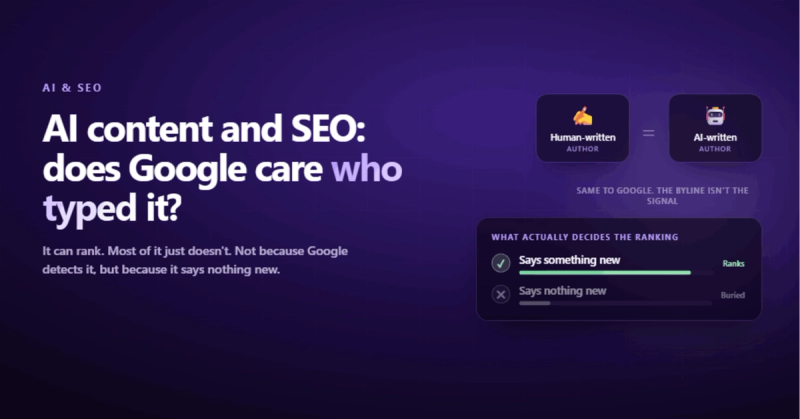
AI Generated Content and SEO: Does Google Care Who Typed It?
Last month, a potential client sent me their website for a review. The blog had 47 posts published over six weeks. Every single one read like it was written by someone who'd never actually done the thing they were writing about. Because it wasn't. It was ChatGPT, barely edited, pumped out on a schedule that no human team could match. Their organic traffic? Flat. Zero movement. Forty-seven posts, and Google treated them like they didn't exist.
Here's the direct answer: AI generated content can rank in Google, but most of it doesn't. Not because Google has some secret AI detector that penalizes machine-written text. The content fails for a much simpler reason. It doesn't say anything that isn't already on page one. Google doesn't care who typed the words. Google cares whether those words give the reader something they can't get from the ten other results already ranking.
That's the part everyone skips when they talk about ai generated content seo. They focus on whether Google "allows" it. The real question is whether what you're producing deserves to rank at all.
What Google Actually Says About AI Content
Google's position on this has been clear since early 2023, and they haven't walked it back. Their helpful content guidelines focus on one thing: was this content created for people? Not "was this content created BY people." For people.
The exact quote from Google: "Appropriate use of AI or automation is not against our guidelines." They don't penalize content for being AI-generated. They penalize content for being useless. There's a difference, and most people conflate the two because most AI content happens to be both.
Google's spam policies target content that's "generated primarily to manipulate search rankings." That word "primarily" is doing heavy lifting. If you're using AI to churn out 200 thin articles about topics you know nothing about, purely to capture search traffic, that's spam. If you're using AI to help draft an article that you then rewrite with your actual experience and opinions, that's a tool. Same technology, completely different intent.
The Helpful Content System (which Google baked into their core ranking algorithm in 2024) rewards content that demonstrates first-hand experience. You can't fake that with a prompt. You can use AI to organize your thoughts, clean up your structure, even draft sections. But the experience itself has to be real.
The E-E-A-T Problem Nobody Talks About
E-E-A-T stands for Experience, Expertise, Authoritativeness, and Trustworthiness. Google uses it to evaluate content quality. Here's what most ai content seo guides won't tell you: AI fails hardest on the first E. Experience.
A language model can synthesize information from thousands of sources. It can explain concepts clearly. It can structure an argument well. What it cannot do is tell you what happened last Tuesday when it tried to implement the advice it's giving you. It can't share the specific moment when a strategy failed or a client pushed back or the data surprised everyone in the room.
I've been building websites for over ten years. When I write about web performance, I'm writing from the time I spent two weeks building a custom animation system for a client's homepage, only to discover their actual customers were on 4G connections in rural areas. Nobody ever saw the animations. They bounced before the page finished loading. That story does more for E-E-A-T than any amount of well-structured AI text because it proves I was actually there, making actual mistakes, learning actual lessons.
AI can't do that. It can generate plausible-sounding experience. "In my experience, website speed matters." Sure. But readers and Google's quality raters can smell the difference between someone who has opinions because they've done the work, and someone (or something) that's summarizing other people's opinions.
Why 90% of AI Content Fails at SEO
The problem with most ai generated content for seo isn't that Google detects it's AI-written. The problem is more fundamental than that.
AI generates content by predicting the most likely next word. By definition, it produces the most average, most expected version of whatever you ask it to write. The output is a statistical composite of everything that already exists on the topic. It's the mean. The median. The consensus.
Now think about what Google is trying to do. It already has ten pages ranking for any given query. Why would it add an eleventh page that says the same thing as the first ten? It wouldn't. And it doesn't.
The content that ranks is content that adds something. A new data point. A contrarian opinion backed by evidence. A specific case study. A framework nobody has articulated yet. AI, left to its own devices, will never produce that. It'll produce a competent summary of what already ranks, which is exactly what Google doesn't need more of.
I see this constantly with agency clients. They come to me after six months of publishing AI articles, wondering why nothing moved. I read their posts and they're perfectly fine. Grammatically correct. Well-structured. Covering all the right topics. And saying absolutely nothing that a reader couldn't find in the first three Google results. That's not a content strategy. That's an echo.
What Actually Works: AI as a Tool, Not a Replacement
The businesses I've seen succeed with AI content aren't using it as a replacement for thinking. They're using it as a power tool for the boring parts so they can spend more time on the parts that actually matter.
Here's what that looks like in practice:
Research and outlining. AI is excellent at pulling together information from multiple sources and organizing it into a logical structure. I use it to generate outlines, identify subtopics I might miss, and find angles worth exploring. The outline is the scaffolding, not the building.
First drafts of factual sections. If a section of your article needs to explain how something works technically (what Core Web Vitals measure, how Google's crawler processes JavaScript, what a 301 redirect does), AI can draft that accurately. It's summarizing established knowledge. That's what it's good at.
Editing and restructuring. AI can tighten a paragraph, suggest a better heading, or flag when you're being redundant. Using it as an editor is different from using it as a writer.
But the things that make content rank? Those have to come from you:
Original insights and opinions. "I tested this on three client sites and here's what happened" beats "experts recommend this approach" every time. Google's algorithms are getting better at distinguishing between regurgitated advice and content that comes from actual practice.
Specific data and examples. Real numbers, real screenshots, real before-and-after comparisons. AI can't generate your Google Analytics data or your case study results. That's your moat.
Voice and personality. Readers stick around for writers who have a point of view. AI writes like a committee. Nobody bookmarks a committee.
Can Google Actually Detect AI Content?
This is the question everyone asks first, and it's the wrong question. But let me answer it anyway.
Google has never confirmed they use AI detection in their ranking algorithm. They've said repeatedly that they focus on content quality, not content origin. Third-party AI detectors (GPTZero, Originality.ai, etc.) have false positive rates high enough that relying on them for business decisions is reckless.
A study by Stanford researchers found that AI detectors are biased against non-native English speakers, flagging their writing as AI-generated at significantly higher rates. If your google ai content policy strategy is based on "passing" AI detectors, you're optimizing for the wrong thing.
Google doesn't need to detect AI to deal with low-quality AI content. Their existing quality signals handle it. Content that lacks original information, doesn't demonstrate experience, reads like every other result on the SERP, and doesn't generate user engagement signals (time on page, return visits, low bounce rate) will naturally sink. It doesn't matter whether a human or a machine produced it. Bad content loses. That mechanism has existed since Panda in 2011. AI content just produces bad content faster and at higher volume.
The Hidden Cost: How AI Content Erodes Brand Trust
Here's something the ai written blog posts ranking guides never mention: what AI content does to your brand long-term.
When someone reads a generic AI article on your site, they don't think "this was well-written but lacked originality." They think "this company has nothing interesting to say." That's a brand impression. And it compounds.
Every bland, personality-free post you publish trains your audience to expect nothing from you. They stop opening your emails. They stop visiting directly. They stop recommending your blog to colleagues. The engagement signals that Google watches (return visits, time on page, pages per session) all decay. And then your rankings follow.
I watched this happen in real time with a competitor in the web design space. They went from thoughtful, opinionated posts twice a month to AI-generated content five times a week. Their traffic spiked for about two months (more pages indexed, more long-tail queries caught). Then it cratered. Not because of a penalty. Because people stopped engaging. The content was technically "about" the right topics, but it had the personality of a microwave manual.
Compare that to the companies doing it right. They publish less often, but every post has a take. An angle. Something that makes you think "huh, I hadn't considered that." Those are the sites that build organic backlinks, get shared on social media, and generate the kind of user behavior signals that Google interprets as quality.
A Practical Framework for Using AI in Your Content
If you want to use AI for content without tanking your SEO or your brand, here's the framework I use with clients:
Step 1: Start with what you know. Before you open ChatGPT, write down the three things you know about this topic that most people get wrong. If you can't name three, you don't know enough to write about it yet. Go learn first.
Step 2: Use AI for structure, not substance. Ask AI to suggest an outline based on what's currently ranking. Let it organize the topics. Then throw away any section where you don't have something original to add.
Step 3: Write the opinion sections yourself. Every post needs at least two sections where you're saying something that AI wouldn't generate on its own. A story from experience. A position that contradicts the consensus. A specific example with real numbers.
Step 4: Use AI to polish, not produce. After you've written the core content, use AI to tighten sentences, check for logical gaps, and improve transitions. This is editing, not writing. Big difference.
Step 5: Read it out loud. If any sentence sounds like something a chatbot would say ("it's important to note," "this approach offers numerous benefits," "by following these best practices") rewrite it. If it doesn't sound like something you'd say to a colleague over coffee, it's not your voice. And if it's not your voice, it's not adding E-E-A-T.
Does AI Content Hurt SEO? The Honest Answer
AI content doesn't hurt your SEO directly. Google has been explicit about this. There's no "AI penalty."
But does ai content hurt seo indirectly? Yes. In three ways:
Dilution. If you publish 50 AI articles and 5 of them rank, you have a 10% success rate, which looks fine until you realize those 45 duds are diluting your site's overall quality signals. Google evaluates sites holistically. A site where most content is thin, unoriginal, and low-engagement tells Google's systems something about the entire domain, not just those individual pages.
Opportunity cost. Every hour spent prompting, editing, and publishing AI content is an hour not spent creating the one piece that could actually break through. I'd rather a client publish one genuinely original post per month than ten AI summaries per week. One piece that earns links and shares will outperform a hundred pieces that don't.
Crawl budget waste. This matters more for larger sites, but it's real. Every low-value page you publish is a page Google has to crawl and evaluate. If you're flooding your site with AI content, you're asking Google to spend its crawl budget on pages that offer nothing new. That can slow down the indexing of your pages that actually matter.
Frequently Asked Questions
Does Google penalize AI-generated content?
No. Google doesn't penalize content for being AI-generated. They penalize content for being unhelpful, spammy, or created primarily to manipulate rankings. AI content that demonstrates genuine expertise, includes original insights, and serves user intent can rank well. The method of creation doesn't matter; the quality does.
Can AI-generated content rank on Google in 2026?
Yes, AI content can rank, but most of it doesn't. The content that ranks successfully uses AI as a tool in the process while adding human expertise, real experience, and original perspectives. Pure AI output that just repackages existing information rarely outperforms what's already ranking.
How does Google detect AI-written content?
Google hasn't confirmed they use AI detection in their ranking algorithm. They focus on quality signals instead: originality, depth, user engagement, E-E-A-T, and whether the content satisfies search intent. You don't need to worry about "passing" AI detection. You need to worry about creating content worth ranking.
Should I disclose that content was written with AI?
Google doesn't require AI disclosure for ranking purposes. However, transparency with your audience builds trust. If AI played a significant role in creating the content, disclosing that honestly can actually strengthen your brand's credibility rather than harm it.
Is it better to write content manually or use AI for SEO?
The best approach is a hybrid. Use AI for research, outlining, drafting factual sections, and editing. Write the opinion sections, case studies, and experience-based content yourself. This gives you the efficiency of AI with the originality and E-E-A-T signals that Google rewards.
How much AI content is too much?
There's no magic ratio. The test is simple: does every page on your site offer something a reader can't find elsewhere? If you're publishing faster than you can add original value to each piece, you're publishing too much. Quality per page matters more than total page count.
Will Google's stance on AI content change?
Google's core principle (reward helpful content, demote unhelpful content) has been consistent for over a decade. The specific signals they use will evolve, but the direction is clear: content that demonstrates real expertise and serves users will continue to win, regardless of how it was produced.


Comments