
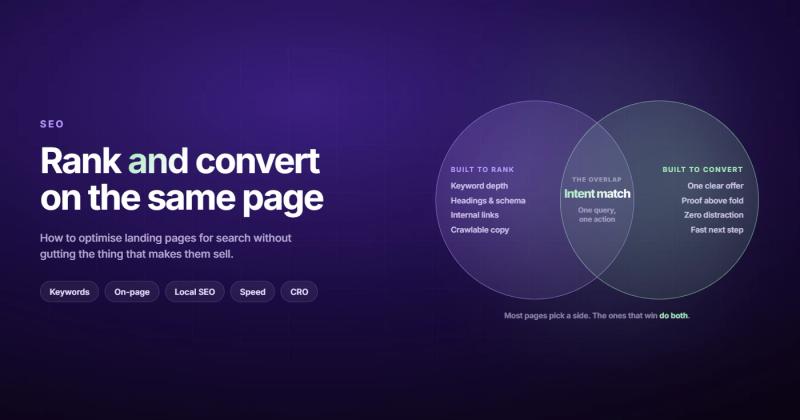
Most landing pages never rank. Not because they're poorly designed or missing keywords, but because they were never built to rank in the first place. They were built to convert paid traffic, dropped behind an ad campaign, and forgotten the moment the budget ran out.
Landing page SEO is what happens when you build a page that does both: ranks organically for a specific search query AND converts visitors once they arrive. It's a page that earns traffic instead of renting it.
The short answer to "should I optimise my landing pages for SEO?" is yes, but only if the page targets a keyword with real search volume and genuine intent. Not every landing page deserves organic traffic. Some exist purely for paid campaigns, and that's fine. The ones that should rank, though, are leaving money on the table if they don't.
What Is an SEO Landing Page?
An SEO landing page is a standalone page designed to rank in search results for a specific keyword while also guiding visitors toward a single action: signing up, booking a call, downloading something, or buying.
The key word there is "single action." A blog post can ramble across five subtopics and still perform. A landing page can't. It exists to do one thing, and every element on the page, from the headline to the CTA button, supports that one thing.
What makes it different from a regular landing page? A regular landing page gets traffic from ads. An SEO landing page gets traffic from Google. That changes the rules. You need enough content for Google to understand what the page is about, but not so much that it buries the conversion path. It's a balancing act, and most people get it wrong by leaning too far in one direction.
How Landing Page SEO Differs From Traditional SEO
Traditional SEO for blog posts is straightforward. Write 2,000 words, cover the topic thoroughly, sprinkle in keywords, add internal links. The goal is information delivery. You want readers to learn something and maybe click through to another page.
Landing page SEO is tighter. You're optimising for search engines AND for a conversion event on the same page. That creates tension, because Google wants depth and landing pages want brevity.
Here's where the difference shows up in practice:
| Factor | Blog Post SEO | Landing Page SEO |
|---|---|---|
| Primary goal | Inform and educate | Convert a visitor |
| Word count | 1,500-3,000+ | 500-1,500 |
| CTAs | Soft (internal links) | Hard (forms, buttons) |
| Navigation | Full site nav | Minimal or none |
| Content depth | Broad topic coverage | Focused on one offer |
| Search intent | Informational | Commercial or transactional |
The trap most people fall into: they strip the landing page so lean for conversions that Google has nothing to rank. Or they stuff it so full of SEO content that it reads like a blog post with a button at the bottom. Neither works.
Keyword Research for Landing Pages (It's Not the Same)
Keyword research for landing pages follows different rules than keyword research for blog content. You're not looking for informational queries. You're looking for keywords where someone is ready to act.
Think about intent. Someone searching "what is email marketing" wants to learn. Someone searching "email marketing platform for small business" wants to buy. Your landing page targets the second type.
The best landing page keywords have three qualities:
- Commercial or transactional intent (they're looking for a solution, not a definition)
- Enough monthly volume to justify building the page (anything above 100 searches/month is worth testing)
- Specificity that matches your actual offer
Long-tail keywords work particularly well for landing pages because they carry clearer intent. "Web design agency" is vague. "Webflow development agency for B2B SaaS" tells you exactly what that person needs.
"I once built three landing pages targeting three different niches, each with its own keyword cluster. The page targeting the most specific long-tail keyword outperformed the other two combined. Specificity wins because it matches what people actually type when they're ready to hire someone."
On-Page SEO for Landing Pages
On-page SEO for landing pages follows the same fundamentals as any other page, but with tighter constraints. Here's what matters and what's different.
Title Tag and Meta Description
Your title tag should include the primary keyword near the start and stay under 60 characters. For landing pages specifically, add a benefit or differentiator. "Landing Page SEO Guide" is boring. "Landing Page SEO: Rank and Convert on the Same Page" tells the searcher why to click.
Meta descriptions should be 120-150 characters, include the keyword naturally, and give a reason to click through. Think of it as ad copy for organic results.
Heading Structure
One H1 per page. Put your primary keyword in it. Use H2s for major sections and H3s for subsections. Don't skip levels (going from H2 to H4 confuses both screen readers and search engines). Your H2s should use variations from your keyword cluster, not just repeat the primary keyword in different ways.
URL Structure
Short, descriptive, keyword-forward. /services/landing-page-seo beats /lp/offer-v2-final-updated. Use hyphens, lowercase, no stop words unless they're needed for readability.
Image Optimisation
Every image needs descriptive alt text that ties to the page topic. Use WebP format, compress under 200KB, and include width/height attributes to prevent layout shift. Use loading="lazy" for anything below the fold. This matters more on landing pages because Core Web Vitals directly affect both rankings and conversion rates.

Content Strategy: How Much Is Enough?
This is where most landing pages fail at SEO. They either have 200 words and a form (not enough for Google to rank) or 3,000 words and seventeen sections (too much for anyone to convert).
The sweet spot for an SEO landing page is 500-1,500 words of focused, useful content. But the number isn't what matters. What matters is whether you've answered the searcher's question completely enough that they don't need to hit the back button.
Structure your content to support the conversion, not compete with it. Put the offer and CTA above the fold. Then use the content below to address objections, build trust, and cover the keyword depth Google needs to rank you. Think of it as: the top of the page sells, the bottom of the page ranks.
A pattern that works well: hero section with headline and CTA, then social proof, then a section explaining what you do and why it works (this is where your keyword-rich content lives), then FAQ, then a final CTA. The reader gets the offer immediately but can scroll for more information if they need convincing.
Should You Create Different Landing Pages for Different Keywords?
Yes, but with a major caveat: each page needs to be genuinely different, not just the same template with swapped keywords.
Google treats near-identical pages targeting slight keyword variations as duplicate content. One strong page targeting a keyword cluster outperforms five thin pages targeting individual terms. If "landing page SEO," "SEO for landing pages," and "search engine optimization landing page" all have the same intent, one page handles all three.
When to create separate pages:
- Different services: a web design service page and an SEO service page should be separate, even if both mention landing pages
- Different locations: if you serve multiple cities, location-specific landing pages make sense (more on this below)
- Different audiences: a landing page for SaaS companies and one for healthcare providers need different messaging even if the service is the same
When NOT to create separate pages: keyword variations that all mean the same thing. Don't build separate pages for "web design services," "website design services," and "web designing services." That's not SEO strategy. That's spam.
Local SEO Landing Pages
Local SEO landing pages deserve their own section because they follow a specific pattern. If your business serves specific geographic areas, these pages can drive serious organic traffic from people searching "[service] in [city]" or "[service] near me."
Each local landing page needs:
- The city/region name in the title tag, H1, and naturally throughout the copy
- Content specific to that location (not just "We serve [City]" with the city name swapped)
- Google Maps embed or address information
- Local testimonials or case studies if available
- LocalBusiness schema markup with the correct address and service area
The mistake everyone makes with local landing pages: creating 50 identical pages with only the city name changed. Google caught onto this years ago. Each local page should reference specific details about serving that area. What problems do clients in that market face? Are there local regulations or considerations? What local results have you achieved?
If you can't write genuinely different content for each location, consolidate. Three strong local pages beat twenty weak ones.
Page Speed and Mobile Optimisation
Landing pages have less room for error on speed than blog posts. A blog reader who waited two seconds might still stay because they're invested in the topic. A landing page visitor who waited two seconds is gone. They'll click the next search result.
The fundamentals: compress images, minimise JavaScript, use a CDN, and test with Google PageSpeed Insights. Your target is a Largest Contentful Paint under 2.5 seconds and a Cumulative Layout Shift under 0.1.
Mobile is non-negotiable. More than half of web traffic is mobile, and Google uses mobile-first indexing. Your landing page CTA buttons need to be at least 48x48 pixels. Forms need to be usable on a phone screen. And the page needs to load fast on a 4G connection, not just your office WiFi.
I learned this the hard way after building a client homepage with smooth animations that nobody on a mobile connection ever saw. They bounced before the animations loaded. Speed is the foundation. Everything else is decoration if the page doesn't load.
Building Backlinks to Landing Pages
Landing pages are harder to build links to than blog posts. Nobody naturally links to a service page. You have to be more deliberate about it.
Strategies that actually work:
- Create a genuinely useful blog post related to your landing page topic, then link from the post to the landing page. This is the most reliable approach. Write content that supports your overall marketing strategy and funnel readers toward your landing pages.
- Guest post on industry blogs and include a contextual link back to your landing page (not your homepage).
- Create data, research, or a tool that people reference. A free calculator or assessment related to your landing page topic earns links naturally.
- Get listed in relevant directories and resource pages in your industry.
Internal links matter too. Every relevant blog post on your site should link to your key landing pages with descriptive anchor text. If you've written about SEO checklists or website conversion, those posts should point readers toward related service pages.
Measuring Landing Page SEO Performance
You need to track two things: rankings and conversions. A landing page that ranks #1 but converts at 0.5% isn't working. A landing page that converts at 10% but gets zero organic traffic also isn't working.
Set up tracking in Google Search Console and Google Analytics. Watch these metrics:
- Organic impressions and clicks (is Google showing your page?)
- Average position for your target keywords
- Click-through rate from search results (is your title/description compelling?)
- Bounce rate from organic traffic specifically
- Conversion rate segmented by traffic source
Check monthly. Landing page SEO is slower than paid ads. You won't see results in a week. Give it 3-6 months of consistent performance before making major changes. If your page isn't ranking after six months, revisit your keyword choice, content depth, and backlink profile.
5 Mistakes That Kill Landing Page SEO
After working on dozens of landing pages across different industries, the same mistakes keep showing up.
1. No-indexing every landing page by default. Some marketers set all landing pages to noindex because "they're only for ads." If a page targets a valuable keyword with search volume, you're throwing away free traffic.
2. Thin content. A headline, three bullet points, and a form isn't enough for Google to rank. You need enough substance to prove your page actually answers the query. That doesn't mean 5,000 words. It means enough to be genuinely useful.
3. Duplicate pages for keyword variations. Building fifteen pages that say the same thing with different city names or slightly different keyword phrasing. Google consolidates these, and your authority gets split across all of them instead of concentrated in one strong page.
4. Ignoring page speed. Every landing page builder claims to be fast. Test yours with real tools. A 4-second load time on mobile kills both your rankings and your landing page experience score.
5. No internal linking strategy. Isolated landing pages with no links pointing to or from them are invisible to Google's crawlers. Connect them to your site architecture with contextual internal links from related blog content and service pages.
FAQ
Can landing pages rank on Google?
Yes. Landing pages can rank on Google if they're properly optimised with relevant keywords, enough content depth to satisfy the search query, good page speed, and a clear topic focus. Google doesn't care whether a page is a "landing page" or a "blog post." It cares whether the page answers the searcher's question well.
How long should an SEO landing page be?
Aim for 500-1,500 words. Enough content for Google to understand the topic, but not so much that the conversion path gets buried. The right length depends on your keyword's competition. If the top-ranking pages have 2,000 words, you probably need at least 1,500.
Should all landing pages be indexed?
No. Only index landing pages that target keywords with actual search volume. Pages built exclusively for paid campaigns (like post-click pages for specific ad groups) can stay noindexed. But if a page targets a keyword people are searching for, it should be indexed.
What's the difference between a landing page and a web page for SEO?
A landing page is focused on a single conversion action with minimal navigation. A standard web page (like a blog post or about page) provides broader information and includes full site navigation. For SEO, both follow the same fundamentals, but landing pages require tighter content and clearer intent matching.
How do I balance SEO content with conversion design?
Put the conversion elements (headline, CTA, social proof) above the fold. Put the SEO-supporting content (detailed explanations, FAQ, related information) below. The top of the page converts visitors who are ready. The bottom of the page ranks in Google and convinces visitors who need more information.
Do I need different landing pages for each keyword?
Only if the keywords represent genuinely different intents or audiences. Keywords that mean the same thing should be targeted by a single, strong page. Create separate pages only when the service, location, or audience is different enough to warrant unique content.
Comments