
Open ten custom web development company websites in ten tabs. Read the hero on each one. You'll see "scalable" over and over, "tailored to your business" almost as often, and "no cookie-cutter solutions" more times than you can count. By tab six you can't remember which company said what, because none of them said anything.
Here's the plain answer. A custom web development company builds the parts of your website that off-the-shelf tools can't do for your business, and uses proven tools for everything else. The good ones start with what the site has to do for you (book calls, sell, qualify leads) and pick the technology last. The expensive ones start by telling you how much they're going to build from scratch.
That difference decides whether you pay for a website or for a very long invoice. So let's look at what "custom" should mean, when you need it, and the questions that separate the two kinds of company before you sign anything.
What "custom" should actually mean
Think about a good tailor. You walk in for a made-to-measure suit. The tailor doesn't weave the fabric. They don't forge the buttons or spin the thread. They buy all of that from people who do it better, and spends his time on the one thing nobody else can do: making it fit you. Your shoulders, your arms, the way you stand.
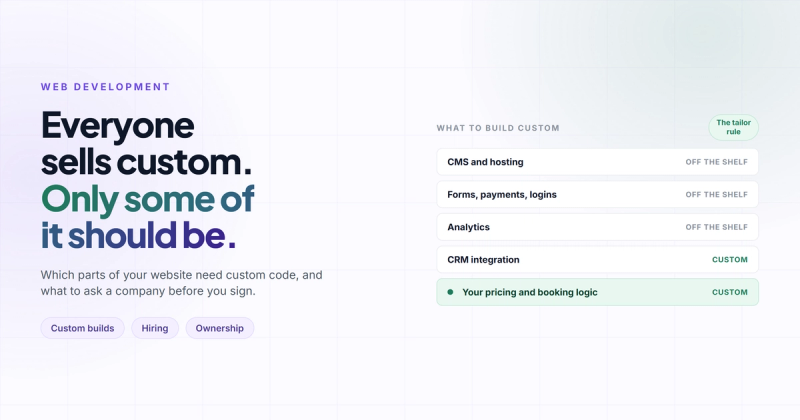
Custom web development works the same way, or it should. The fabric is the stuff every website needs: a CMS, hosting, forms, analytics, payments, logins. Those are solved problems. Rebuilding them is like asking your tailor to grow cotton.
The fit is everything specific to your business. The quote calculator that knows your pricing rules. The booking flow that matches how your team actually schedules. The integration that pushes a lead into your CRM with the right tags so sales calls back in ten minutes, not three days. That's where custom code earns its money.
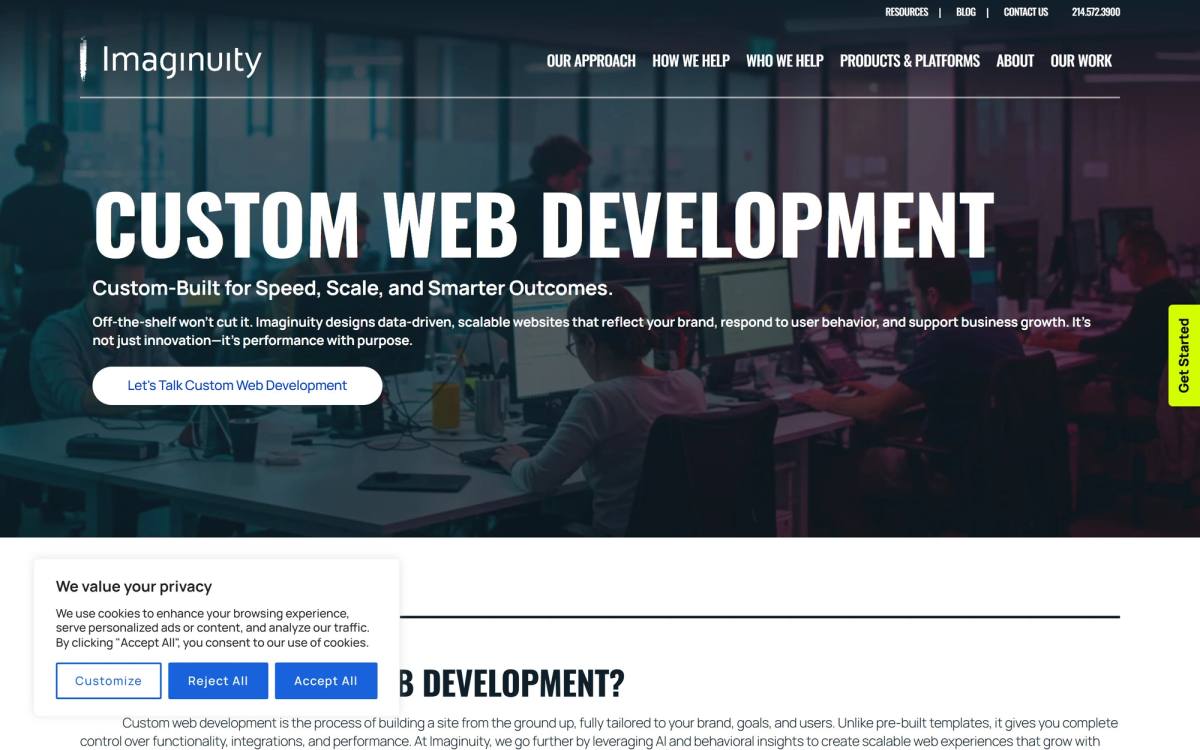
Now look at how the industry defines it. "Building a site from the ground up." Everyone repeats this. Almost nobody asks what "the ground" is. If it means your own login system, your own CMS and your own image pipeline, you're paying for cotton farming (and you'll pay again every time a security patch comes out for the code nobody else uses).
The useful definition is narrower: custom where you're different, standard where you're not. A company that can't tell you which parts of your project fall into each bucket hasn't thought about your project yet.
Custom vs template: an honest decision table
Not every business needs a custom build. Plenty of the sites I'd call well made are a good template, a strong message and fast hosting. The question isn't "custom or not". It's "which parts".
| If your website needs to... | You probably need |
|---|---|
| Explain what you do and collect enquiries | A template or site builder, with real work on the copy |
| Look distinct from competitors, with a CMS your team can edit | Custom design on a visual platform like Webflow or WordPress |
| Run your own pricing logic, quotes or bookings | Custom development for that feature, standard tools around it |
| Sync with your CRM, ERP or internal systems | Custom integrations through their APIs |
| Give customers a login, a dashboard or a portal | A custom web application, built on a proven framework |
Notice that "custom" shows up in a column, not as the whole site. Most real projects land in the middle rows: custom design, one or two custom features, and standard everything else. If you're still choosing the platform underneath, the Webflow vs WordPress comparison covers that trade-off on its own.
(If a company quotes the top row at bottom-row prices, the table just paid for itself.)
What you're really paying a custom web development company for
Here's an uncomfortable fact for my own industry. Writing the code is the cheapest it has ever been. AI tools can turn a finished design into working pages in hours, and they're getting better every month.
I took this seriously enough to change my own website. In September 2026 I removed "Webflow development" and "Webflow migration" from my homepage, my service pages, my footer and my Upwork profile, and replaced them with plain "web development" and "website migration". Years earlier I'd hidden my React background to sell Webflow. Now the tool wasn't the point at all.
Nobody is paying for the build anymore. They're paying for knowing what to build.
So when you compare companies, don't compare who types faster. Compare who asks better questions. The value sits in discovery (what should this site do for the business?), in structure and messaging, in design that guides people to the next step, and in the dull engineering judgement that keeps the site fast and maintainable three years from now. In tailor terms: the measuring and the fittings are the job. The sewing is the easy part.

How a good custom web development company works
Every service page shows a five-step process diagram. They all look alike. What matters is what happens inside each step, so here's what to look for.
- Discovery that changes the plan. Workshops, analytics, a look at how leads actually arrive. If discovery never removes a feature from your wishlist, it was a sales meeting with a new name.
- Structure and content before pixels. Sitemap, page goals, the message on each page.
- Design you can click. A prototype, reviewed on your phone, not a PDF of a desktop screen.
- Build on a staging site you can visit any time. These are your fittings. You should see progress weekly, not at the end.
- Launch with a checklist: redirects from every old URL, analytics, forms tested end to end, and speed checked against Google's Core Web Vitals thresholds.
- After launch, a plan for who fixes things, who updates things, and what that costs.
The step where projects go wrong is the estimate inside step one, and it's usually the "small" features. On a healthcare app I worked on in Ireland, the address form needed to validate an Eircode, the Irish postcode: three characters, a space, four characters. Seven characters. It ate the better part of a sprint. Auto-formatting as people typed, then an address API that returned a different format, then phone validation returning "undefined" for perfectly valid Irish mobile numbers.
That's why a good company asks annoying questions about your forms, your edge cases and your data before it gives you a number. A company that quotes a custom feature in a five-minute call is guessing, and you'll pay for the guess later in change requests.
Questions to ask before you sign
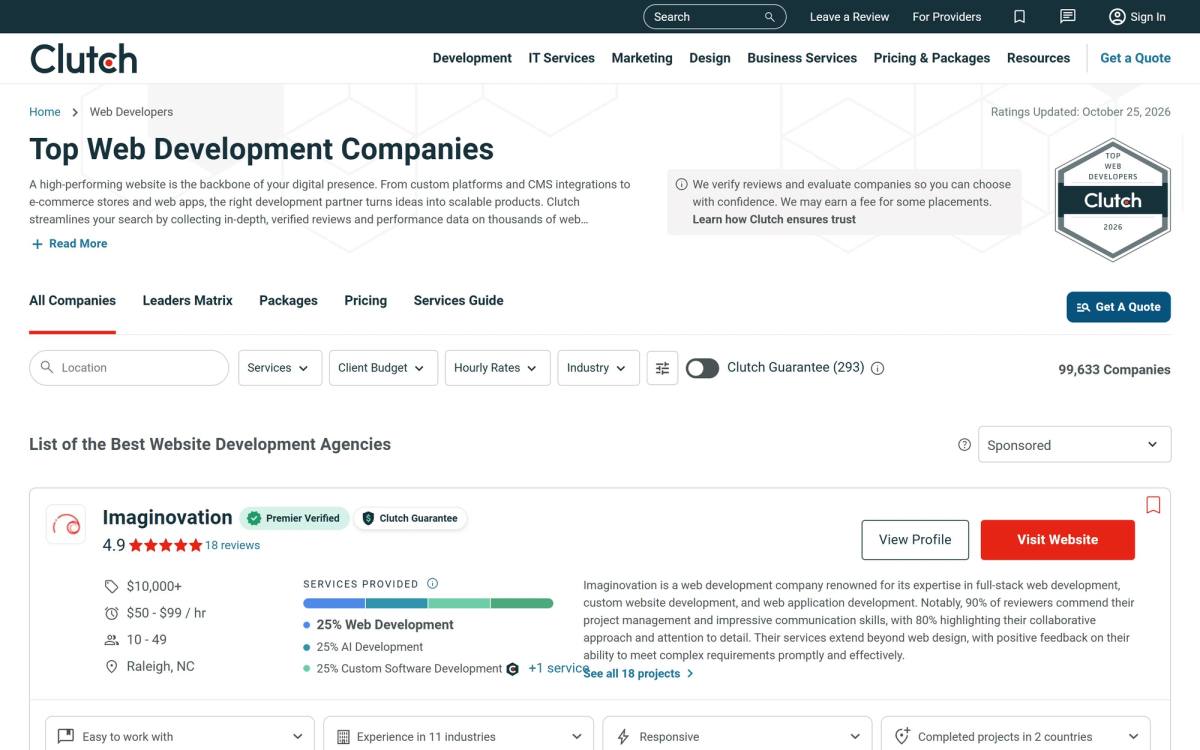
With that many options, reviews and portfolios only get you to a shortlist. These questions get you from the shortlist to a decision. You'll learn more from how a company answers them than from the answers themselves.
- "Which parts of my project would you build custom, and which would you use existing tools for?" The tailor question. A vague answer means they haven't looked closely, or they bill by the hour and like the cotton farm.
- "Will the domain, hosting account and code repository be in my name?" They should be, from day one. Domain transfers between registrars follow ICANN's transfer policy, which is a lot easier when you're the registrant and not your developer.
- "Who will actually write the code?" Some agencies sell you a senior team and hand the work to someone you never meet. Ask for names.
- "Can I see three live sites similar to mine?" Live URLs, not mockups. Open them on your phone. Run one through PageSpeed Insights while you're on the call.
- "How do you handle security updates for custom code?" Every line they write is a line someone has to maintain. A team that knows the OWASP Top 10 will answer this one without blinking.
- "What happens if we stop working together?" Can another developer pick up the code? Is it documented? This one is awkward to ask and very revealing to hear answered.
If you want the broader version of this, with what to look for on an agency's own website, read how to choose a web design agency. Most of it applies to development companies too.
Cost and timeline, without the fog
Custom web development pricing has a huge range because "custom" covers everything from a designed marketing site to a full customer portal. The honest way to think about it: the price follows the custom parts. A marketing site with custom design and standard tools costs a fraction of a site where half the features are bespoke logic.
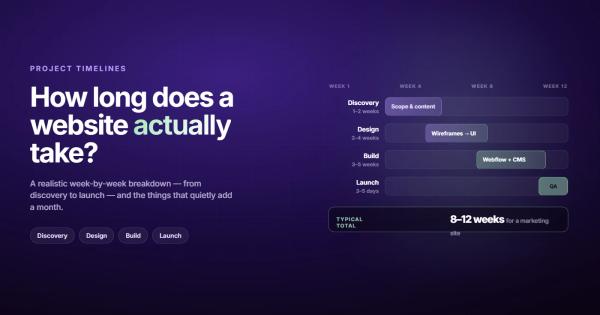
Timelines follow the same rule. A focused marketing site can launch in about six weeks. Each custom feature, integration or user role adds time, mostly in discovery and testing rather than in typing code. For real numbers and what moves them, see the website cost breakdown and how long it takes to build a website.
One rule I'd hold any company to: a fixed price needs a fixed scope. If the scope is still fuzzy, pay for discovery first as its own small project. It's the cheapest insurance in web development, and the output is yours even if you hire someone else to build.
FAQ
What does a custom web development company do?
It plans, designs and builds a website or web application around your business's specific needs, then supports it after launch. The best ones write custom code only for the parts that make your business different, like pricing logic or integrations, and use proven tools for everything else.
Is custom web development better than a template?
Only when your site needs to do something a template can't. If your website explains your services and collects enquiries, a good template with strong copy will often beat a custom build. Custom pays off for unique features, integrations and customer-facing tools.
How much does custom web development cost?
It depends on how much of the project is truly custom. A custom-designed marketing site on a standard platform sits at the lower end, while web applications with logins, dashboards and integrations cost several times more. Ask for the price per feature so you can see what each custom part adds.
How long does a custom website take to build?
A focused marketing site usually takes around six weeks. Web applications and sites with several integrations take longer, often a few months, mainly because of discovery and testing. Weekly staging reviews keep the timeline honest.
Who owns the website after a custom build?
You should. Get the domain, hosting and code repository in your name from the start, and make sure the contract transfers full ownership of the code on final payment.
Should I hire a freelancer or a custom web development company?
A strong freelancer is great for a well-defined site with one or two custom features. A company makes more sense when you need design, development and SEO together, or when the project is big enough that one person becomes a risk if they get sick or busy.
Pick the tailor, not the fabric
Every custom web development company will show you the fabric: the frameworks, the stack, the AI-powered whatever. It all looks great on the shelf. What you're buying is the fit. Someone who measures carefully, tells you which parts don't need to be custom, and brings you back for fittings before the final stitch.
You don't need custom buttons. You need a website that fits the way your business actually wins customers. If that's what you're after, here's how we approach web development, starting with the measuring.
Comments