

Search engine positioning is the work of moving one specific page up the results for one specific search. Not your whole site. Not your domain authority. One page, one query, one spot. You pick the page, you pick the term, you figure out what's holding it at number eight, and you fix that thing.
That's the whole definition. The reason it needs a 3,000 word article is that almost everything people believe about their position is slightly wrong, including the number they're looking at.
I get a version of the same email every few months. A client writes in: "We were ranking third for our main keyword and now we're seventh, what happened?" Nine times out of ten, nothing happened. They were never third. They were somewhere between second and fourteenth depending on who was searching, from where, on what device, and whether Google felt like showing a video carousel that day. The dashboard averaged all of that into a tidy "3" and the client built a quarter of expectations on top of it.

What search engine positioning actually is
Three words get used as if they're the same thing, and they're not.
Positioning is the spot. Where your page sits in the results right now, for one query. Ranking is the process of earning that spot. SEO is the whole discipline that produces both, across every page you own.
So search engine positioning is a subset of SEO with a much tighter frame. SEO asks "how do we grow organic traffic." Positioning asks "can we move this page from six to three for this term, and what would that take?" The second question is answerable. The first one is a planning meeting.
| Term | Scope | What you measure |
|---|---|---|
| Search engine positioning | One page, one query | Position for that query |
| Ranking | The process of earning positions | Movement over time |
| SEO | The whole site | Traffic, conversions, coverage |
| SEO positioning | Usually the same as positioning | Same thing, different label |
You'll also see "search engine placement" and "website positioning." Same idea, older vocabulary. Nobody has ever meant something different by them.
The useful part of framing work this way is that it forces a decision. You can't optimize a page for a query until you've named the query. Half the sites I audit have never done that. They have a services page that's vaguely about three things and ranks properly for none of them, because nobody ever sat down and said "this page is for this search."
Your position isn't a number, it's a range
Here's the thing that breaks most reporting. There is no single position for a page.
Google personalises results by location, search history, device, and language. Your page can be fourth in Chicago and ninth in Dallas for the same query on the same afternoon. Add the SERP features (video blocks, People Also Ask, local packs, AI answers) and the number of organic slots above you changes from search to search.
So when a rank tracker says "position 4," it means position 4 for one simulated searcher in one location. That's a sample, not a measurement.
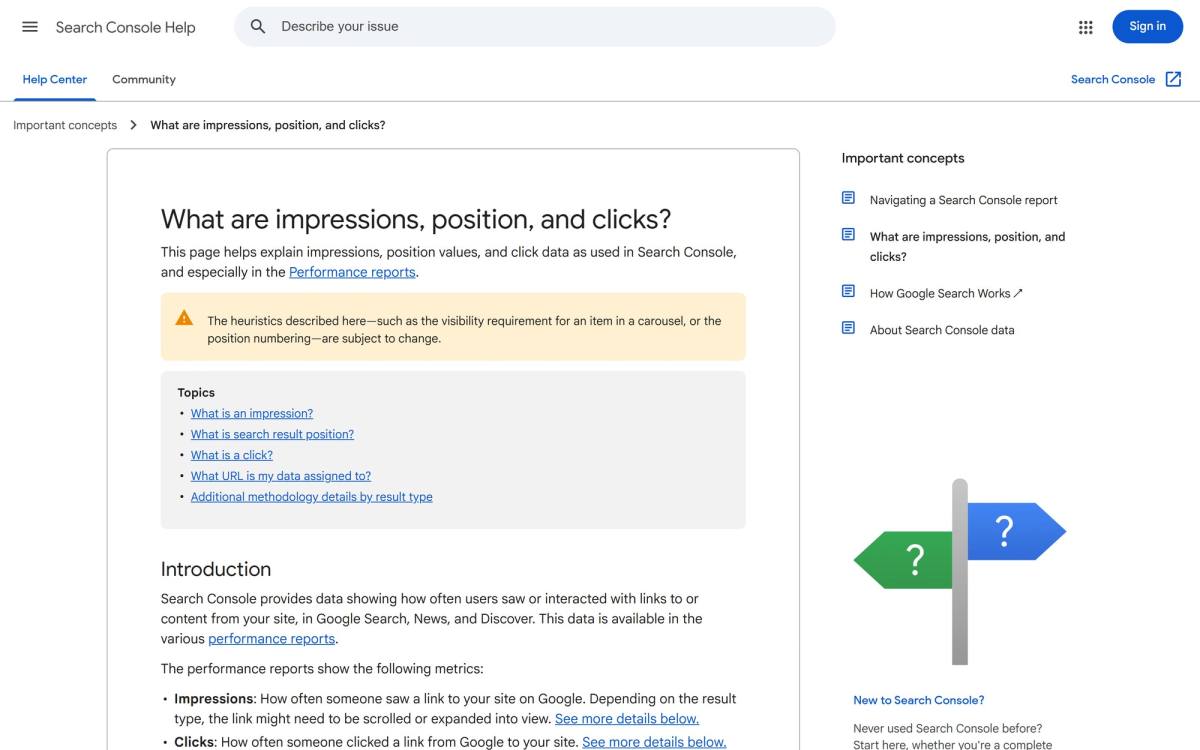
Search Console is more honest, and that honesty is what confuses people. Google defines average position as the topmost position your link occupied, averaged across every query where it got an impression. Two things follow from that, and both matter.
First, a page that ranks third for one term and fortieth for two hundred long tail variants will show an average position somewhere in the twenties. That number describes nothing you can act on. It's the average of a Ferrari and two hundred bicycles.
Second, a position is only recorded if the result got an impression. If your page sits on page three and nobody scrolls that far, that query doesn't drag your average down. Fix a page, start appearing on page two for a hundred new terms, and your average position gets worse while your traffic goes up. I've had to explain this on a call more than once.
What position one is actually worth now
Every article about positioning quotes the same statistic: the first organic result gets about 40% of clicks. It's been repeated for years. It's also out of date.
First Page Sage's 2026 click-through rate report puts blended position one CTR at 7.1%, down from 39.8% a year earlier. The reason is simple. In July 2026 Google made the AI-generated answer the default response to a query instead of an optional layer sitting above the links.
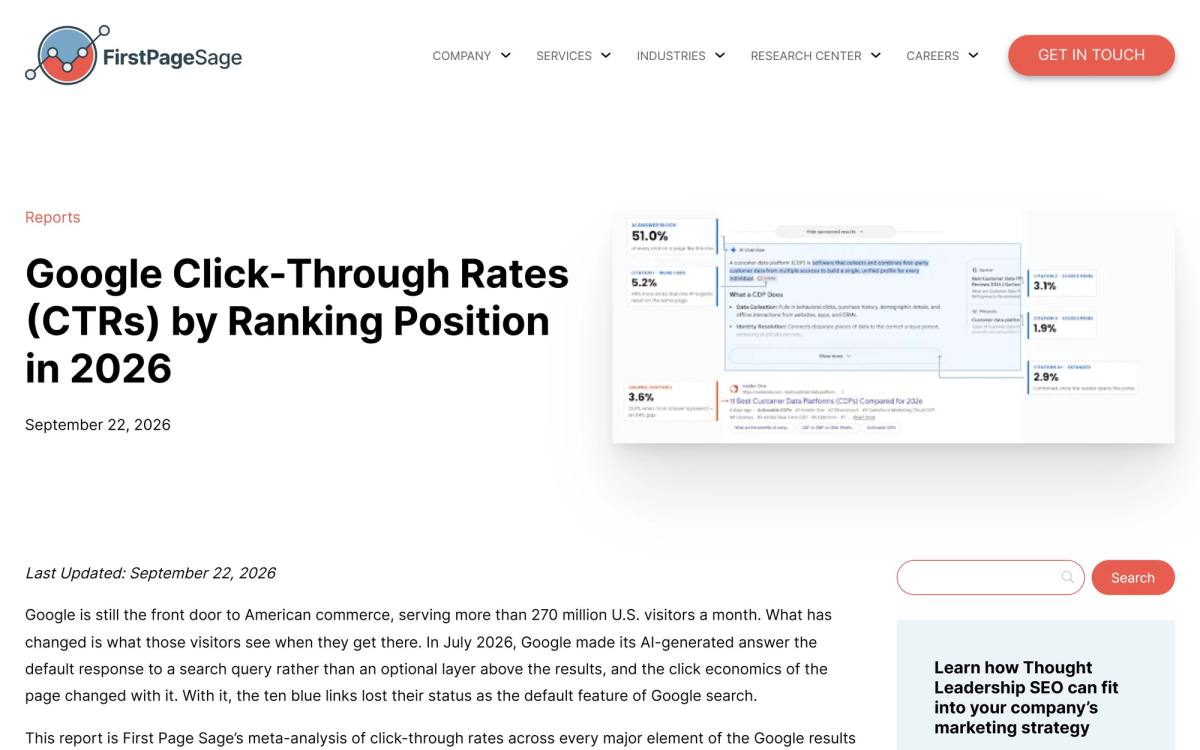
Think of it like a shop on a busy street. Position one was the unit by the crossing, the one everyone walked past. It's still the best unit on the street. But now there's someone standing in the doorway answering most of the questions before anyone goes inside, and he occasionally mentions your shop by name.
Two things follow. Positioning still matters, because being cited in the answer block correlates with ranking well in the organic results underneath it. And raw position is now a worse proxy for traffic than it used to be, which means you have to watch clicks, not just rank.
If you want to go deeper on the citation side of this, we compared the tools that measure it in our rundown of the best LLM SEO checkers.
How to check your real search engine position
Three ways, in order of how much I trust them.
Search Console, filtered properly
Open the Performance report, switch on Average Position, then filter to a single query and a single page. Do not read the site-wide number. It's an average of everything and it means nothing.
Branded searches are the other distortion. Your own company name ranks first and inflates everything. Filter it out with a custom regex on the query dimension, set to "Doesn't match":
Query -> Custom (regex) -> Doesn't match
(?i)(yourbrand|your brand|yourbrand\.com)
What's left is your real competitive position. It's usually a worse number and a far more useful one.
An incognito search with location set
Crude but honest. Open a private window, set the location you care about, and search. You see what a person sees, including the AI answer, the ads, and how far down the page your link actually sits. Rank trackers never show you that your "position 4" is eleven hundred pixels below the fold.
A rank tracker
Useful for one job: watching a set of terms over weeks to spot a trend. Not useful for answering "what position am I." Any single reading is noise. The line over two months is the signal.
Seven moves that actually change your position
These are in order. Doing number five before number one is how agencies burn budgets.
1. Match the intent before anything else
If the top ten results for your term are all comparison listicles and you published a service page, you aren't in a tough fight. You're in the wrong fight. Google has already decided what kind of page answers this query, and it won't make an exception for you.
Search the term. Look at what format the top five use. If yours doesn't match, change the format or change the target. We wrote a longer piece on reading this correctly in search intent optimization.
2. Cover the question completely
Not "write more words." Cover the sub-questions a reader would ask next. If every page in the top five explains pricing and yours doesn't, that gap is why you're ninth. Length is a side effect of coverage, never the goal.
3. Fix the on-page elements, once
Title tag with the term near the front. One H1. Headings that mirror the real sub-questions. A URL that reads like the topic. This is an afternoon of work and it's genuinely worth doing, but it's a floor, not a lever. Everyone in your top ten has already done it.
4. Win the click, not just the spot
Two pages at the same position don't get the same traffic. The title and description decide that. Specific beats clever: a number, a year, a constraint, a promise you can keep. "Website Redesign Cost in 2026: What You'll Actually Pay" earns more clicks than "Our Guide to Redesign Pricing," and it's the same page.
5. Earn links that are about the topic
Links still move positions more than anything else on this list. Relevance beats volume by a wide margin. Three links from pages genuinely about your subject will do more than forty from a directory nobody reads.
6. Clear the technical floor
Crawlable, indexable, fast, correct canonicals, no accidental noindex. None of this will push you from nine to three on its own. All of it will quietly cap you if it's broken. Our SEO checklist covers the parts that actually move something.
A warning from experience. I once went into my TV's service menu to fix an upside-down picture, changed one setting I didn't understand, and ended up with a TV that played sound perfectly and showed nothing but black. Technical SEO has the same shape. Change things one at a time, write down what you changed, and know how to undo it.
7. Refresh what already ranks
The cheapest positions you will ever win are on pages sitting at eight through fifteen. They already have relevance and some authority. They usually need updated facts, a better title, and the two sub-questions they never answered. I'd rather fix five of those than publish one new page.
When your own pages fight each other
This one is almost never in the guides, and it's the first thing I check when a page won't move.
If three of your pages all target roughly the same query, Google has to pick one. It picks inconsistently, splits the links you've earned across all three, and keeps none of them strong. You watch your position flip between seven and twelve every week and blame the algorithm. The algorithm is just confused about which of your pages you meant.
Finding it takes two minutes. In Search Console, filter to the query, then open the Pages tab. If more than one of your URLs shows impressions for it, you've found the problem.
The fix is a decision, not a technique. Pick the page that should own the term. Then either merge the others into it and redirect, or rewrite them to target something genuinely different. Rewriting is usually better, because the other pages probably exist for a reason you've forgotten.
I've seen a page jump four positions from nothing but this. No new links, no new content. Just removing the competition it was getting from its own site.
Ranking first for a term that can't pay you
You can do everything above, land position one, and get nothing out of it.
This is the failure mode nobody writes about, because it looks like success in the dashboard. The rank is green. The traffic is up. The pipeline is flat. Somewhere along the way you optimised for a term that people search when they're curious, not when they're buying.
I read Hormozi's book and had that uncomfortable moment every agency owner dreads, the one where you realise you're selling "websites" just like everyone else. No niche, no specific problem, no real offer. That book broke me out of the commodity trap.
Same trap, different surface. Chasing the biggest search volume in your category is the SEO version of selling "websites." It feels like ambition and it's usually just a lack of a decision.
Before you spend six months on a term, ask what happens after the click. Who searches this? What do they want next? Is there anything on the page that would let them buy? A term with 200 searches a month from people with a budget beats one with 12,000 from students and competitors, and the boring terms are nearly always the cheaper fight, because everyone exciting went after the big one.
The page has to do both jobs, which is harder than it sounds. We broke that down in landing page SEO.
How long this actually takes
Longer than anyone selling it will tell you.
Ahrefs studied this and found that only 1.74% of newly published pages reach the top ten within a year. Of the pages that do get there, about 41% manage it within the first month, which tells you the outcome is mostly decided early. And 72.9% of pages currently in the top ten are over three years old, with the average number one page around five years old. You can read the full study on the Ahrefs blog.
Reasonable expectations, from what I see on real projects:
- Moving a page from 15 to 8: a few weeks, often just from a refresh
- Moving a page from 8 to 3: two to four months, usually needs links
- Getting a brand new page into the top ten on a competitive term: six to twelve months, and it might not happen
Which is why move seven on that list is the one I'd start with. The pages you already have are the only ones where the clock has already been running.
Positioning tools, and when you actually need one
You need exactly one tool to start, and it's free. Search Console tells you which queries you already appear for, which pages appear for them, and roughly where. That covers the first few months of anyone's positioning work.
A paid rank tracker or a website positioning tool earns its cost when you're tracking more than about thirty terms, or when you need a defensible report for someone who pays the invoice. Below that it mostly produces charts you look at too often.
The thing worth paying for sooner is competitor visibility: seeing which terms other sites rank for that you don't. That's a research problem, and it's where tools genuinely beat doing it by hand. If you'd rather hand the whole thing over, that's what our SEO and AEO service exists for.
One rule regardless of budget. Check the number against reality every so often. Open a private window, run the search, and look at the page. Tools drift. The actual results page never lies about what a person sees.
Questions people actually ask
Is search engine positioning the same as ranking?
No. Positioning is the spot your page holds right now for a query. Ranking is the ongoing process of earning that spot. In conversation they get used interchangeably and nobody is harmed by it, but the distinction matters when you're deciding what to work on.
What's the difference between SEO positioning and SEO?
Scope. SEO covers everything across the whole site: technical health, content, links, structure. SEO positioning narrows to one page and one query and asks what it would take to move it up. Positioning is a subset of SEO, not an alternative to it.
Why does my position change every day?
Because it was never one number. Results vary by location, device, search history, and which SERP features Google decides to show that day. Daily movement of two or three spots is normal. A drop of ten or more that holds for a week is worth investigating.
Why is my average position in Search Console so bad?
Almost always because it's averaging a few good terms with hundreds of long tail ones you barely rank for. Filter to a single query and a single page before you read the number. Site-wide average position is the least useful metric in the report.
Is position 11 the same as page two?
Usually, but not reliably. The number of organic results on page one varies with the SERP features Google shows. With a local pack and a video carousel in play, the tenth organic result can sit far enough down that the page break stops mattering. Treat 11 as a near miss worth attacking, not a different category.
Does positioning still matter with AI answers on every result?
Yes, with a caveat. Pages that rank well organically are the ones that get cited in the answer block, so the work that earns a position also earns the citation. What's changed is the payoff per position. Watch clicks and conversions alongside rank, because position one buys less traffic than it did a year ago.
How do I improve my search engine placement fastest?
Find the pages already sitting between positions eight and fifteen, check that nothing else on your own site is competing for the same term, update the content to answer what the top results answer, and rewrite the title to earn the click. That sequence produces movement in weeks. Everything else takes months.
Can I do this myself?
The first 80%, yes, and this article is most of it. The part that's genuinely hard to do alone is earning relevant links and diagnosing why a page that looks right still won't move. That's usually where outside help pays for itself.
Pick one page. Pick one query. Open Search Console, filter to both, and write the number down. Then find out what the three results above you are doing that you aren't.
That's the entire job. Everyone who's good at this is just running that loop more often than you are.


Comments