
Last month I searched for "web design agency for SaaS startups" in ChatGPT. Our agency didn't show up. A competitor with weaker domain authority and half our content did.
That was the moment I stopped treating LLM SEO as a thought-leadership topic and started treating it as a real problem to solve. The issue? There's no native analytics for AI search. Google Search Console shows you nothing. Perplexity doesn't send you a report. You're invisible by default, and you won't know it until a prospect tells you they found a competitor through ChatGPT instead of you.
That's exactly what the best LLM SEO checkers fix. They run queries against AI engines on your behalf, record what the models say, and track changes over time so you can see where you stand and what to do about it.
I spent time testing the main options. Here's the breakdown.
What LLM SEO Checkers Actually Do (and What They Don't)
It's worth being clear on the mechanism before picking a tool, because there's a lot of vague marketing around this category.
Traditional SEO tools tap into Google's infrastructure. They crawl indexed pages, analyze backlink graphs, and pull ranking data from an API. The underlying data exists somewhere centralized you can query.
AI search doesn't work that way. When someone asks ChatGPT "what's the best accounting software for small businesses," the model generates an answer from its training data, sometimes augmented with live web retrieval. There's no index to query, no rank position to track. The only way to know how you appear is to ask the model directly and record the answer.
LLM SEO checkers automate that process. They run a set of target prompts across AI engines like ChatGPT, Perplexity, Google AI Overviews, Gemini, and Claude, then store the responses, extract brand mentions and citations, and surface the data in a dashboard. The better tools run these queries on a schedule so you can see trends over time, not just a one-time snapshot.
What they can't do: they can't directly improve your AI visibility. They're monitoring tools, not optimization tools. Some are adding "action layer" features that recommend content changes, but the actual work of improving how AI models perceive your brand still falls on you.

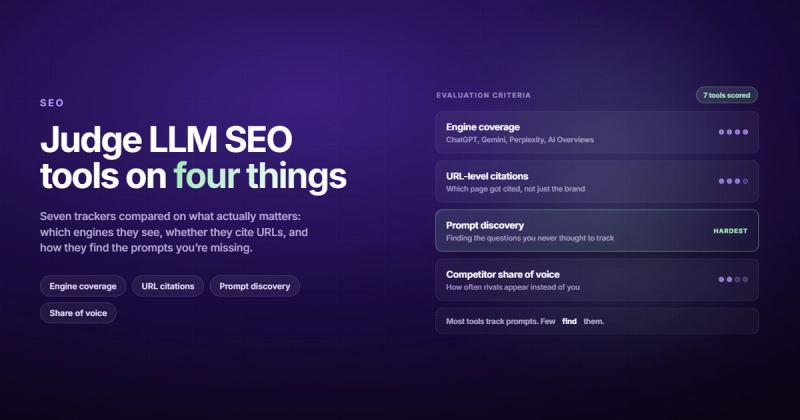
4 Things That Actually Separate Good LLM Tools From Expensive Dashboards
There are a growing number of these tools and most of them do roughly the same thing. Here's what actually distinguishes useful ones from pretty ones.
Engine coverage. A tool that only monitors Google AI Overviews is missing ChatGPT, Perplexity, Gemini, and Claude. In 2026, AI-assisted research happens across multiple platforms, and your visibility can look completely different from one engine to another. You need coverage across at least four engines to get an honest picture of where you stand.
Citation tracking at the URL level. Knowing your brand appeared in 40% of AI responses is a start. Knowing which specific page on your site keeps getting cited (and which ones never do) is what actually lets you act. The tools that track citations at the source URL level are worth significantly more than the ones that just count brand mentions.
Prompt discovery. This is the part nobody talks about enough. To track your visibility, you first have to know which prompts are relevant to your business. Which questions are your prospects asking AI engines? Good tools help you find these through competitor analysis or domain-based suggestions. Tools that assume you already know them put you in a blind spot you don't know you're in.
Competitor share of voice. Your visibility in isolation means nothing. If you appear in 35% of relevant AI responses but your main competitor appears in 75%, you're losing ground you can't see in any other tool. Relative visibility tells the real story.
LLM SEO Checkers at a Glance
| Tool | Engines Covered | Free Tier | Starting Price | Best For |
|---|---|---|---|---|
| Rank Prompt | ChatGPT, Perplexity, Gemini, Claude | No | $39/mo | Most teams |
| SE Ranking | AI Overviews, AI Mode, ChatGPT, Gemini, Perplexity | No | Varies by plan | Full SEO suite users |
| Otterly AI | 4 core + paid add-ons | No | $29/mo | Budget-conscious teams |
| Peec AI | 3–10 depending on plan | Yes (limited) | $95/mo | API access, agencies |
| AIclicks | ChatGPT, Perplexity, Gemini, Claude | No | $59/mo | Citation analysis |
| LLMrefs | Varies | Yes | Free+ | First-time audits |
| Omnia | 7 engines | Audit only | €79/mo | Enterprise, multi-market |
The 7 Best LLM SEO Checkers: Honest Reviews
1. Rank Prompt — The Best Starting Point for Most Businesses
Rank Prompt runs your prompts across ChatGPT, Perplexity, Gemini, and Claude, then reports which brands appeared, what descriptions they got, which sources were cited, and who appeared alongside them. The reporting is clean and the pricing starts at $39/month, which makes it the most accessible serious option on this list.
What it does well: prompt-level tracking, multi-engine coverage, and clear reporting you can actually explain to a client or stakeholder. Where it falls short: there's no recommendation engine. It shows you what's happening but doesn't tell you what to change. You'll need to interpret the data and develop your own content response. For most teams at $39/month, that's a reasonable trade-off.
If you're running an agency and want to add LLM visibility reporting to your SEO offering, Rank Prompt is a good place to start without committing to enterprise pricing before you know what you're doing.
2. SE Ranking — If You Want LLM and Traditional SEO in One Dashboard
SE Ranking built LLM tracking on top of a full traditional SEO platform. The AI visibility tracker covers Google AI Overviews, Google AI Mode, ChatGPT, Gemini, and Perplexity. You get citation tracking, mention sentiment, and competitor comparisons alongside the keyword rank tracking, site audit, and backlink monitoring you'd expect from a full-service SEO tool.
The advantage is obvious: one platform, one login, one invoice. If you're already running an SEO process with rank tracking and site audits, consolidating LLM visibility into the same tool saves time and gives you a more complete picture of your search presence. The LLM data quality is competitive with dedicated tools.
The limitation is that SE Ranking isn't the deepest LLM tool on the list. If citation analysis or prompt discovery is your primary need, a specialized tool will go further. But for the average SEO practitioner who wants LLM visibility without adding another subscription, this is the most practical option.
3. Otterly AI — Genuinely Useful at $29/Month
Otterly AI is the cheapest non-free option on this list and it punches above its price. The $29/month entry tier covers four core AI engines and 50+ countries, which is more geographic flexibility than tools charging three times the price.
It's not built for enterprise scale. If you're tracking hundreds of prompts across many markets with a team of people, you'll hit its limits. But for a startup or small agency monitoring ten to fifteen brand-relevant prompts to understand where they stand, Otterly AI works well.
The paid add-ons let you expand engine coverage as your needs grow, which means you're not locked into a tier that's more than you need right now. That kind of incremental pricing is sensible for teams that want to validate LLM SEO investment before committing to it fully.
4. Peec AI — Best for Teams That Need API Access
Peec AI covers up to ten AI engines depending on your plan, with a genuine free tier that includes ChatGPT and Perplexity monitoring. The paid plans start at $95/month, which puts it in the mid-range.
The feature that separates Peec AI from cheaper options is the MCP (model context protocol) integration and API access. If you're running an agency that wants to pull LLM visibility data into custom client reports, or a product team that wants LLM citations as an input to a broader analytics system, Peec AI's API access is worth the extra cost. Most tools at this price don't offer that.
The free tier is a genuinely useful starting point. If you want to check your LLM visibility without spending anything before you know whether the data is useful to you, Peec AI's free plan gives you enough to form an opinion.
5. AIclicks — Goes Deeper on Citations Than Anyone Else
AIclicks focuses specifically on the citation layer: which sources AI models reference when they mention your category, how often your domain appears, and what content types tend to get picked up across ChatGPT, Perplexity, Gemini, and Claude.
Where it stands out is competitive citation analysis. If you want to understand why a competitor keeps getting cited in AI responses to queries you should own, AIclicks can help you reverse-engineer that. It's not just "they appeared 60 times and you appeared 20 times." It surfaces which of their specific pages keep getting cited and what those pages have in common.
That kind of analysis connects directly to content strategy. If you can see that long-form comparison pages with structured data consistently get cited across multiple AI engines in your category, that's a content brief, not just a data point. It ties neatly into the broader question of how AI engines evaluate content quality.
Starting at $59/month.
6. LLMrefs — The Right Tool for Your First LLM Audit
LLMrefs has a free plan. That makes it the right tool for one specific situation: you've never done an LLM visibility audit before and you want to find out whether your brand shows up in AI responses before spending money on monitoring.
The free tier is limited. You won't get enterprise-grade competitive analysis or prompt discovery from it. But you'll find out quickly whether you're invisible in AI search or whether you have a baseline to build on, and that's worth knowing before you commit budget to it.
The paid plans are affordable and expand coverage. LLMrefs won't be the final tool for a team that takes LLM SEO seriously, but it's a sensible starting point for businesses running their first audit.
7. Omnia — When You're Managing This at Scale
Omnia covers seven AI engines, tracks mentions across unlimited countries, and includes an action layer that turns monitoring data into specific content recommendations. It's the most complete tool on this list and the most expensive, starting at €79/month.
The multi-country tracking is relevant for B2B brands that sell into multiple markets where AI engine preferences vary. The action layer is what separates Omnia from the rest: instead of reporting what's happening, it tells you what content changes would improve your position. That moves it from a monitoring tool to an optimization tool, which is a meaningfully different category.
For a VC-funded startup, a larger B2B brand, or an agency managing LLM visibility as a client service, Omnia's depth is worth the price. For most small businesses, the cheaper options cover 80% of the same ground. Know which situation you're in before paying for the extra 20%.
Do You Actually Need to Pay for This?
Here's the honest answer: if you've never done an LLM visibility audit, start with a free option. LLMrefs or Peec AI's free tier will give you a useful baseline in under an hour without spending anything. Once you know what your current visibility looks like, you'll have a much clearer sense of whether paid monitoring is worth the investment.
If you're running SEO campaigns, reporting visibility metrics to clients, or operating in a competitive category where AI search drives real purchase research, a paid tool pays for itself quickly. The question isn't whether LLM SEO matters. It's whether you're at a stage where systematic tracking drives better decisions than occasional manual checks.
One thing free tools consistently miss: competitive share of voice. Free plans show you your own visibility. They don't show you what competitors are doing in the same responses. That gap is often where the most useful insight lives. Our SEO and AEO service incorporates this kind of competitive LLM analysis as a standard part of how we build visibility strategies.
The Hard Part These Tools Can't Solve for You
Here's something the comparison posts tend to skip: the biggest challenge in LLM SEO isn't picking the right tool. It's knowing which prompts to track.
The prompts that matter for your business are the questions your actual prospects are asking AI engines at different stages of their research. Some of those questions look like your target keywords. Many of them don't. "Best CRM for small sales teams" is different from "what CRM does a 10-person sales team actually use" even though both are queries your prospects might run.
Getting prompt discovery right requires understanding your customers' buying process, not just matching keywords. The tool can track whatever prompts you give it. Choosing the right prompts is the strategic work that happens before you open the dashboard.
Once you have the right prompts, improving your visibility comes down to a well-established set of levers: authoritative content that gets cited by credible sources, structured data that helps AI engines extract clean information from your pages, and consistent mention across the web by sources the models trust. If you're building an organic visibility strategy that's designed to compound over time, LLM visibility fits naturally into that framework rather than running parallel to it.
The tools on this list are good. None of them do the thinking for you. That's still your job.
Frequently Asked Questions
What is an LLM SEO checker?
An LLM SEO checker is a tool that monitors how your brand or website appears in AI-generated responses from platforms like ChatGPT, Perplexity, Google AI Overviews, and Gemini. Unlike traditional SEO tools that track Google rankings, LLM SEO checkers query AI engines directly and track brand mentions, citations, and competitive share of voice.
How is LLM SEO different from traditional SEO?
Traditional SEO focuses on ranking in Google's indexed search results, where position is determined by factors like backlinks and on-page optimization. LLM SEO (also called Generative Engine Optimization or GEO) focuses on how AI language models cite and reference your content in generated responses. Both matter, but the mechanisms that drive visibility are different. A page can rank on page one of Google and never appear in ChatGPT responses, and vice versa.
Which AI engines should my LLM SEO tool cover?
At minimum: ChatGPT, Perplexity, Google AI Overviews, and Gemini. These four cover the majority of AI-assisted search traffic in most markets. Claude coverage is worth adding if you're targeting tech-savvy or developer audiences who use Anthropic's tools. A tool that only covers one or two engines gives you an incomplete and potentially misleading picture.
Is there a free LLM SEO checker worth using?
Yes. LLMrefs has a free plan that covers basic brand monitoring, and Peec AI's free tier includes ChatGPT and Perplexity tracking. Both are good for a first audit. Free plans consistently miss competitive data and multi-engine coverage, so treat them as starting points rather than ongoing solutions.
How often should I check my LLM visibility?
For most businesses, weekly automated tracking is sufficient. AI models update their training data on varying schedules and retrieval-augmented systems can shift faster. If you're actively publishing content intended to improve your LLM visibility, monitoring every few days lets you see which changes actually moved the needle. For quarterly strategy reviews, monthly aggregate data is enough.
Do small businesses need LLM SEO tools?
It depends on whether your prospects use AI search as part of their research process. For B2B services, SaaS products, and professional services where buyers do extensive research before contacting you, AI search visibility increasingly influences which brands they consider. For highly local or transaction-based businesses, the impact is currently smaller. The free audit tools make it easy to check your current visibility and decide whether it's worth investing in systematic tracking. Check what you're actually missing before assuming it doesn't apply to you.
What's the difference between LLM SEO and AEO (Answer Engine Optimization)?
They're closely related but not identical. AEO traditionally referred to optimizing for featured snippets and structured answers in Google Search. LLM SEO is specifically about AI language models and how they generate responses. In practice, many practitioners use the terms interchangeably to describe the same goal: getting your brand and content into the answers that AI systems generate, not just the blue links that follow them. If you're working on your SEO foundation from scratch, building for both traditional rankings and AI visibility simultaneously is more efficient than treating them as separate projects.
Comments