
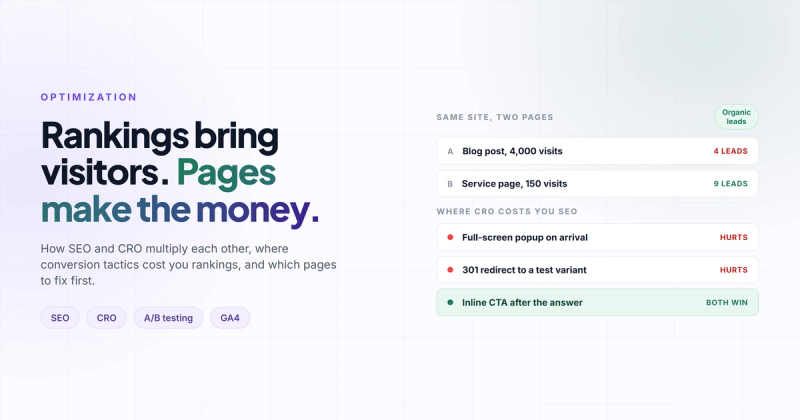
CRO SEO means running search engine optimization and conversion rate optimization as one system instead of two departments. SEO brings the right people to a page from Google. CRO makes sure more of them actually do something once they're there: call, book, buy, fill in the form. The two multiply each other, so improving one without the other wastes most of the effort.
That's the short answer. The longer one is more interesting, because SEO and CRO don't always get along. Some of the most common conversion tactics quietly hurt rankings, and some of the most common SEO habits produce pages that rank fine and convert nobody.
I audit both sides of this on client sites. The pattern I see most often is two decent efforts that never talk to each other. So here's how they fit together, where they fight, and which pages to fix first.
What CRO SEO actually means
Quick refresher on the two halves, since the terms get used loosely.
SEO is everything you do so a page shows up when the right person searches: content that matches the query, a site Google can crawl, links that give it authority. Its scoreboard is impressions, clicks and organic sessions.
CRO (conversion rate optimization) is everything you do so a visitor takes the action the page exists for. Its scoreboard is the percentage of visitors who convert.
Here's the part most articles skip. Neither scoreboard is the one your business cares about. The number that pays the bills is this:
organic revenue = organic sessions × conversion rate × value per conversionSEO owns the first term. CRO owns the second. Because it's multiplication and not addition, a weak term drags the strong one down with it. Doubling traffic to a page that converts at 0.2% gets you double of almost nothing.
Why doing only one of them wastes the other
Think of it like a restaurant. SEO is the sign out front, the location, the reviews on Google Maps. CRO is the menu, the waiter, and whether anyone can figure out how to order. A great sign in front of a confusing restaurant just means more people walk in, look around, and leave. A brilliant menu in a restaurant nobody can find feeds the staff and nobody else.
Let me make that concrete with two pages. These numbers are illustrative, but the shape is something I see in almost every analytics account I open:
| Page | Organic sessions / month | Conversion rate | Leads | What it needs |
|---|---|---|---|---|
| Blog post A | 4,000 | 0.1% | 4 | CRO |
| Service page B | 150 | 6% | 9 | SEO |
The team usually celebrates page A, because 4,000 sessions looks great in a report. Page B quietly produces twice the leads from 4% of the traffic. Getting A from 0.1% to 0.5% is worth 16 extra leads a month. Getting B from 150 to 600 sessions is worth 27. Neither of those wins shows up if you only look at one scoreboard.
That's the real case for CRO SEO. You need to see the whole equation before deciding what to work on, or you'll keep polishing the term that's already fine.

Does CRO actually help rankings?
Every SEO and CRO article says yes, and most of them say it for the wrong reason. The usual claim is that CRO lowers bounce rate and raises dwell time, and Google ranks you higher for it. Google has said for years that it doesn't use your Google Analytics bounce rate. So that version is mostly folklore.
The real mechanism is simpler. Google watches how searchers behave on the results page itself. In the 2023 US antitrust trial, Google's own engineers testified about a system called NavBoost that uses click data from search. A searcher who clicks your result, finds what they wanted, and stops searching is a good signal. A searcher who clicks, hits a wall of popups, and bounces back to try the next result is a bad one.
So CRO helps SEO when it makes the page better at satisfying the search. It doesn't help when it just makes the page better at extracting an email address. Those are different goals, and the difference matters in the next section.
The influence also runs the other way. SEO decides who arrives. A page ranking for the wrong query will never convert well, no matter how many button colours you test. Most "conversion problems" I see on organic pages are really search intent problems wearing a disguise.
Where SEO and CRO fight each other
None of the top-ranking guides on this topic spend much time here, which is odd, because this is where people lose money. Here are the four conflicts I run into most.
Popups and interstitials
The full-screen email popup is the classic CRO tactic. It also lands squarely on a page Google has written specifically about. Its guidance on intrusive interstitials and dialogs says they make content harder to reach and can hurt search performance. On mobile, a popup that covers the answer the searcher came for is the fastest way to send them back to the results page.
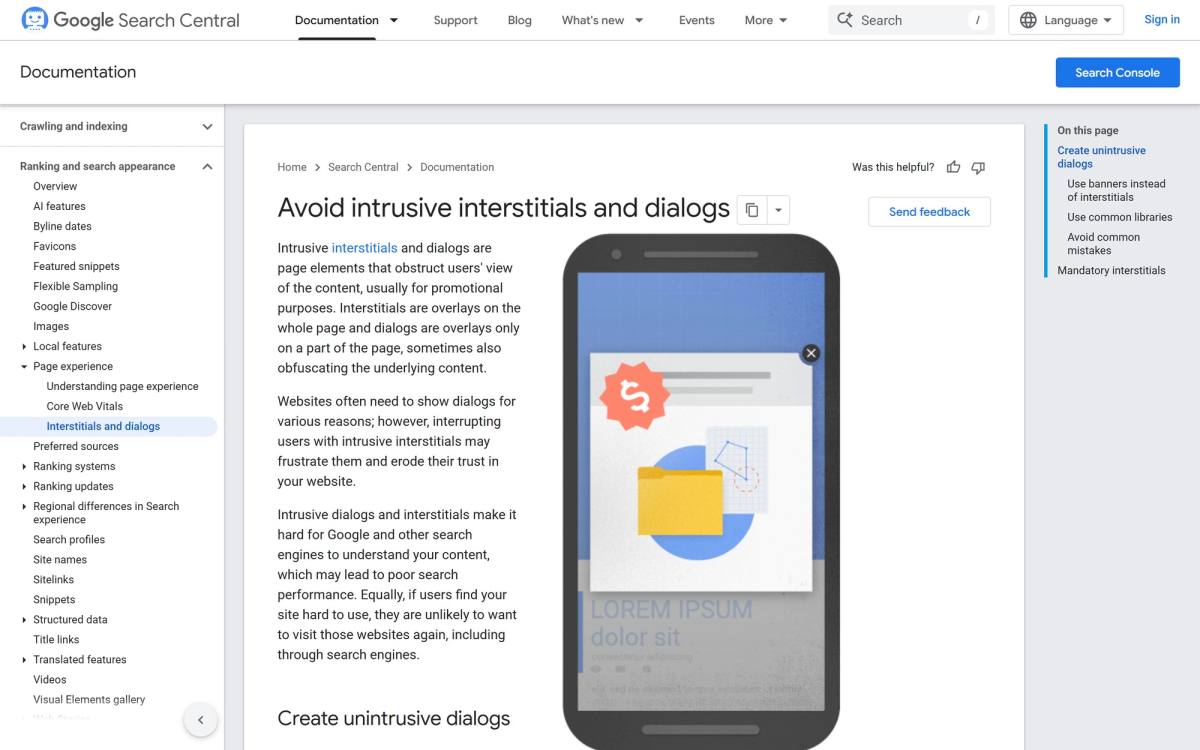
The fix is boring and works: an inline CTA after the answer, or a small banner that doesn't block the content. You give up some email signups from people who would have unsubscribed anyway.
A/B tests done carelessly
Split testing is the core of CRO, and it's mostly safe for SEO. Mostly. Google publishes rules for it in Minimize A/B testing impact in Google Search, and they come down to four things: don't show Googlebot a different page than users (that's cloaking), put rel="canonical" on variant URLs pointing at the original, use 302 redirects rather than 301s, and end the test when it's done.
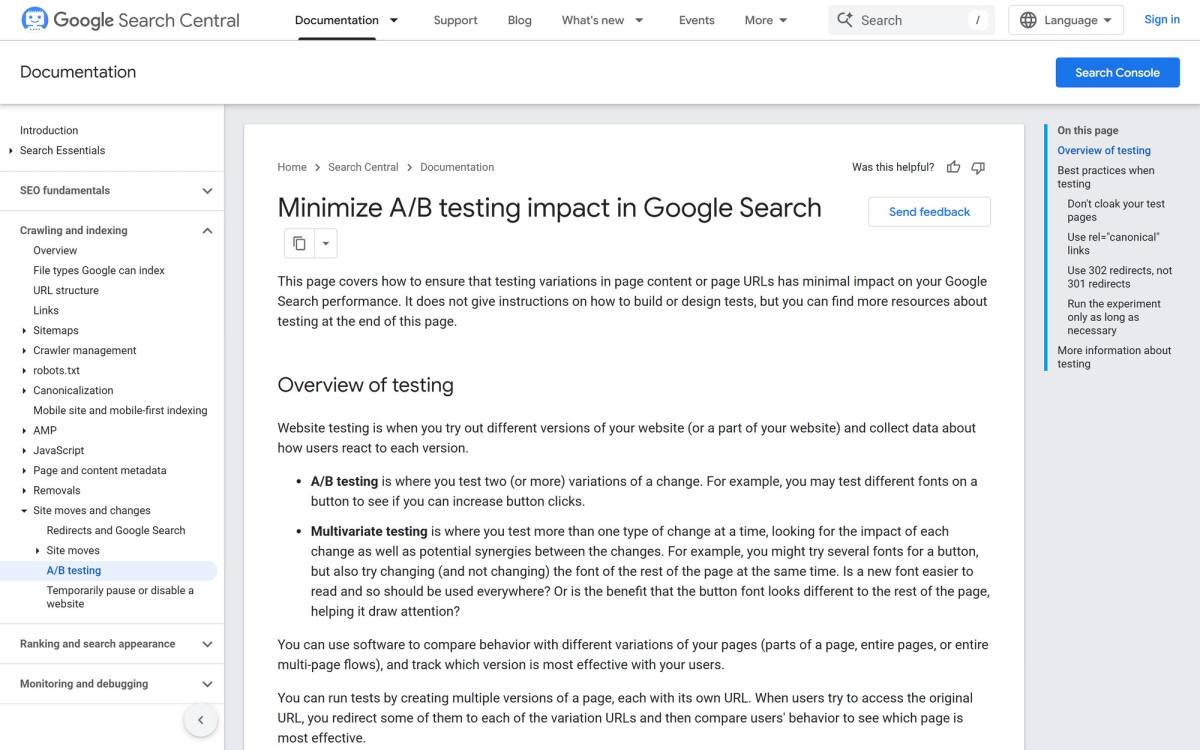
That last one is the one people break. A "test" that has run for nine months with two live URLs isn't a test anymore. It's duplicate content. I wrote up how to run this safely on one platform in Webflow A/B testing.
The "conversion-optimized" page that deleted its content
A CRO consultant looks at a 2,000-word service page and says nobody reads all that, cut it to a headline, three bullets and a form. Conversion rate goes up. Six weeks later organic traffic is down by half, because the 2,000 words were what ranked.
Both people were right about their own scoreboard. The answer is almost never to pick one. Put the conversion path at the top for people who are ready, and keep the depth below it for people (and crawlers) who need it.
The CTA that arrives before the answer
Someone searches "how much does a website redesign cost" and lands on a page whose first screen is "Book a free strategy call." They didn't ask for a call. They asked a question. Answer it first, then ask for something. The ask lands better once you've earned it.
If your conversion tactic makes the searcher's trip shorter, it helps SEO. If it makes the trip longer, it's borrowing from your rankings to pay for this month's leads.
How to combine SEO and CRO, page by page
This is the working list. It's ordered roughly the way a visitor experiences a page, from the search result to the form.
1. Match the page and the ask to the search intent
Intent decides both what ranks and what converts. An informational query ("what is a CRO audit") wants an explanation, and the right conversion is small: a related guide, a newsletter, a free checklist. A commercial query ("CRO audit service") wants proof and a price, and the right conversion is a call or a quote. Asking an informational visitor to book a sales call is like proposing on a first date.
2. Write titles and meta descriptions that pre-sell the click
The search result is the first conversion point, and it's the one both teams forget they share. A title that contains the keyword gets you ranked. A title that also promises a specific outcome gets you clicked. "SEO checklist" ranks. "SEO checklist: 27 checks in the order that matters" gets the click. A higher click-through rate also sends the healthy behavior signal from earlier.
3. Answer first, then ask
Put the direct answer in the first paragraph. That's what wins featured snippets and AI overviews, and it's what keeps a searcher from pogo-sticking back to Google. Then make the first CTA appear right after the answer, not before it.
4. Make it fast
Speed is one of the few things that's unambiguously good for both. Google uses Core Web Vitals as part of page experience, and every extra second of load time costs visitors before they ever see your offer. If your site feels sluggish and you're not sure why, start with why your website feels slow.
5. Design for the phone first
Google indexes the mobile version of your site, and most organic visitors arrive on a phone. Check the page on a real phone: can you read it and tap the button without zooming?
6. Put proof where the doubt is
Reviews, case studies and client logos work best right next to the claim they support, not in a testimonial carousel at the bottom of the page. On a service page, the doubt usually peaks at the price and at the form. That's where the proof goes.
7. Use internal links as conversion paths
Internal links spread authority around your site, which is the SEO reason. They also walk a reader from an informational post to a commercial page, which is the CRO reason. A blog post that ranks well and links nowhere useful is a dead end. Every post should point to at least one page that sells something.
8. Test without breaking indexing
Change one thing at a time on pages with enough traffic to reach a result, and follow Google's testing rules above. On low-traffic pages, skip formal testing. You won't reach significance before the next redesign. Make the change you'd defend in an argument and watch the trend.
Which pages to fix first: the organic conversion report
You don't need a strategy deck for this. You need one report.
In GA4, open the landing page report, filter the session source to organic search, and add your key event (lead, purchase, booking) as a column. Sort by sessions. Now put each page into one of four boxes:
| High conversion rate | Low conversion rate | |
|---|---|---|
| High organic traffic | Protect it. Don't touch the content without a reason. | CRO first. Fix intent match, CTA placement, proof. |
| Low organic traffic | SEO first. This page has proven it converts. | Ask whether it should exist at all. |
The bottom-left box is where the money usually hides. Those pages already convert, and nobody is working on them because they look small in the traffic report.
Data like this has humbled me more than once. I run a car accessories store in Serbia, and I was sure our buyers were mostly men. The numbers said women were the majority. Every assumption I'd made about the product pages was built for the wrong person. Your landing page report will probably contradict something you're sure about too. Let it.
If you want a deeper version of this process with a checklist for each page, the CRO audit guide covers the conversion side step by step.
Questions people ask about CRO and SEO
Is SEO part of CRO?
No, they're separate disciplines that share a goal. SEO increases the number of qualified visitors from search, and CRO increases the share of those visitors who convert. They overlap on page speed, content quality, search intent and user experience, which is why they work best when one person or team plans both.
Does CRO affect SEO rankings?
Indirectly. Google doesn't read your conversion rate, but it does see whether searchers who click your result find what they need. CRO that makes pages faster, clearer and more useful tends to help rankings. CRO that adds friction (intrusive popups, CTAs blocking the answer) tends to hurt them.
Should I do SEO or CRO first?
Look at your organic landing page report before deciding. If you have traffic but few conversions, start with CRO, since it's usually faster and cheaper to fix a page than to grow traffic. If your pages convert well but nobody finds them, start with SEO. A brand new site with almost no traffic should start with SEO, because there's nothing to optimize yet.
Can A/B testing hurt SEO?
It can if you break Google's rules. Showing Googlebot a different version than users is cloaking, permanent 301 redirects to variants can move rankings to the wrong URL, and tests left running for months create duplicate pages. Use rel="canonical" on variants, 302 redirects, and end tests promptly.
Do popups hurt SEO?
Intrusive ones can, especially on mobile. Google's guidance specifically calls out interstitials that cover the main content right after a visitor arrives from search. Small banners, inline CTAs and legally required dialogs (cookie consent, age verification) are fine.
What's a good conversion rate for organic traffic?
It depends too much on the page type to give one number. A blog post converting under 1% to a lead can be perfectly healthy, while a service or pricing page should do several times better. Compare each page against its own past and against similar pages on your own site, not against an industry average.
One equation, so stop running two teams
The fastest win in CRO SEO usually isn't a new tactic. It's putting the traffic report and the conversion report on the same screen and looking at them together for the first time. Most sites have at least one page in the bottom-left box that's been converting quietly for years, waiting for someone to send it more people.
Go find yours this week. And if you'd rather have someone else run the numbers on both halves, that's exactly what our SEO service does: rankings and the conversions that make them worth having.
Comments