
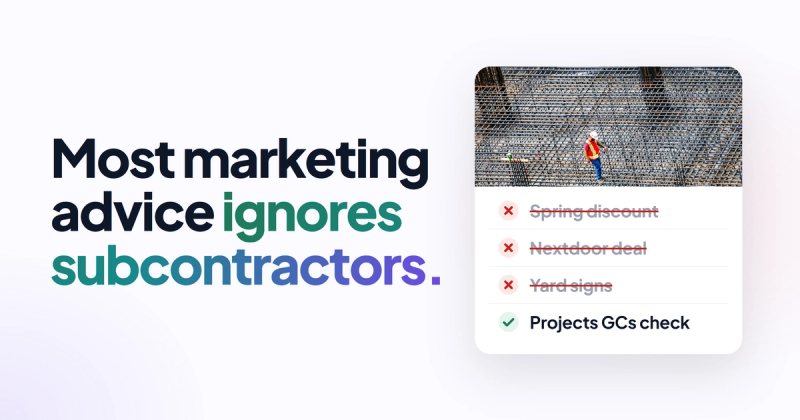
The estimator pricing a school renovation has no use for your spring discount. They need three drywall numbers by Thursday, and right now they're deciding whose name goes on the invite list. Most marketing advice for contractors was never written for that person.
Construction marketing for a subcontractor is the system that gets general contractors to find you, trust you and invite you to bid: a website that says what you build and for whom, a Google profile and listings that match it, proof from past projects, follow-up so no invitation or call goes unanswered, and steady presence between bids. Paid ads come last. The rest of this post is that system, in the order I'd build it, plus a small study of what the ranking advice actually tells you to do.
We sorted 98 construction marketing tips. 10 were written for subs
I used to think the same as everyone else. In my head, construction marketing meant running promotions, local ads and a listing on Nextdoor, and that was it. Then I started looking at commercial subs for our commercial contractor work and noticed their buyer isn't a homeowner at all. So I went back to the advice that ranks and checked who it's really talking to.
The method: I searched "construction marketing", "construction marketing strategies" and "marketing for subcontractors" on Google (US, November 2026) and read 14 ranking articles. Nine of them are tip lists, 98 tips in total, and I sorted every tip by the buyer it assumes. "Sponsor a school team" needs a homeowner. "Publish case studies" works when the buyer is a GC. "Start a blog" or "run Google ads" is a generic channel that only works for a sub once it's aimed at an estimator.
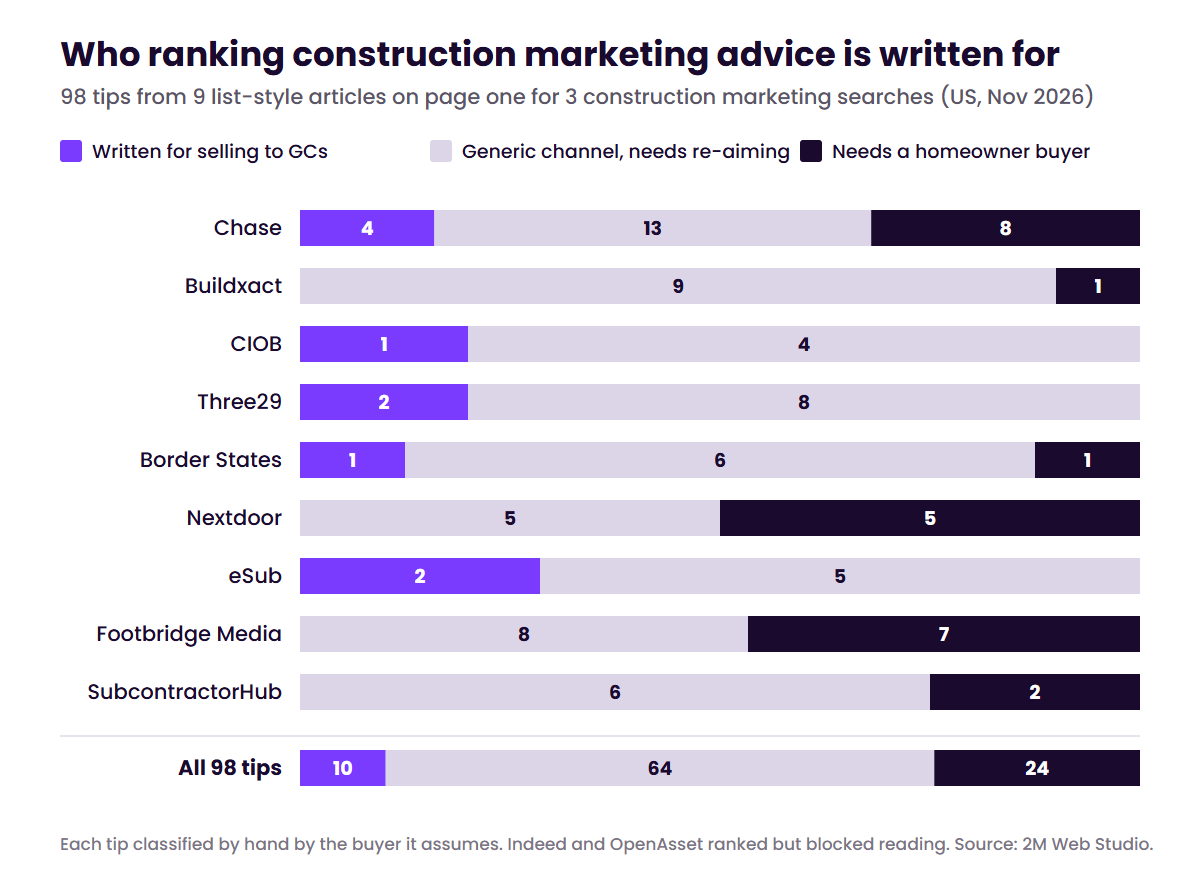
Two-thirds of the advice is generic: have a website, do SEO, post on social. None of it is wrong, but it's aimed at nobody in particular, and for a commercial sub that means the wrong person by default. The vocabulary gives it away:
| Words a GC's estimator uses | Ranking articles that use them (of 14) |
|---|---|
| Estimator | 1 |
| Bid list or bid invitation | 1 |
| Prequalification | 1, in passing |
| Capability statement | 0 |
| EMR (safety rating) | 0 |
| Homeowner | 6 |
(The one article that talks about estimators is from a UK agency. American subs, you're on your own.) The sample is small, it's one month of results, and the sorting is my judgment, so treat the exact split loosely. The direction isn't close.
Your customer is a buyer, not a shopper
Think of two bakeries on the same street. One sells croissants to people walking past, so it needs a nice window, a chalkboard special and a loyalty card. The other supplies forty restaurants. Its customer is a chef who orders every week and cares about three things: does the bread show up on time, is it the same every time, and will this bakery still pick up the phone when something goes wrong.
A commercial sub is the wholesale bakery. Almost all construction marketing advice is written for the shop with the window.
The GC's estimator or project manager is the chef. They're not browsing. They have a scope, a deadline and a reputation on the line if a sub flakes halfway through the job. So your marketing has one question to answer for them: can I put your name in front of my owner without regretting it? That's why projects, safety, crew size and responsiveness do the selling, and coupons do nothing.
Construction marketing for subcontractors, in the order that works
Order matters more than the list. Every item below shows up in the generic advice too. What changes for a sub is who each piece is aimed at, and what has to be finished before the next piece starts.
1. Write down the strategy before you spend anything
Which GCs do you want to work for, on which type of work, in which area, at what size? What do their estimators need to see before they'd invite you? It sounds like homework (it is), but every later step gets aimed by this one. Skip it and you end up with a nice website talking to nobody in particular.
2. Build the website as the hub, one job per page
Your website is where every other channel points, so it gets built before them. The homepage says in one sentence what you build and for whom: "Commercial interior framing and drywall for GCs across North Texas" beats "Quality you can trust." Each page does one job: a projects page with scope and size, a safety page, a page that tells an estimator exactly how to send you plans. We checked what estimators find on 44 real subcontractor websites, and most failed on the basics. If you're starting from a gallery of photos, our contractor website guide covers the order: message first, gallery last.
3. Make Google, Maps and listings match the site
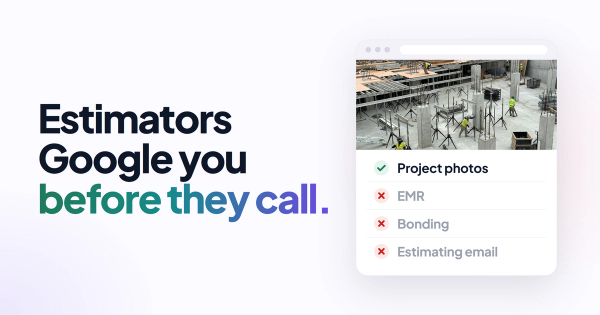
Estimators Google a sub's name before they call. Your Google Business Profile should say the same thing your homepage says, with the same name, phone and service area, and real project photos. Google's own help page says local results rest on relevance, distance and prominence, "how well-known a business is". Then add a few listings that GCs in your market actually use. A few, not every directory that emails you.
4. Collect reviews and stop losing leads
Ask the GCs and owners you've finished work for to leave a review. Then fix the leak most subs never look at: invitations that sit unanswered in an inbox and calls that go to voicemail on a busy site day. Set up automatic replies and a follow-up list so nobody who reached out gets lost. In bakery terms, it's the chef who called on a Tuesday and never heard back. They don't call twice.
5. Show up every month, everywhere your buyers look
This is the part that keeps you remembered between bids. Post finished projects with the problem you solved. Share what you know for free (how you handle a tight schedule, a tricky detail). Put it on LinkedIn, where GC staff actually spend time, on your website, on your Google profile, and in a shape AI tools can pick up when someone asks "who does commercial drywall in Dallas?" Keep doing it every month. Being seen everywhere, constantly, is what makes a name feel safe to an estimator who has never met you.
6. Run ads last, with a landing page that matches
Ads go last for a reason. When you're ready for faster results, build a landing page for each ad that says exactly what the ad promised, track which ones turn into conversations, and cut the ones that don't. Google scores this itself: its Quality Score includes landing page experience, defined as how relevant and useful your page is to the people who click your ad.
What to stop paying for
The advice I'd push back on hardest is "get a website and run ads." People do the two out of sync. The ads have no strategy behind them and send people to a website that doesn't match what the ad said. Visitors land, don't know what to do, and leave (the classic case of a website that isn't generating leads). Running ads doesn't mean anyone converts. The real problem is an undefined strategy, and ads only make it more expensive.
When you pay for traffic and people land on a website with no messaging, no proof and no projects, you're not just losing money. You're losing reputation.
So stop spending on ads until the hub is ready: proper messaging, case studies, testimonials, real projects, optimized profiles. Stop paying for homeowner channels too: Nextdoor deals, yard signs, home shows. An estimator won't see any of them (they're working, not walking the dog).
Here's what the right order did for one of our clients, a strong local business that had a website and, in two years, five sales to show for it. We fixed how they targeted their area, their messaging and their content, rebuilt the website as the hub, and only then added ads, social media and landing pages for their main products. In the first month they made more sales than in the previous two years. Nothing clever happened in that month. Almost everything had been in the wrong order before.
FAQ
What is construction marketing?
Construction marketing is how a construction business gets found and chosen by the people who hire it. For residential builders that's homeowners. For commercial subcontractors it's general contractors, their estimators and project managers, so the website, Google profile and content all have to answer a business buyer's questions.
Do subcontractors need marketing if they get work from referrals?
Referrals bring the first call, but the GC still looks you up before inviting you. If they find nothing, or a site that doesn't say what you do, the referral loses its weight. Marketing makes sure what they find backs up what they heard.
Should a commercial subcontractor run Google Ads?
Only after the website, Google profile and proof are in place. Ads send people to your site, so a weak site makes them expensive. When you do run them, send each ad to a landing page that matches it and track which ones turn into real bid conversations.
Is social media worth it for subcontractors?
Yes, if it's aimed at the right people. LinkedIn is where GC staff spend time, and project posts that show the problem and the result work better there than generic job-site photos. Post consistently, monthly at least, so your name stays in front of estimators between bids.
Next time someone hands you a list of construction marketing tips, ask one question about each one: would the chef notice? If it's a window display, skip it. If it's bread on time, every week, start there. And if you'd rather have someone build the whole system for you, that's exactly what we do for commercial subcontractors.

Comments