
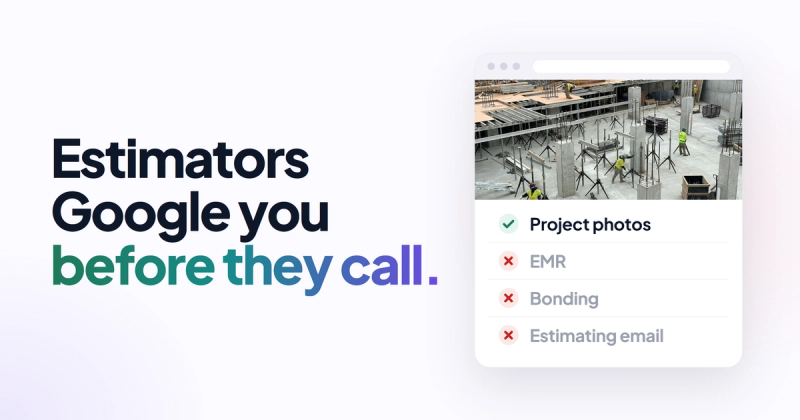
Signing up for every bid platform feels like progress. The profile goes live, the notification emails start, and the invitations keep going to the same six subs they always went to.
Here's how to get on bid lists that actually send you work. Pick the general contractors whose jobs fit your trade and size. Register and prequalify on their vendor portals. Get introduced by a supplier or another trade, then email the estimator a short note with your trade, territory and typical job size. After that, bid or decline every invitation you get. Most subs stop there, and it's exactly where the real filter starts: the estimator looks you up.
Think of it like hiring. A bid platform is a job board with 300 CVs on it. The estimator is the hiring manager, and when somebody mentions your name, they Google you before they pick up the phone. Whatever they find in the next two minutes decides whether you get the call.
Why signing up everywhere doesn't get you invited
I used to think getting on every listing out there was the number one tactic. More listings, more chances. It sounds like simple math.
It isn't. I bid for work on Upwork myself, and Upwork is a bid platform with a nicer font. Every proposal there says the same things, so on the platform you look exactly as good as everybody else. What I changed wasn't another profile. I stopped writing essay proposals and started sending a three-minute video of how I actually run a project. That's the difference between being listed and being chosen.
Construction bid platforms work the same way. BuildingConnected, PlanHub and the rest are useful, and you should be on the one or two your target GCs actually use. But they're crowded, and every sub on them has the same "quality work, on time" line. Being on a list puts you in the pile. It doesn't move you to the top of it (nobody has ever been hired for having the most job board accounts).
How to get on general contractors' bid lists in five steps
None of these steps is a secret. The order matters, and so does doing them properly for ten GCs instead of badly for fifty.
1. Pick 10 GCs whose work fits, and prequalify with them
Find the GCs building the projects you want, at your job size and in your area. Most have a subcontractor prequalification form on their website. Fill it in completely: insurance certificates, license numbers, safety records, references. Half-finished forms sit in a database nobody searches.
2. Get introduced instead of cold-applying
Your supplier reps and the other trades on your jobs already know which estimators are short on coverage in your trade. Ask them directly. A name passed along by someone the estimator trusts is the referral in the hiring analogy, and referrals skip the CV pile.
3. Email the estimator a note they can forward
Keep it to three lines: your trade, where you work, your typical job size, and that you've completed their registration. Something like "Commercial electrical, ground-up and tenant improvement, within 60 miles of Tampa, $250K to $3M in our scope." An estimator can act on that. "We do quality work" can't be acted on.
4. Make the lookup pay off
This is the step the ranking guides skip. Every route above ends with the estimator typing your company name into Google. If your website answers their questions, the introduction turns into an invitation. If it's a photo album with a contact form, you're back in the pile. The next section shows how often that happens.
5. Answer every invitation, even with a no
Bid it or decline it, but never ignore it. "We're at capacity in March, so we'll pass on this one" tells the estimator you're organized. Silence tells them to stop inviting you.
What estimators find when they look you up: 44 sub websites
So what does an estimator actually find? I searched Google for commercial electrical, concrete and mechanical contractors in nine US metros (Dallas, Atlanta, Phoenix, Denver, Charlotte, Nashville, Tampa, Houston and Columbus) and kept every local business on page one, minus directories, bid platforms and one national firm. A script opened each homepage plus up to five linked pages and checked for what a GC needs before inviting a new sub. Eight sites wouldn't load or showed a bot check, which left 44. I went through every match by hand, because "bonding" on an electrician's site turned out to mean grounding and bonding wires, and a "$65" figure was a furnace tune-up promo.
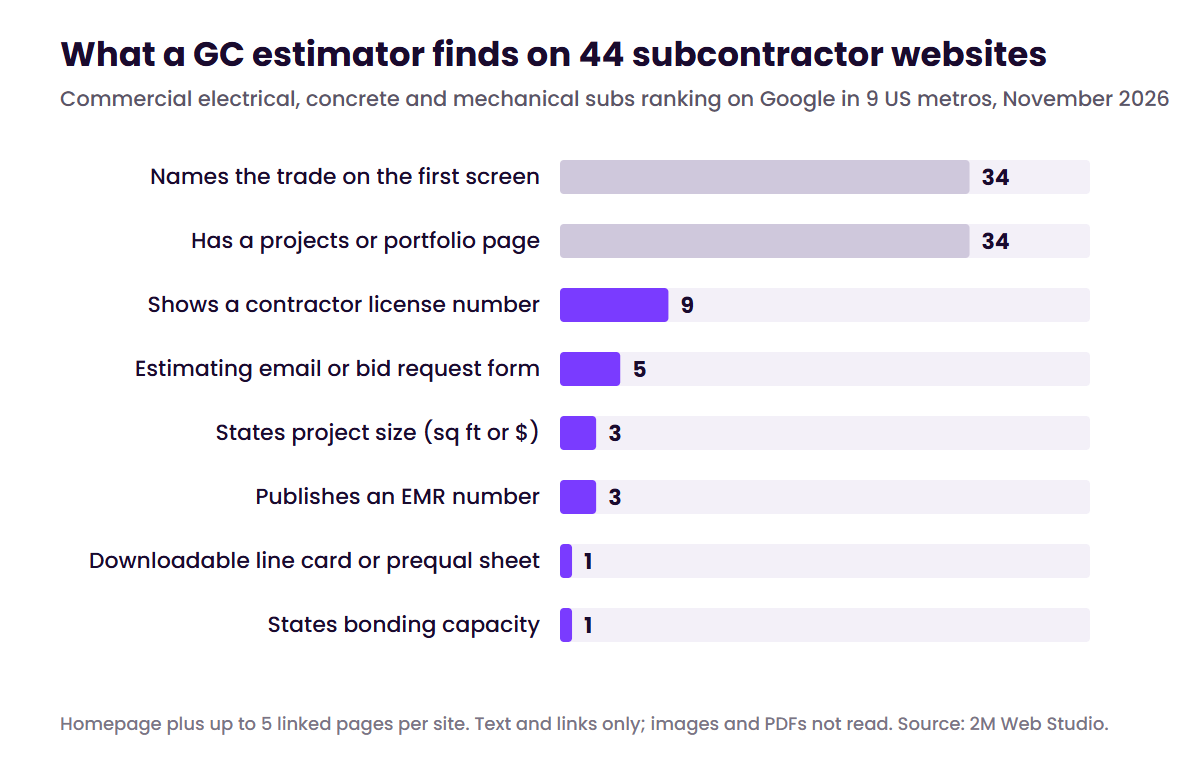
The gallery is there. 34 of the 44 have a projects page, and 37 link to social media. What's missing is everything an estimator needs to move you from "heard of them" to "invite them":
- Only 3 publish an EMR number, and one of those is from 2022.
- 3 state a project size anywhere, in square feet or dollars.
- 1 states its bonding capacity. A few more say "licensed, bonded and insured", which is a slogan, not a number.
- 5 give an estimating email or a bid request form. The rest send GCs to the same contact form homeowners use.
- 1 has a downloadable line card. None mentions a capability statement.
No site passed more than four of the eight checks, and 30 of the 44 passed two or fewer. These companies rank on page one of Google for their trade and city, so they're the ones estimators find first. Back to the hiring manager: imagine opening a candidate's LinkedIn profile and finding nothing but photos of offices they've worked in.
What the sample can't prove: it's 44 sites, checked once in November 2026, and the script read text and links only, so a number inside an image or PDF counts as missing.
What your website should answer before the estimator calls
The fix is smaller than a redesign: put the answers to an estimator's questions where they can find them in two minutes. In rough order of what they look for first:
- One line with trade, territory and job size, on the first screen. "Commercial concrete, tilt-up and slabs, Charlotte metro, $500K to $5M." Ten of the 44 sites didn't even name their trade above the fold.
- A project list with the GC, building type, size and your scope, not just photos. One sentence on the problem you solved beats twenty photos of finished slabs.
- Your safety numbers: EMR, recordable rate from your OSHA injury records, training hours. If your EMR is under 1.0, it's a selling point. Print it as text.
- Bonding capacity per job and in total, and your license numbers. If bonding is what's holding you back, the SBA surety bond program guarantees bonds on contracts up to $9 million for non-federal work and $14 million for federal work.
- A one-page capability statement or line card as a PDF, so the estimator can forward you to the project manager without retyping anything.
- An estimating email that a human reads. estimating@yourcompany.com, linked from the navigation.
Then there's the part a checklist can't capture: whether anyone else talks about you. A sub that shows up in the local business news, on Google Maps with recent reviews, on LinkedIn with last month's job and in AI answers for "commercial electricians in Tampa" reads as established. Being talked about is proof by itself, and your website is the hub it all points back to. We built our websites for commercial contractors around exactly that, and the same idea runs through our guide to websites for contractors.
How to get more construction bids once you're on the list
Getting on the list is round one. Staying on the short list, the handful of subs an estimator calls every time, comes from a record they can trust: bids in on time, clean scope letters, quick answers to questions, and a clear no when you can't take the job.
Then keep feeding the engine instead of adding listings: every finished project goes on the website with its size and GC, and your Google profile gets reviews from the GCs you've worked with. If your site gets visits but no bid requests, the reasons are usually the ones in why a website doesn't generate leads, and a free homepage teardown will show you which ones apply to yours.
The hiring manager is going to Google you either way. The only question is whether they find a candidate, or just a nice set of photos.
FAQ
How do I get on a general contractor's bid list?
Register and prequalify on the GC's subcontractor portal, then email the estimator for your trade with your territory, typical job size and completed registration. An introduction from a supplier rep or another trade speeds this up. Once you're invited, respond to every invitation with a bid or a clear decline.
Is it worth signing up for construction bid platforms?
Yes, but only the one or two your target GCs actually use. Signing up everywhere puts you in more crowded lists without making you stand out on any of them. The time is better spent on prequalification and a website that answers an estimator's questions.
What is an EMR and should I put it on my website?
EMR, the experience modification rate, compares your workers' compensation claims with the average for companies of your trade and size, where 1.0 is average. If yours is under 1.0, publish it as text on a safety page. Only 3 of the 44 sub websites we checked did.
Why am I not getting invited to bid?
Usually one of four things: your contact details in their system are out of date, they don't know your trade, territory or job size, you ignored an earlier invitation, or what they find online doesn't give them enough to trust you with a job. Call the estimator and ask. It's faster than guessing.

Comments