

I opened the 40 kitchen remodelers Google ranks on page one across nine US cities and read the first thing each homepage says. Two of them talk about the homeowner's problem. The other 38 talk about themselves, or say nothing at all.
That's where most remodeling marketing breaks. Remodeling marketing that books consultations starts with a website that says what problem you solve and for whom, a Google Business Profile full of recent reviews, and a reply to every lead within minutes. Only then do Google, AI tools, social media and ads pay off, because the traffic they send lands somewhere that converts.
Think of your website as the model home. Ads, SEO, Houzz and Angi are road signs pointing people to it. Most remodelers keep buying bigger signs while the model home has the lights off, nobody at the door and no sign saying what they build. Below is what the 40 homepages showed, why the portfolio-first site stopped working, and the order I'd fix things in.
What 40 remodeler homepages tell a homeowner
The method was simple. I searched "kitchen remodeler" plus the city for San Antonio, Phoenix, Charlotte, Denver, Tampa, Nashville, Raleigh, Atlanta and Dallas, took the organic results, dropped Yelp, Houzz, Thumbtack, Angi, Reddit and national franchises, and kept 42 local remodelers. Two of them wouldn't load, so 40 homepages made it through. Each one loaded at phone size, and I recorded the main headline (the H1), what the first screen asks you to do, and what's on the page.
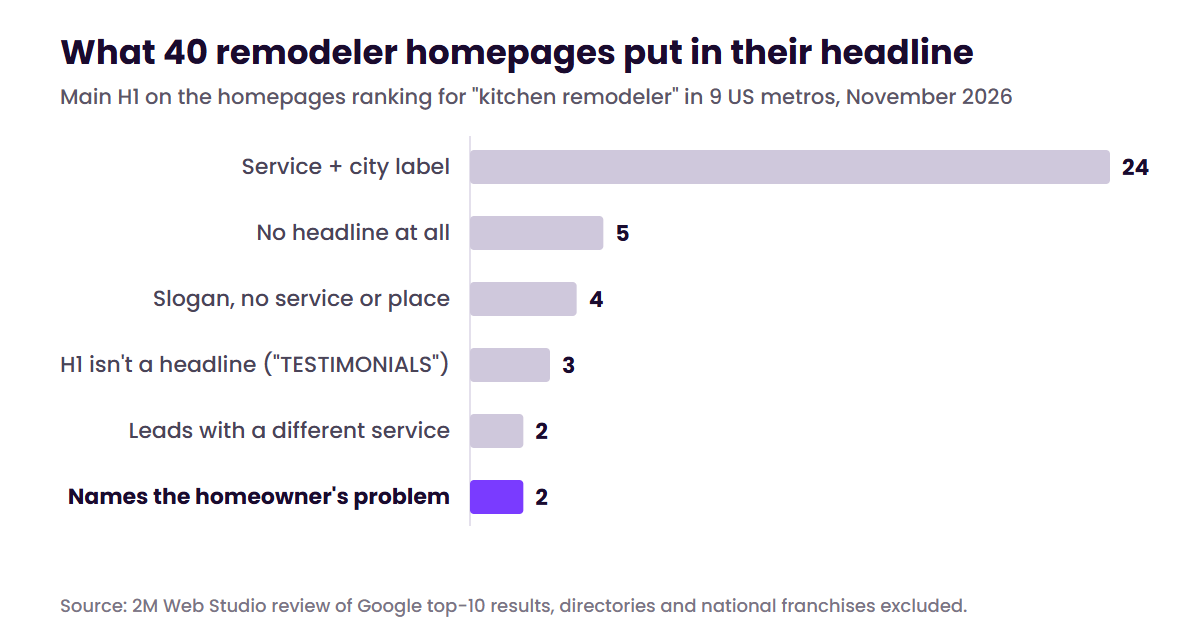
The biggest group, 24 of 40, is the service-plus-city label: "Kitchen & Bath Remodeling in Raleigh". That tells Google what you do, which helps. It tells a homeowner nothing about why they should call you instead of the next result, which has the exact same headline (nine of the 40 headlines use the word "luxury", which tells you how much it narrows things down).
The rest gets worse. Five homepages have no H1 at all, three use the H1 for a word like "TESTIMONIALS" or the domain name, and two lead with a different service entirely (flooring, concrete coatings) while ranking for kitchen remodeling.
| What we checked | Homepages |
|---|---|
| Headline names the homeowner's problem | 2 of 40 |
| Before-and-afters mentioned anywhere on the homepage | 5 of 40 |
| First phone screen asks for a consultation or estimate | 15 of 40 |
| First phone screen has no ask and no tap-to-call link | 15 of 40 |
| Main content visible within 2.5 seconds on mobile | 0 of 32 |
That last row is Lighthouse, run once per site in mobile mode. Google's own guidance says the main content should appear within 2.5 seconds. The median here was 9.6 seconds, with a median performance score of about 38 out of 100, and no site reached the 90+ range Lighthouse calls good. Small sample, one run, lab data, so treat the exact numbers loosely. The pattern matches what our study of 866 small business homepages found across ten industries.
Why the portfolio-first website stopped working
I used to think a remodeler's site mainly needed a good list of past projects. Show the kitchens, let the work sell itself.
I changed my mind. A homeowner planning a remodel isn't shopping for photos. They're worried about the budget running over, the job dragging on for months, and a crew they can't reach once the demo starts. A site has to show it understands that, explain how you handle it, and then show the work as proof. That order also matters for search: it's what gets you picked up by ChatGPT and Google's AI answers, which need a page that says what problem you solve, and a gallery with captions like "Project 14" gives them nothing to quote.
Here's a test you can run on your own homepage. Imagine a homeowner asks what you do, and you get one sentence to say what you do and who you do it for. That sentence is your headline. Most of the 40 sites above would answer with their city.
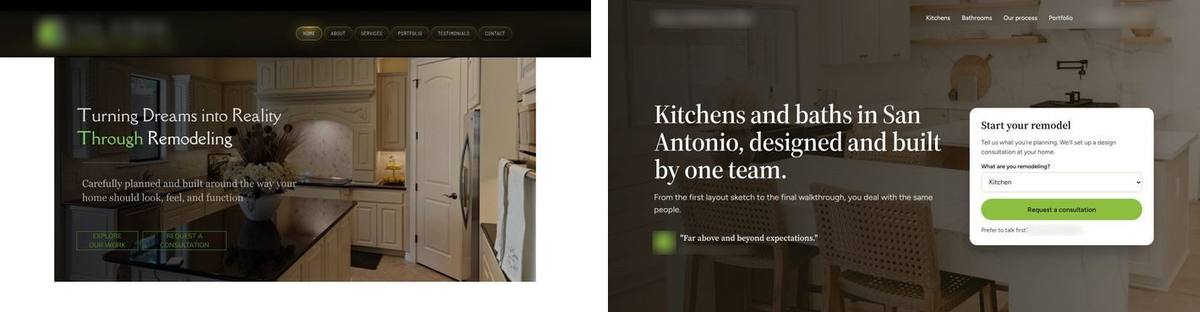
That San Antonio homepage is a good example of a pretty website without any tactic. The headline was "Turning Dreams into Reality Through Remodeling", which every remodeler in America could use. The two buttons were thin outlines that almost disappear against the photo. Nothing told a visitor they'd found a kitchen and bath team in their city, let alone why to trust it.
The redesign keeps the same company and the same kind of photos and changes the order: what they build and where, a line on why one team matters, a real review, and a form that asks one question. "View our portfolio" is still there. It just comes after the visitor believes you understand their project (nobody falls in love with a gallery from a company they haven't decided to trust yet).
Remodeling marketing in the right order
Here's how I'd run marketing for a remodeler, in the order I'd do it. The order is the point: each step makes the next one cheaper.
1. Decide who you're building for
Week one is research. Who's your best client (the empty-nester redoing a kitchen, the family adding a bathroom), what are they worried about, and what do they type into Google? Strategy comes first because every later step depends on it. A site written for "homeowners" ends up written for nobody.
2. Fix your Google Business Profile
Google says local results depend on relevance, distance and prominence, and reviews feed prominence. Fill in every service, add real project photos, and ask for a review after every finished job. This is the map pack, and for "kitchen remodeler near me" it usually shows near the top of the page.
3. Rewrite the website message
This is where the model home gets its lights back on. The order on the homepage: show you understand what they're looking for, then social proof, then previous work, with one clear ask on every screen. Before-and-afters belong high up, because a finished kitchen means little until you see what it started as. If you want a second pair of eyes, our free homepage teardown does exactly this check.
4. Plug the leaks you already have
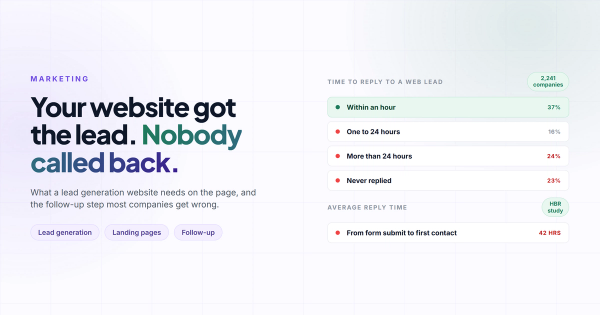
Homeowners rarely ask just one remodeler. If your reply arrives a day after someone else's, you're already second. Missed calls get an automatic text back, every form gets an instant reply, and quiet quotes get a reminder. It's the cheapest marketing on this list, because these people already wanted to talk to you.
5. Get found on Google and in AI tools
Now traffic is worth buying or earning. Pages for each service and area you work in, answers to the questions homeowners ask (cost, timeline, permits), and consistent business details everywhere. Our post on websites for contractors goes deeper on what those pages need.
6. Show up on social media
People spend hours a day there, and remodeling is visual. Short videos of a job in progress, a before-and-after reel, a homeowner walking through their new kitchen. You don't need to go viral. You need the person who saw your truck in their neighbor's driveway to find you and see recent work.
7. Run paid ads when you need jobs this month
SEO and reviews compound but take months. If the calendar has gaps now, targeted ads with real video or photos of your work fill them. Run them last on purpose: ads pointed at a site with no message and an invisible button are road signs leading to a locked model home.
Rent leads or own them: Angi, Houzz and your own site
Lead platforms work. Houzz Pro, Angi and the rest will send you homeowners, and for a new company that can be the difference between a full month and an empty one.
The problem is what you're building while you pay. On those platforms you're getting leads, and nothing else. You depend on their software, their pricing and their rules, and the homeowner often contacts three other remodelers in the same breath. Time spent on your own website, Google profile, Maps presence, reviews and social does something the platforms can't: it raises your own reputation. Keep that up for a few years and when someone in your area searches for a remodeler, you're the first name they see.
Use lead platforms as a bridge, not a foundation. Every month you rent leads is a month you could have spent building an address people come to on their own.
If your site gets visitors but the phone stays quiet, the leak is usually on the site itself. We wrote up the most common causes in why a website isn't generating leads.
Tactics that look busy but don't book consultations
The top-ranking "remodeling marketing ideas" lists all repeat a few tactics. Some of them are fine. Three of them I'd skip or delay.
- Time-limited promotions. "10% off kitchens booked before Friday" looks like a marketing trick, and homeowners read it that way. A remodel is one of the biggest checks they'll ever write; urgency makes them more careful, not less. Show what they're looking for, how you solve it and what the result looks like.
- A blog full of DIY renovation tips. It attracts people who want to do the work themselves, which is the one audience guaranteed not to hire you. Write about cost, timelines, permits and how you run a job instead.
- Retargeting ads before the site converts. Following visitors around the internet with ads only works if the page they come back to gives them a reason to call. Fix step 3 first.
Everything above comes back to the model home. Turn the lights on, put someone at the door, make the sign say what you build, and then buy the road signs. If you'd rather have us set the whole thing up, that's exactly what we do for remodelers: site, Google profile, instant replies, reviews and tracking, improved every month.
Frequently asked questions
What marketing works best for home remodeling companies?
A clear website message, a strong Google Business Profile with recent reviews, and fast replies to every lead. Those three turn existing interest into consultations. Once they work, SEO, AI search, social media and paid ads bring in more people and actually pay off.
How do I get more leads for my remodeling business?
Start by keeping the leads you already get: answer missed calls with an automatic text, reply to every form within minutes and follow up on quiet quotes. Then grow the inflow with local SEO, reviews and pages for each service and area. Paid ads and lead platforms fill short-term gaps.
Are Angi and Houzz worth it for remodelers?
They can be, especially for a newer company that needs jobs now. But you're renting leads that other remodelers see too, and nothing you pay for stays with you. Treat them as a bridge while your own site, reviews and Google profile start bringing in work.
How much should a remodeler spend on marketing?
Work backwards from what one finished job is worth and how many you can take on. Fixing the website message and the lead follow-up costs far less than ads and makes every later dollar work harder, so spend there first. Scale paid spend only once you can see which channel books consultations.
Do remodelers need a website if they have Houzz and Instagram?
Yes. Houzz and Instagram are rented space with their own rules and competitors one tap away. Your website is the hub that Google, AI tools and your Google profile point to, and it's the only place where the message, proof and ask are fully yours.
How long does remodeling marketing take to work?
Lead follow-up and a clearer homepage can show results within weeks, because they convert people who are already finding you. Local SEO and reviews usually take a few months to build. Paid ads work immediately, but stop the day you stop paying.


Comments